• Fri frakt över 249 kr
  • •
  • Snabba leveranser
  • •
  • Billiga böcker
Kundservice

Du är på sajten för privatpersoner.

Företag, bibliotek eller offentlig verksamhet?

Du handlar på classic.bokus.com, där alla dina funktioner finns intakta.
Till classic.bokus.com
Bokus logotyp. Gå till startsidan.
  • Erbjudanden
  • Nyheter
  • Student
  • Topplistor
  • Barn & ungdom
  • Bokus Play
  • E-böcker
  • Pocketböcker
  • Spel & pussel

10% rabatt på allt med kod: NYSTART10 →

Sidfot

Mina sidor

    Hjälp

    • Kundservice
    • Vanliga frågor och svar
    • Frakt och leverans
    • Retur vid ångerrätt
    • Reklamera vara
    • Betalning
    • Köpvillkor
    • Allmänna villkor
    • Information om webbplatsens tillgänglighet

    Om Bokus

    • Om oss
    • Pressrum
    • För studenter
    • För företag
    • För bibliotek och offentlig verksamhet
    • För leverantörer
    • Hållbarhet

    Populärt

    • Aktuella erbjudanden
    • Presentkort
    • Studentlitteratur
    • Nya böcker
    • Topplistor
    • Signerade böcker
    • Engelska böcker

    Inspiration

    • Boktips
    • BookTok
    • Populära bokserier
    • Barnbokskaraktärer
    • Populära författare
    Logotyp för Bokus
    Följ oss på Facebook (extern länk)Följ oss på Instagram (extern länk)Följ oss på YouTube (extern länk)Följ oss på TikTok (extern länk)
    bokus @ CookiesAnpassa cookiesIntegritetspolicyKöpvillkor
    Till Citymail hemsida (extern länk)Till Budbee hemsida (extern länk)Till Postnord hemsida (extern länk)Till Schenker hemsida (extern länk)Till Early Bird hemsida (extern länk)Till Walleys hemsida (extern länk)
    1. Naturvetenskap och teknik
    2. Matematik och naturvetenskap
    3. Astronomi

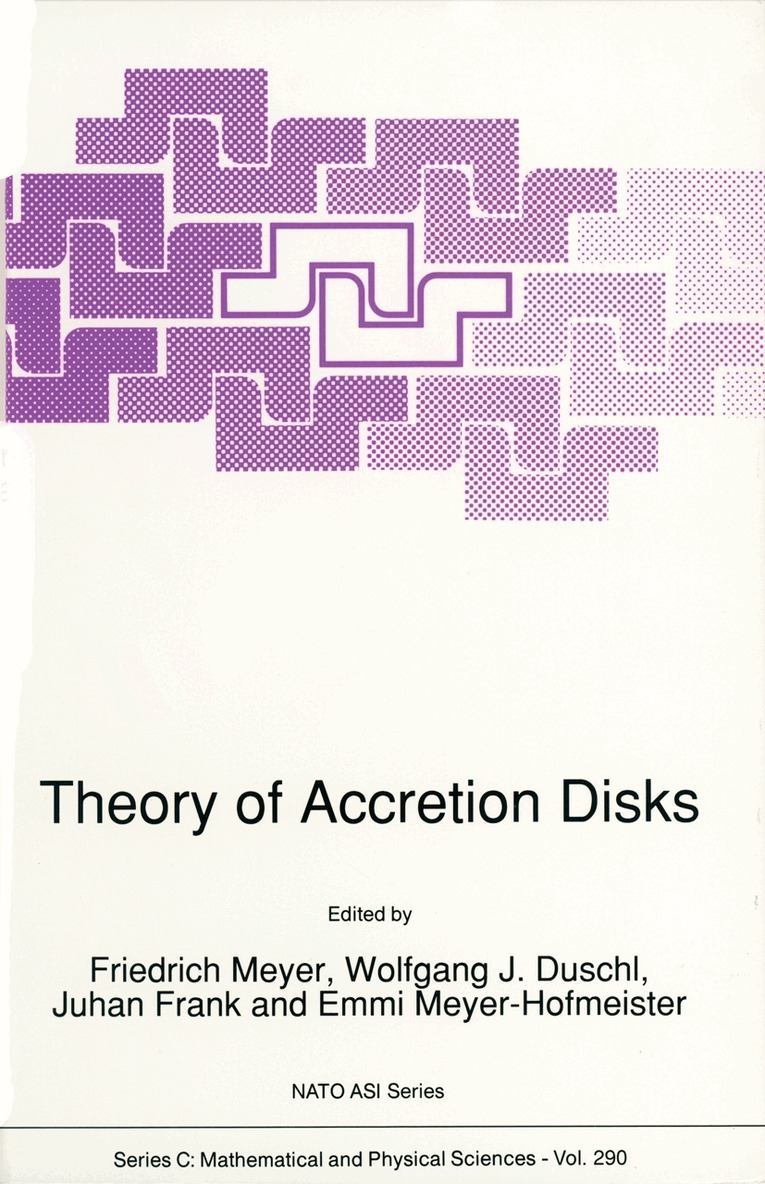
    Theory of Accretion Disks

    AvF. Meyer,Wolfgang J. Duschl

    Häftad, Engelska, 2011

    Del i serien Nato Science Series C:

    547 kr

    Beställningsvara. Skickas inom 10-15 vardagar. Fri frakt över 249 kr.

    Beskrivning

    With the advent of space observatories and modern developments in ground­ based astronomy and concurrent progress in the theoretical understanding of these observations it has become clear that accretion of material on to compact objects is an ubiquitous mechanism powering very diverse astrophysical sources ranging in size and luminosity by many orders of magnitude. A problem common to these systems is that the material accreted must in general get rid of its angular momentum and this leads to the formation of an Accretion Disk which allows angular momentum re-distribution and converts potential energy into radiation with an efficiency which can be higher than the nuclear burning yield. These systems range in size from quasars and active galactic nuclei to accretion disks around forming stars and the early solar system and to compact binaries such as cataclysmic variables and low-mass X-ray binaries. Other objects that should be mentioned in this context are 88433, the black hole binary candidates, and possibly gamma-ray burst sources. Observations of these systems have provided important constraints for theoretical accretion disk models on widely differing scales, lumi­ nosities, mass-transfer rates and physical environments.

    Produktinformation

    • Utgivningsdatum:2011-12-21
    • Mått:155 x 235 x 27 mm
    • Vikt:744 g
    • Format:Häftad
    • Språk:Engelska
    • Serie:Nato Science Series C:
    • Antal sidor:492
    • Förlag:Springer
    • ISBN:9789401069588

    Utforska kategorier

    • Astronomi inom Naturvetenskap och teknik
    • Tillämpad fysik inom Naturvetenskap och teknik

    Innehållsförteckning

    • Conference Photograph.- Preface.- List of Participants.- Welcoming Address.- Observational Evidence for Accretion Disks in Galactic Nuclei.- The Low-Frequency Spectra of Accretion Disks in Active Galactic Nuclei: The Dark Side of the Big Blue Bump.- Observational Constraints on Viscosity in the AGN Accretion Discs.- Accretion Disk Magnetohydrodynamics and the Origin of Jets.- Formation of Relativistic MHD Jets in the Magnetosphere of Accretion Disks.- Nonsteady MHD Jets from Magnetized Accretion Disks - Sweeping-Magnetic-Twist Mechanism -.- Statistical Modelling of IR/UV Spectra in AGN.- Formation and Evolution of the Solar Nebula.- Angular Momentum Transport in Protostellar Disks.- Protostellar Discs.- Formation of Viscous Protostellar Accretion Disks.- Formation and Structure of Protostellar Accretion Disks.- Merging White Dwarfs, Disk Formation and Type I Super-Novae.- Variability of Active Galactic Nuclei and Galactic QPO Sources: A Diagnosis.- Nonlinear Pulsation in the Transonic Region of Geometrically Thin Accretion Disks.- One-Armed Oscillations Of Disks and Their Applications.- Thermal and Tidal Instabilities in Accretion Disks of Dwarf Novae.- Hydrodynamic Simulation of Accretion Disks in Cataclysmic Variables.- Simulations of Accretion Flow in Close Binary Stars.- Viscous Evolution of Accretion Discs in the Quiescence of Dwarf Novae.- Black Hole Accretion Disc Instability and Soft X-Ray Transients.- Non-Axisymmetric Shear Instabilities in Thick Accretion Disks.- Instabilities of Accretion Flows Caused by the Interaction of Internal Gravity Modes.- Simulations of Three-Dimensional Slender Tori.- Accretion Disks in Low Mass X-Ray Binaries.- Reflected Accretion Disk Emission Lines in Cataclysmic Variables.- The Structure of the Boundary Layer of Accretion Disksin Cataclysmic Binaries.- The Dynamics of Twisted Accretion Discs.- A Free Accretion Disk in Sn 1987A?.- The Spectra of Relativistic Accretion Disks.- The Compact Object in SS433: Neutron Star or Black Hole?.- Physics of Accretion by Spiral Shock Waves.- Spiral Shocks in Accretion Disks: A Preliminary Numerical Study.- Mass Transfer by Tidally Induced Spiral Shocks in an Accretion Disc.- Accretion Disks and the Link Between an AGN and its Host Galaxy.- Large-Scale Accretion Flows in AGN.- The Disk Accretion of a Tidally Disrupted Star onto a Massive Black Hole.- Line Radiation from Stationary Accretion Disks.- Continuum Spectra of Accretion Discs.- Influence of Radiative Transfer on the Vertical Structure of Accretion Disks.- Dusty Disks and the Infrared Emission from AGN.