• Fri frakt över 249 kr
  • •
  • Snabba leveranser
  • •
  • Billiga böcker
Kundservice

Du är på sajten för privatpersoner.

Företag, bibliotek eller offentlig verksamhet?

Du handlar på classic.bokus.com, där alla dina funktioner finns intakta.
Till classic.bokus.com
Bokus logotyp. Gå till startsidan.
  • Erbjudanden
  • Nyheter
  • Student
  • Topplistor
  • Barn & ungdom
  • Bokus Play
  • E-böcker
  • Pocketböcker
  • Spel & pussel

10% rabatt på allt med kod: NYSTART10 →

Sidfot

Mina sidor

    Hjälp

    • Kundservice
    • Vanliga frågor och svar
    • Frakt och leverans
    • Retur vid ångerrätt
    • Reklamera vara
    • Betalning
    • Köpvillkor
    • Allmänna villkor
    • Information om webbplatsens tillgänglighet

    Om Bokus

    • Om oss
    • Pressrum
    • För studenter
    • För företag
    • För bibliotek och offentlig verksamhet
    • För leverantörer
    • Hållbarhet

    Populärt

    • Aktuella erbjudanden
    • Presentkort
    • Studentlitteratur
    • Nya böcker
    • Topplistor
    • Signerade böcker
    • Engelska böcker

    Inspiration

    • Boktips
    • BookTok
    • Populära bokserier
    • Barnbokskaraktärer
    • Populära författare
    Logotyp för Bokus
    Följ oss på Facebook (extern länk)Följ oss på Instagram (extern länk)Följ oss på YouTube (extern länk)Följ oss på TikTok (extern länk)
    bokus @ CookiesAnpassa cookiesIntegritetspolicyKöpvillkor
    Till Citymail hemsida (extern länk)Till Budbee hemsida (extern länk)Till Postnord hemsida (extern länk)Till Schenker hemsida (extern länk)Till Early Bird hemsida (extern länk)Till Walleys hemsida (extern länk)
    1. Naturvetenskap och teknik
    2. Matematik och naturvetenskap
    3. Astronomi

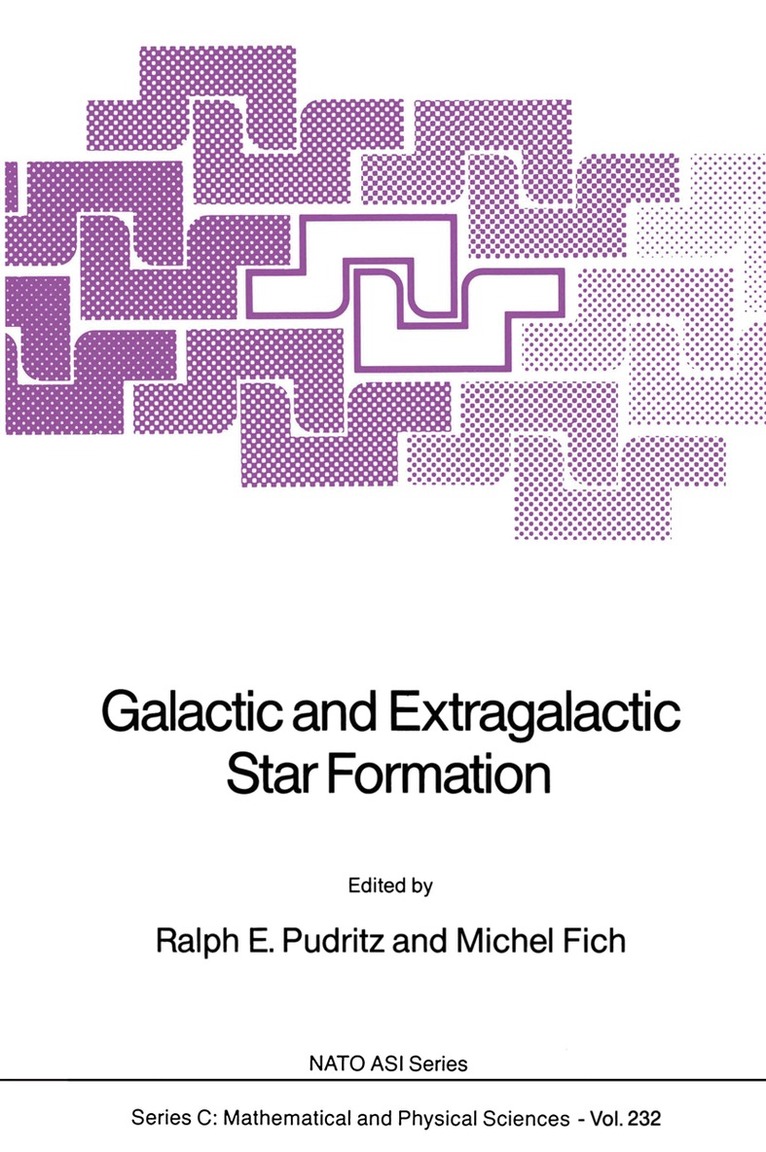
    Galactic and Extragalactic Star Formation

    AvRalph E. Pudritz,Michel Fich

    Häftad, Engelska, 2011

    Del i serien Nato Science Series C:

    547 kr

    Beställningsvara. Skickas inom 10-15 vardagar. Fri frakt över 249 kr.

    Beskrivning

    Recent advances in the instrumentation used to observe star forming regions in both our own Milky Way and in external galaxies have transformed the subject from a phenomenological pursuit into an increasingly unified, physical science. High resolution centimetre, millimetre, infrared, and optical studies of local star forming clouds have allowed us to probe the physics of star formation down to spatial scales approaching those of the solar system. These developments make it possible to better constrain the basic physical processes underlying star formation itself. At the same time, these new instruments have placed extragalactic studies on a footing detailed enough to allow comparison with star forming regions within our own galaxy. This revolution means that we will soon be able to link the physics of local star forming regions to the global star forming properties of galaxies. The entire structure of this NATO Advanced Study Institute was designed to explore this new view of the subject. This Institute on "Galactic and Extragalactic Star Formation" was held from June 21 -July 4, 1987 at the Conference Centre in the village of Whistler, British Columbia, Canada. The informal atmosphere of this lovely mountain resort stim­ ulated many valuable scientific exchanges. The Institute was funded by a major grant from NATO Scientific Affairs. Additional financial and I.I1oral assistance was provided by the Canadian Institute for Theoretical Astrophysics (CITA) and Mc­ Master University.

    Produktinformation

    • Utgivningsdatum:2011-11-11
    • Mått:155 x 235 x 37 mm
    • Vikt:1 025 g
    • Format:Häftad
    • Språk:Engelska
    • Serie:Nato Science Series C:
    • Antal sidor:688
    • Förlag:Springer
    • ISBN:9789401078351

    Utforska kategorier

    • Astronomi inom Naturvetenskap och teknik

    Innehållsförteckning

    • 1 Galactic Star Formation.- 1.1 Lectures.- On the Importance of Outflows for Molecular Clouds and Star Formation.- Radio and Infrared Properties of Young Stars.- Energetic Winds and Circumstellar Disks Associated with Low Mass Young Stellar Objects.- Masers in Galactic and Extragalactic Star Forming Regions.- Interstellar and Circumstellar Toroids.- The Behaviour of Magnetic Fields in Star Forming Regions.- The Origin of Bipolar Outflows.- Vibrationally Excited Molecular Hydrogen Emission from Galactic Regions of Star Formation.- Physical Conditions in Dense Cores.- Long Term Support and Gravitational Stability of Molecular Clouds.- Formation of Giant Molecular Clouds.- Star Formation in the Galactic Disk.- 1.2 Invited Talks.- Observations of Star Forming Regions with the Hat Creek Millimeter Array.- High Resolution Observations with the Owens Valley Millimeter Wave Interferometer.- Ultracompact HII Regions: Their Morphologies and Spectral Energy Distributions.- The Magnetic Field in the Bipolar Nebulae S106.- High Resolution CO Observations of Young Low Mass Stars.- The Effects of Multiple Scattering in the Disks Around Young Stellar Objects.- 1.3 Panel Discussion.- Star Formation and the Solar System.- 1.4 Summary Talk.- Meeting Summary: Star Formation in the Milky Way.- 2 Extragalactic Star Formation.- 2.1 Lectures.- Star Formation at the Galactic Center.- Star Formation in the Andromeda Galaxy.- Supernovae and Their Remnants.- The Starburst Galaxy M82.- M82: A Nearby Starburst Galaxy-CO Observations.- Star Formation in Blue Compact and Irregular Galaxies.- Large-Scale Aspects of Star Formation and Galactic Evolution.- Influence of Large-Scale Dynamics Upon Star Formation in Galaxies.- Starbursts: Nature and Implications.- Bimodal Star Formation, Starbursts, and Galaxy Formation.- Primordial Star Formation.- 2.2 Invited Talks.- The Evolution of Starburst Galaxies to Active Galactic Nuclei.- Atomic Hydrogen and OH Emission in Luminous Infrared Galaxies.- Evolution and Initial Mass Function in Starbursts.- Aperature Synthesis Maps of HCN, HCO+, CO, and 3 mm Continuum Toward M82.- The Molecular Content of Galaxies.- High Mass Star Formationj in Galactic and Extragalactic Molecular Clouds.- Abundances of the Heavy Elements in the Magellanic Clouds.- 2.3 Panel Discussion.- The Efficiency of Star Formation in Galaxies: Can We Measure It?.- No More Heterodyne Blues: Gas Masses From Millimeter and Sub-Millimeter Continuum Photometry.- The Efficiency of Star Formation in Galaxies: Can We Measure It? (“The Infrared Toolkit”).- The Initial Mass Function.- 2.4 Summary Talk.- Concluding Remarks.- 3 Poster Titles.- 3.1. Galactic Star Formation.- 3.2. Extragalactic Star Formation.