• Fri frakt över 249 kr
  • •
  • Snabba leveranser
  • •
  • Billiga böcker
Kundservice

Du är på sajten för privatpersoner.

Företag, bibliotek eller offentlig verksamhet?

Du handlar på classic.bokus.com, där alla dina funktioner finns intakta.
Till classic.bokus.com
Bokus logotyp. Gå till startsidan.
  • Erbjudanden
  • Nyheter
  • Student
  • Topplistor
  • Barn & ungdom
  • Bokus Play
  • E-böcker
  • Pocketböcker
  • Spel & pussel

10% rabatt på allt med kod NYSTART10 →

Sidfot

Mina sidor

    Hjälp

    • Kundservice
    • Vanliga frågor och svar
    • Frakt och leverans
    • Retur vid ångerrätt
    • Reklamera vara
    • Betalning
    • Köpvillkor
    • Allmänna villkor
    • Information om webbplatsens tillgänglighet

    Om Bokus

    • Om oss
    • Pressrum
    • För studenter
    • För företag
    • För bibliotek och offentlig verksamhet
    • För leverantörer
    • Hållbarhet

    Populärt

    • Aktuella erbjudanden
    • Presentkort
    • Studentlitteratur
    • Nya böcker
    • Topplistor
    • Signerade böcker
    • Engelska böcker

    Inspiration

    • Boktips
    • BookTok
    • Populära bokserier
    • Barnbokskaraktärer
    • Populära författare
    Logotyp för Bokus
    Följ oss på Facebook (extern länk)Följ oss på Instagram (extern länk)Följ oss på YouTube (extern länk)Följ oss på TikTok (extern länk)
    bokus @ CookiesAnpassa cookiesIntegritetspolicyKöpvillkor
    Till Citymail hemsida (extern länk)Till Budbee hemsida (extern länk)Till Postnord hemsida (extern länk)Till Schenker hemsida (extern länk)Till Early Bird hemsida (extern länk)Till Walleys hemsida (extern länk)
    1. Naturvetenskap och teknik
    2. Matematik och naturvetenskap
    3. Astronomi

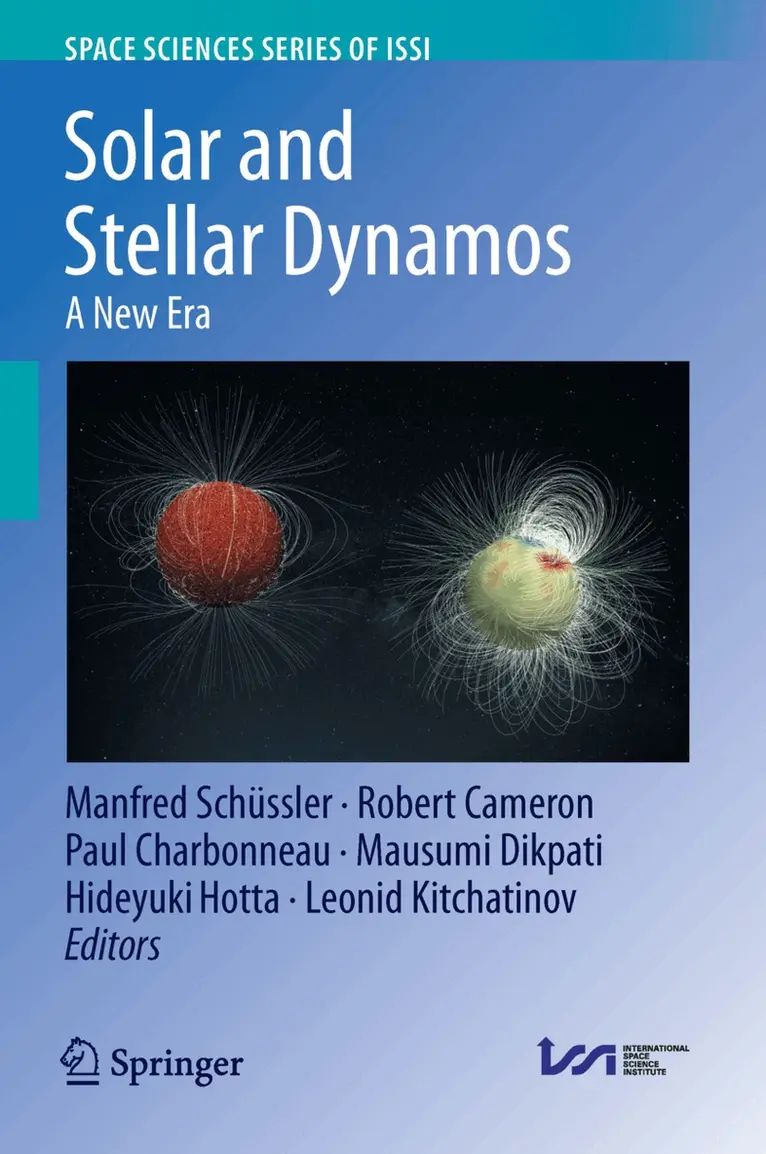
    Solar and Stellar Dynamos

    A New Era

    AvManfred Schüssler,Robert Cameron

    Inbunden, Engelska, 2024

    Del 90 i serien Space Sciences Series of ISSI

    546 kr

    Beställningsvara. Skickas inom 10-15 vardagar. Fri frakt över 249 kr.

    Beskrivning

    This volume provides a comprehensive overview of the current understanding of the dynamo processes that generate magnetic fields in the Sun and other stars with outer convection zones. Magnetic fields are responsible for the restless activity of the Sun, which include the coming and going of sunspots throughout its 11-year activity cycle, the heating of the solar corona, and the driving forces behind huge eruptions of mass and energy that can affect near-Earth space and terrestrial technical systems. Likewise, other stars show such activity, often even much more energetically as their solar counterparts. The review papers collected in this volume are written by experts in this research field. The papers deliver introductions to the observational results on solar and stellar magnetic fields and provide detailed presentations on the theoretical concepts and models for self-excited dynamo processes and the underlying flow patterns that cause the emergence, structure, and evolution of magnetic patterns at the surfaces of the Sun and other stars. Comprehensive and realistic numerical simulations have become an indispensable tool for understanding the turbulent processes in stellar interiors as well as for testing analytical approaches and simplified models.Readers looking for a comprehensive and up-to-date account of this dynamic research field will find a most valuable collection of reviews; serving both as an introduction for newcomers in the field as well as a timely compendium for the active researcher.The book is a spin-off from the Topical Collection "Solar and Stellar Dynamos: A New Era" of the journal Space Science Reviews.

    Produktinformation

    • Utgivningsdatum:2024-10-09
    • Mått:155 x 235 x 32 mm
    • Vikt:1 041 g
    • Format:Inbunden
    • Språk:Engelska
    • Serie:Space Sciences Series of ISSI
    • Antal sidor:514
    • Förlag:Springer
    • ISBN:9789402422610

    Utforska kategorier

    • Astronomi inom Naturvetenskap och teknik
    • Tillämpad fysik inom Naturvetenskap och teknik

    Mer om författaren

    Manfred SchüsslerManfred Schüssler worked at the Max Planck Institute for Solar System Research (MPS) as a Research Group Leader. Since his retirement in 2016  he is a guest scientist at MPS. His main research interests are the structure and dynamics of solar magnetic fields and dynamo theory of the solar cycle. His research methods are numerical simulations and analytical calculations, often with an emphasis on interpreting and understanding observational results. He was also involved in the preparation and realization of the “Sunrise” stratospheric balloon observatory. Manfred Schüssler authored and co-authored over 180 research papers in refereed journals and more than 40 review papers.Robert H. CameronRobert Cameron studies how magnetic fields, plasma and radiation interact on the Sun and other stars. In particular, he is interested in how the magnetic field is generated and its role coupling the lower layers of stellar atmospheres. To these ends he uses numerical models and theory, but with a particular emphasis on understanding the observations.Paul CharbonneauPaul Charbonneau is professor of Physics at the Université de Montréal (Canada) since 2002. During the preceding decade he was a member of scientic staff of the National Center for Atmospheric Research's High Altitude Observatory, in Boulder (Colorado, U.S.A.). His research is primarily in the areas of computational physics and numerical simulations, focusing on magnetohydrodynamics, the dynamo mechanism underlying solar and stellar magnetic cycles, and the prediction of solar flares. He also pursues other research interests, notably in the intersection of physics and biology, the emergence of complexity in natural systems, including questions related the origin of life. He has authored or co-authored  over 150 research articles, review articles, and book chapters, and is the authors of two research monographs/textbooks entitled Solar and Stellar Dynamos (2013, Springer) and Natural Complexity (2017, Princeton University Press)Mausumi DikpatiMausumi Dikpati, currently a senior scientist at HAO, came to NSF-NCAR in 1996 as an ASP Postdoc, after receiving her PhD in physics from the Indian Institute of Science in Bangalore, India. She has since continued her career at NSF-NCAR. Mausumi’s primary research area has been global magnetohydrodynamics of the Sun, to simulate solar variability on time scales from a few days to several months, up to a decade, with recent focus on solar MHD Rossby waves, their implications for pre-solar-storm activity-patterns, and for predicting the “stormy seasons” of space weather. Her activities in the application of modern data assimilation methods to solar models, using the NCAR-DART framework in collaboration with CISL, have enabled her to win several large research grants. She won John Firor HAO Outstanding Publication award in 2007 for solar cycle prediction research and the Wenner-Gren guest professorship award from Stockholm in 2016. Her research on the extended minimum at the end of solar cycle 23 was recognized as one of the top 100 science-discoveries in 2011 by Discover Magazine. Mausumi has also been active in education and outreach as well as in various community services; she is currently serving on "Solar & Heliospheric Decadal Panel'' of the US National Academy.Hideyuki HottaHideyuki Hotta is currently a Professor at the Institute for Space-Earth Environmental Research at Nagoya University. He earned his Ph.D. in science from the University of Tokyo, Japan, in 2014. Then, he worked at High Altitude Observatory, USA, and got a tenure track position at Chiba University, Japan, in 2015. Since 2023, he has been working at Nagoya University as a professor, where he has been since that time. His research interests are solar and stellar turbulence and magnetic fields. He mainly carries out numerical simulations with high-performance computing.Leonid KitchatinovLeonid Kitchatinov received his Ph.D. from the Ioffe Institute of Physics and Technology, St. Petersburg. He is a specialist in stellar MHD and dynamo theory. He is permanently affiliated to the Institute of Solar-Terrestrial Physics, Irkutsk, and in parallel to the Pulkovo Astronomical Observatory, St. Petersburg. He has worked repeatedly at the Leibnitz Institute for Astrophysics, Potsdam, supported by either the Alexander von Humboldt Foundation or the Deuthsche Forshungsgemeinshaft. He has also spend a year as a research fellow at the University of St. Andrews, UK.

    Innehållsförteckning

    • Preface M. Schüssler, R.H. Cameron, P. Charbonneau, M. Dikpati,H. Hotta and L. Kitchatinov.-  Evolution of Solar and Stellar Dynamo Theory P. Charbonneau and D. Sokoloff.- Solar Cycle Observations A. Norton, R. Howe, L. Upton and I. Usoskin.- Long-Term Modulation of Solar Cycles A. Biswas, B.B. Karak, I. Usoskin and E. Weisshaar.- Scaling and Evolution of Stellar Magnetic Activity E. Işik, J. van Saders, A. Reiners and T. Metcalfe.- Stellar Activity Cycles S. Jeffers, R. Kiefer and Metcalfe.- Dynamics of Large-Scale Flows H. Hotta, Y. Bekki, L. Gizon, Q. Noraz and M.P. Rast.- Dynamics of the Tachocline A. Strugarek, B. Belucz, A.S. Brun, M. Dikpati and G. Guerrero.- Understanding Active Region Origins and Emergence on the Sun and Other Cool Stars M.A. Weber, H. Schunker, L. Jouve and E. Işik.- Surface Flux Transport on the Sun A.R. Yeates, M.C.M. Cheung, J. Jiang, K. Petrovay and  Y.-M. Wang.- Simulations of Solar and Stellar Dynamos and their Theoretical Interpretation P.J. Käpylä, M.K. Browning, A.S. Brun, G. Guerrero and J. Warnecke.- Small-Scale Dynamos: From Idealized Models to Solar and Stellar Applications M. Rempel, T. Bhatia, L. Bellot Rubio and M.J. Korpi-Lagg.- Turbulent Processes and Mean-Field Dynamo A. Brandenburg, D. Elstner, Y. Masada and V. Pipin).- Mean Field Models of Flux Transport Dynamo and MeridionalCirculation in the Sun and Stars G. Hazra, D. Nandy, L. Kitchatinov and A. Rai Choudhuri).- Observationally Guided Models for the Solar Dynamoand the Role of the Surface Field R.H. Cameron and M. Schüssler.- Physical Models for Solar Cycle Predictions P. Bhowmik, J. Jiang, L. Upton, A. Lemerle and D. Nandy.