• Fri frakt över 249 kr
  • •
  • Snabba leveranser
  • •
  • Billiga böcker
Kundservice

Du är på sajten för privatpersoner.

Företag, bibliotek eller offentlig verksamhet?

Du handlar på classic.bokus.com, där alla dina funktioner finns intakta.
Till classic.bokus.com
Bokus logotyp. Gå till startsidan.
  • Erbjudanden
  • Nyheter
  • Student
  • Topplistor
  • Barn & ungdom
  • Bokus Play
  • E-böcker
  • Pocketböcker
  • Spel & pussel

10% rabatt på allt med kod: NYSTART10 →

Sidfot

Mina sidor

    Hjälp

    • Kundservice
    • Vanliga frågor och svar
    • Frakt och leverans
    • Retur vid ångerrätt
    • Reklamera vara
    • Betalning
    • Köpvillkor
    • Allmänna villkor
    • Information om webbplatsens tillgänglighet

    Om Bokus

    • Om oss
    • Pressrum
    • För studenter
    • För företag
    • För bibliotek och offentlig verksamhet
    • För leverantörer
    • Hållbarhet

    Populärt

    • Aktuella erbjudanden
    • Presentkort
    • Studentlitteratur
    • Nya böcker
    • Topplistor
    • Signerade böcker
    • Engelska böcker

    Inspiration

    • Boktips
    • BookTok
    • Populära bokserier
    • Barnbokskaraktärer
    • Populära författare
    Logotyp för Bokus
    Följ oss på Facebook (extern länk)Följ oss på Instagram (extern länk)Följ oss på YouTube (extern länk)Följ oss på TikTok (extern länk)
    bokus @ CookiesAnpassa cookiesIntegritetspolicyKöpvillkor
    Till Citymail hemsida (extern länk)Till Budbee hemsida (extern länk)Till Postnord hemsida (extern länk)Till Schenker hemsida (extern länk)Till Early Bird hemsida (extern länk)Till Walleys hemsida (extern länk)
    1. Naturvetenskap och teknik
    2. Geovetenskap
    3. Miljövetenskap och miljöpolitik

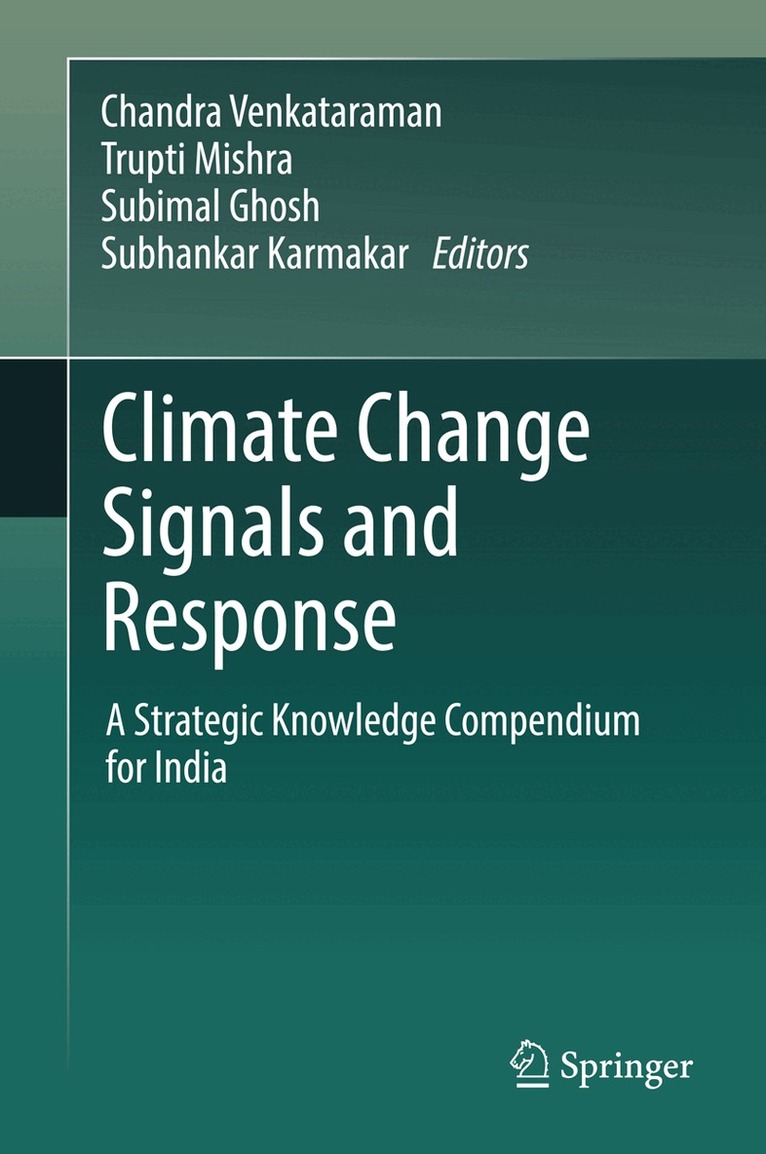
    Climate Change Signals and Response

    A Strategic Knowledge Compendium for India

    AvChandra Venkataraman,Trupti Mishra

    Inbunden, Engelska, 2018

    1 086 kr

    Beställningsvara. Skickas inom 10-15 vardagar. Fri frakt över 249 kr.

    Beskrivning

    This book provides a synthesis of research findings, in terms of strategic knowledge outcomes regarding emergence of recent regional climate signals, implications for impacts assessment, and mitigation and adaptation response, relevant in the Indian context. The first part discusses evidence of climate change and its underlying scientific processes across India, chiefly focusing on impacts that are already visible and attributable to anthropogenic activities. The latter part deals with the responses to climate change, highlighting the mitigation and adaptation strategies in various sectors and communities.The book presents a concise interpretation, distilling practical recommendations and policy prescriptions at national and sub-national levels. It serves as a reference point for understanding scientific advances and persisting uncertainty, future vulnerability and response capacity of interlinked human and natural systems, pertaining to India. It is an excellent resource for policy makers and industry watchers in addition to the research fraternity.

    Produktinformation

    • Utgivningsdatum:2018-07-23
    • Mått:155 x 235 x 24 mm
    • Vikt:670 g
    • Format:Inbunden
    • Språk:Engelska
    • Antal sidor:303
    • Upplaga:18001
    • Förlag:Springer Verlag, Singapore
    • ISBN:9789811302794

    Utforska kategorier

    • Miljövetenskap och miljöpolitik inom Naturvetenskap och teknik
    • Miljöekonomi inom Ekonomi och Ledarskap

    Mer om författaren

    Chandra  Venkataraman  is  a  Professor  of  Chemical  Engineering  and  Associate Faculty  at  the  Interdisciplinary  Programme  in  Climate  Studies,  IIT  Bombay.  She works on environmental and climate science and aerosol nanoparticle engineering. Her  research  has  contributed  influential  scientific  knowledge  on  black  carbon aerosols, climate change and air quality degradation over South Asia. She has built research  networks for climate  and  air  quality studies. She is the National Coordinator of the NCAP-COALESCE project leading 17 institutions investigating regional climate impacts of carbonaceous aerosols (MoEFCC). At IIT Bombay, she was instrumental in the establishment of Interdisciplinary Programme  in  Climate Studies and was Principal Investigator of the DST-supported Centre of Excellence in Climate Studies. She is the recipient of a Fulbright-Nehru Research Fellowship (2012), Vikram Sarabhai Award (2005),   Fellowship of the Indian National Academy of Engineering (2016), the National Academy of Science, India (2017), and the Indian Academy of Science (2017).Trupti   Mishra  is   an   Associate   Professor   at   Shailesh   J.   Mehta   School   of Management  and  Associate  Faculty  at  Interdisciplinary  Programme  in  Climate Studies,  IIT  Bombay.  She  holds  a  Ph.D.  in  Economics  from  IIT  Kharagpur.  Her research  interest  is  focused  on  economics  of  pollution,  economic  assessment  of climate  change  vulnerability,  adaptation  and  mitigation  options  and  corporate environmental sustainability. Her research involves developing different low carbon scenario  in  sectors,  identifying  cost-effective  mitigation  option  for  industry,  suggesting  environmental  compliances  measures  to  achieve  low  carbon  growth.  She has published  her research findings  in various chapters and journal papers. She is also working on climate change impact and adaptation at city and community level. Her co-authored 2017 publication in Climate and Development (Taylor & Francis) on  assessing  the  socio-economic  vulnerability  of  cities  in  India  received  wide mainstream media coverage.Subimal  Ghosh  is  an  Associate  Professor  at  the  Interdisciplinary  Programme  in Climate Studies and a Faculty at the Department of Civil Engineering, IIT Bombay. He works in the area of hydro-meteorology. His research interests include climate change impact assessment with statistical downscaling, understanding land surface feedback to monsoon, hydrological simulation and urban extreme rainfall forecasts. He has received several  awards  in recognition of his research, a few among  them being INAE Young Engineer Award, INSA Young Scientist Award, NASI Young Scientist Award  and  IEI  Young  Engineer  Award.  He has  published  articles  in reputed journals such as Nature Climate Change, Nature Communications, Scientific Reports,Geophysical Research   Letters, Journal of Climate, Water Resources  Research.  He  has  been  selected  as  one  of  the  lead  authors  for  IPCC Assessment Report 6 for a chapter on extremes by Working Group-I.Subhankar Karmakar  is an Associate Professor at the Centre for Environmental Science and Engineering, and an associated faculty member at the Interdisciplinary Programme in Climate Studies, IIT Bombay. He obtained his Ph.D. on “Uncertainty Modelling  in  Water  Resources  Systems”  from  the  Indian  Institute  of  Science, Bangalore,  India,  and  was  a  Postdoctoral  Fellow  at  the  University  of  Western Ontario,   Canada.   Further,   he   received   a   BOYSCAST   Fellowship   from   the Government   of   India   to   pursue   research   on   Ecological   Modelling   at   Duke University, NorthCarolina, USA. His primary research interests are environmental systems   analysis,   uncertainty   modelling   and   risk   vulnerability   analysis   to climate-induced natural hazards. Some of his recent research contributions include understanding  the  dependence  of  Indian  summer  monsoon  rainfall  extremes  on temperature,  mapping  disaster  vulnerability  for  a  densely  populated  coastal  urban area, and developing lifecycle-based decision support tools for selecting wastewater treatment  alternatives.  He  has  published  over  40  international  journal  papers,  5 chapters and several international conference proceedings.

    Innehållsförteckning

    • Section I: Regional Climate Change Signals.- 1. Land surface feedback and impacts of land use change to Indian Monsoon Rainfall.- 2. Intraseasonal short-term suppression of monsoon by aerosols.- 3. Future hydrologic scenarios in India under climate change.- 4. Links between global climate teleconnections and Indian monsoon rainfall.- 5. Urbanisation and Surface Urban Heat Island Intensity (SUHII).- 6. Future Heat Wave Projections and Impacts.- 7. Decadal GMB Estimations for Glaciers in Western Himalayas.- 8. Atmosphere and ocean mixing processes.- 9. Nearshore Sediment Transport in a Changing Climate.- Section II: National and Sub-national Responses to Climate Change.- 10. A comprehensive social vulnerability analysis at a national scale.- 11. Review of energy-economics modelling for India.- 12. Sectoral energy intensity and climate impact.- 13. Scenarios of SLCP emissions and mitigation pathways to 2050.- 14. Drivers of climate change adaptation and measurement of adaptive capacity.- 15. Carbon Mitigation Potential of Alternative Bioenergy Pathways.- 16. Cross sectional institutional linkages in climate change responses.- 17. Present day emissions and low carbon growth pathways for the brick sector.- 18. Consumer response to policy interventions in energy efficiency: Climate policy implication.