• Fri frakt över 249 kr
  • •
  • Snabba leveranser
  • •
  • Billiga böcker
Kundservice

Du är på sajten för privatpersoner.

Företag, bibliotek eller offentlig verksamhet?

Du handlar på classic.bokus.com, där alla dina funktioner finns intakta.
Till classic.bokus.com
Bokus logotyp. Gå till startsidan.
  • Erbjudanden
  • Nyheter
  • Student
  • Topplistor
  • Barn & ungdom
  • Bokus Play
  • E-böcker
  • Pocketböcker
  • Spel & pussel

10% rabatt på allt med kod NYSTART10 →

Sidfot

Mina sidor

    Hjälp

    • Kundservice
    • Vanliga frågor och svar
    • Frakt och leverans
    • Retur vid ångerrätt
    • Reklamera vara
    • Betalning
    • Köpvillkor
    • Allmänna villkor
    • Information om webbplatsens tillgänglighet

    Om Bokus

    • Om oss
    • Pressrum
    • För studenter
    • För företag
    • För bibliotek och offentlig verksamhet
    • För leverantörer
    • Hållbarhet

    Populärt

    • Aktuella erbjudanden
    • Presentkort
    • Studentlitteratur
    • Nya böcker
    • Topplistor
    • Signerade böcker
    • Engelska böcker

    Inspiration

    • Boktips
    • BookTok
    • Populära bokserier
    • Barnbokskaraktärer
    • Populära författare
    Logotyp för Bokus
    Följ oss på Facebook (extern länk)Följ oss på Instagram (extern länk)Följ oss på YouTube (extern länk)Följ oss på TikTok (extern länk)
    bokus @ CookiesAnpassa cookiesIntegritetspolicyKöpvillkor
    Till Citymail hemsida (extern länk)Till Budbee hemsida (extern länk)Till Postnord hemsida (extern länk)Till Schenker hemsida (extern länk)Till Early Bird hemsida (extern länk)Till Walleys hemsida (extern länk)
    1. Naturvetenskap och teknik
    2. Matematik och naturvetenskap
    3. Kemi
    4. Analytisk kemi

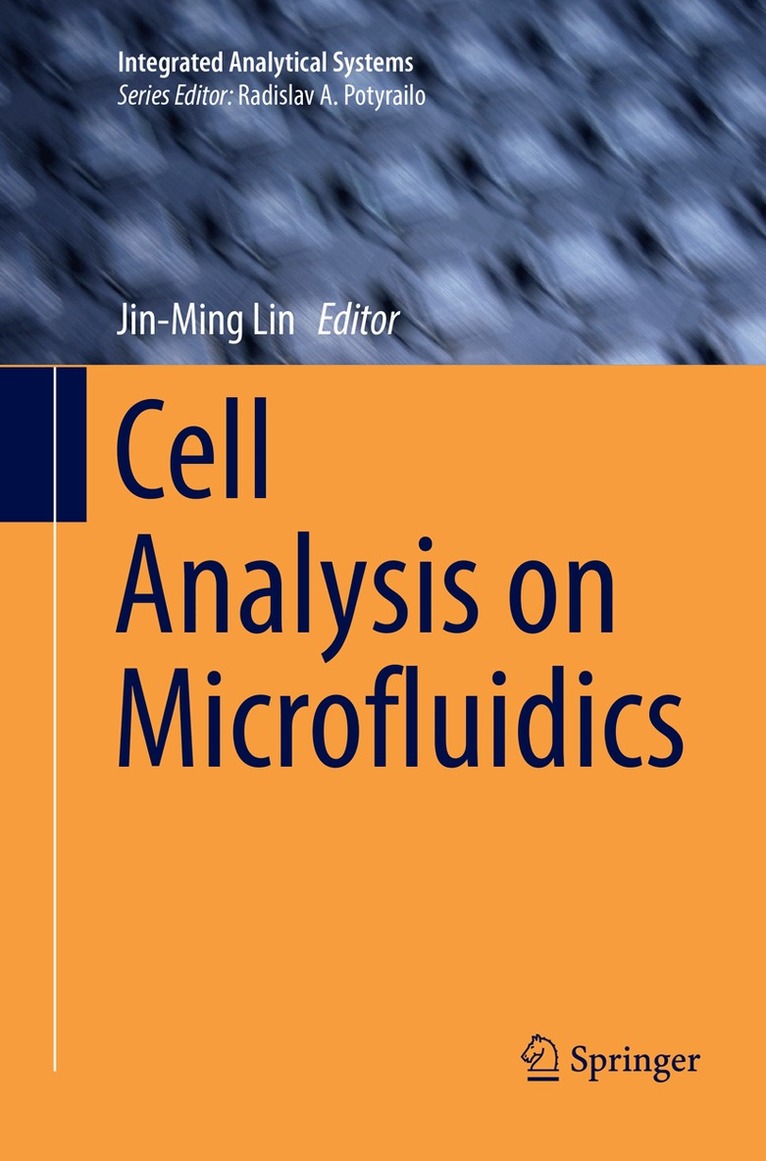
    Cell Analysis on Microfluidics

    AvJin-Ming Lin

    Häftad, Engelska, 2018

    Del i serien Integrated Analytical Systems

    1 679 kr

    Beställningsvara. Skickas inom 10-15 vardagar. Fri frakt över 249 kr.

    Beskrivning

    This book presents a detailed overview of the design, formatting, application, and development of microfluidic chips in the context of cell biology research, enumerating each element involved in microfluidics-based cell analysis, discussing its history, status quo, and future prospects, It also offers an extensive review of the research completed in the past decade, including numerous color figures. The individual chapters are based on the respective authors' studies and experiences, providing tips from the frontline to help researchers overcome bottlenecks in their own work. It highlights a number of cutting-edge techniques, such as 3D cell culture, microfluidic droplet technique, and microfluidic chip-mass spectrometry interfaces, offering a first-hand impression of the latest trends in the field and suggesting new research directions. Serving as both an elementary introduction and advanced guidebook, the book interests and inspires scholars and students who are currently studyingmicrofluidics-based cell analysis methods as well as those who wish to do so.

    Produktinformation

    • Utgivningsdatum:2018-12-25
    • Mått:155 x 235 x 24 mm
    • Vikt:663 g
    • Format:Häftad
    • Språk:Engelska
    • Serie:Integrated Analytical Systems
    • Antal sidor:429
    • Förlag:Springer Verlag, Singapore
    • ISBN:9789811353864

    Utforska kategorier

    • Analytisk kemi inom Naturvetenskap och teknik
    • Cellbiologi inom Naturvetenskap och teknik
    • Materietillstånd inom Naturvetenskap och teknik

    Mer om författaren

    Professor Jin-Ming Lin was born in 1963. He received his Bachelor of Science degree at Fuzhou University in 1984 and his PhD in analytical chemistry at Tokyo Metropolitan University, Japan in 1997. He studied and worked at Showa University, Japan and Tokyo Metropolitan University from 1992 to 2002. He was a professor at the Research Center for Eco-Environmental Sciences, Chinese Academy of Sciences from 2002 to 2004, and has been a professor at Tsinghua University, China since 2004 and was selected as Cheung Kung Scholars Professor of Ministry of Education, China at 2008. He is a Fellow of Royal Chemical Society. He is a general secretary and deputy chair of Mass Spectrometry Committee, Chinese Chemical Society, a vice president Chinese Society of Mass Spectrometry, and a member of the council of the Chinese Society for Chromatography Science. He received several awards for his contributions in chemiluminescence and separation science: Outstanding Young Chemist Award (Chinese Chemical Society, 1992), Young Analyst Award for Flow Injection Analysis (Flow Injection Section, Japan Society of Analytical Chemistry, 2000), Kanton New Century Award (Japan Society of Analytical Chemistry, 2001), National Science Fund for Distinguished Young Scholars of China (National Natural Science Foundation of China, 2002), FIA Award for Science (Flow Injection Section, Japan Society of Analytical Chemistry, 2008), GC Contribution Award (GC Discussion Group, Japan Society of Analytical Chemistry, 2008, 2013), CAIA Awards (China Association for Instrumental Analysis, 2009, 2010 and 2015), Science and Censorship Award (General Administration of Quality Supervision, Inspection and Quarantine of the People's Republic of China, 2010), Award for Science and Technology(Beijing City, 2013), Natural Science Award (Ministry of Education, China, 2015), Liang Shuquan Award for Analytical Chemistry (Chinese Chemical Society, 2015), and Silver Prize from The 10th Race Award for Innovation and Creative Patents (The Innovation Association of Beijing City, China, 2016). His current research is focused on sample pretreatment, chemiluminescence and microfluidic devices. He is the author and co-author of 388 original research papers published in international journals, 32 reviews, 4 books and 45 patents.

    Recensioner i media

    “The present book is a valuable contribution to the development and application of microfluidic platforms for the study of biological systems. The 13 chapters provide a comprehensive overview of the tools available to researchers interested in applying microfluidics to cellular studies, including fabrication approaches and materials, as well as numerous applications of microfluidics to better understand the fundamental unit of life.” (Ryan T. Kelly, Analytical and Bioanalytical Chemistry, Vol. 410, 2018)

    Innehållsförteckning

    • Design and preparation of microfluidic devices.- Recent development of cell analysis on microfluidic.- Cell isolation and recognition with microfluidic device.- Cell culture and observation on microfluidics.- Cell migration with microfluidic chips.- Biomaterial-based microfluidics for cell culture and analysis.- Droplet-based cell analysis on microfluidic.- Single cell analysis on microfluidic.- Microfluidics-mass spectrometry for cell analysis.- Biochemical analysis on microfluidic chips.- Microfluidic cell culture systems for drug research.- Cell metabolite analysis on microfluidic platform.- Microfluidic platforms for bacteria.