• Fri frakt över 249 kr
  • •
  • Snabba leveranser
  • •
  • Billiga böcker
Kundservice

Du är på sajten för privatpersoner.

Företag, bibliotek eller offentlig verksamhet?

Du handlar på classic.bokus.com, där alla dina funktioner finns intakta.
Till classic.bokus.com
Bokus logotyp. Gå till startsidan.
  • Erbjudanden
  • Nyheter
  • Student
  • Topplistor
  • Barn & ungdom
  • Bokus Play
  • E-böcker
  • Pocketböcker
  • Spel & pussel

10% rabatt på allt med kod NYSTART10 →

Sidfot

Mina sidor

    Hjälp

    • Kundservice
    • Vanliga frågor och svar
    • Frakt och leverans
    • Retur vid ångerrätt
    • Reklamera vara
    • Betalning
    • Köpvillkor
    • Allmänna villkor
    • Information om webbplatsens tillgänglighet

    Om Bokus

    • Om oss
    • Pressrum
    • För studenter
    • För företag
    • För bibliotek och offentlig verksamhet
    • För leverantörer
    • Hållbarhet

    Populärt

    • Aktuella erbjudanden
    • Presentkort
    • Studentlitteratur
    • Nya böcker
    • Topplistor
    • Signerade böcker
    • Engelska böcker

    Inspiration

    • Boktips
    • BookTok
    • Populära bokserier
    • Barnbokskaraktärer
    • Populära författare
    Logotyp för Bokus
    Följ oss på Facebook (extern länk)Följ oss på Instagram (extern länk)Följ oss på YouTube (extern länk)Följ oss på TikTok (extern länk)
    bokus @ CookiesAnpassa cookiesIntegritetspolicyKöpvillkor
    Till Citymail hemsida (extern länk)Till Budbee hemsida (extern länk)Till Postnord hemsida (extern länk)Till Schenker hemsida (extern länk)Till Early Bird hemsida (extern länk)Till Walleys hemsida (extern länk)
    1. Data och IT
    2. Systemvetenskap och AI

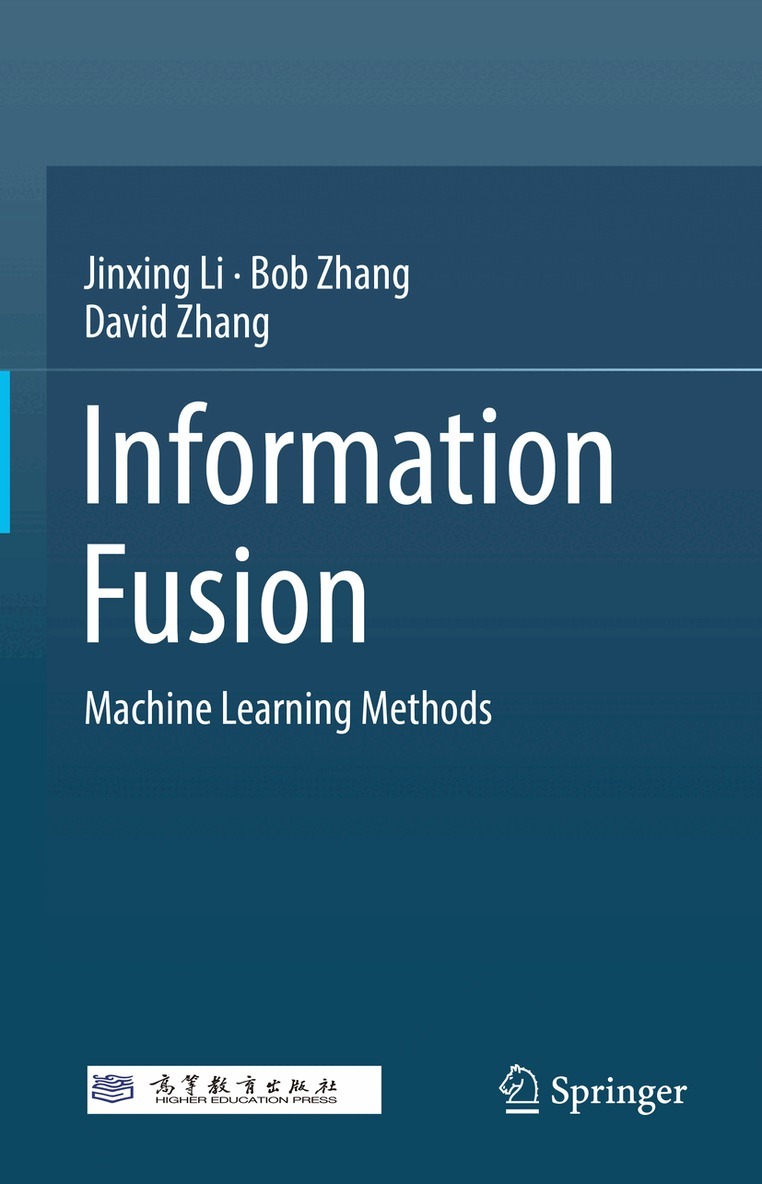
    Information Fusion

    Machine Learning Methods

    AvJinxing Li,Bob Zhang

    Inbunden, Engelska, 2022

    1 118 kr

    Beställningsvara. Skickas inom 10-15 vardagar. Fri frakt över 249 kr.

    Fler format och utgåvor

    Häftad

    1 118 kr

    Beskrivning

    In the big data era, increasing information can be extracted from the same source object or scene. For instance, a person can be verified based on their fingerprint, palm print, or iris information, and a given image can be represented by various types of features, including its texture, color, shape, etc. These multiple types of data extracted from a single object are called multi-view, multi-modal or multi-feature data. Many works have demonstrated that the utilization of all available information at multiple abstraction levels (measurements, features, decisions) helps to obtain more complex, reliable and accurate information and to maximize performance in a range of applications.This book provides an overview of information fusion technologies, state-of-the-art techniques and their applications. It covers a variety of essential information fusion methods based on different techniques, including sparse/collaborative representation, kernel strategy,Bayesian models, metric learning, weight/classifier methods, and deep learning. The typical applications of these proposed fusion approaches are also presented, including image classification, domain adaptation, disease detection, image restoration, etc. This book will benefit all researchers, professionals and graduate students in the fields of computer vision, pattern recognition, biometrics applications, etc. Furthermore, it offers a valuable resource for interdisciplinary research.

    Produktinformation

    • Utgivningsdatum:2022-05-04
    • Mått:155 x 235 x 21 mm
    • Vikt:652 g
    • Format:Inbunden
    • Språk:Engelska
    • Antal sidor:260
    • Förlag:Springer Verlag, Singapore
    • ISBN:9789811689758

    Utforska kategorier

    • Systemvetenskap och AI inom Data och IT
    • Databaser inom Data och IT

    Mer om författaren

    Jinxing Li received his BSc degree from the Department of Automation, Hangzhou Dianzi University, Hangzhou, China, in 2012, his MSc degree from the Department of Automation, Chongqing University, China, in 2015, and his PhD from the Department of Computing, Hong Kong Polytechnic University, in 2018. His research interests include pattern recognition, medical biometrics and machine learning.Bob Zhang received the PhD degree in electrical and computer engineering from the University of Waterloo in 2011. After graduating, he was a postdoctoral researcher in the Department of Electrical and Computer Engineering, Carnegie Mellon University, Pittsburgh, PA, USA. He is currently an Associate Professor in the Department of Computer and Information Science, University of Macau. His research interests focus on biometrics, pattern recognition, and image processing. Dr. Zhang is a Senior Member of IEEE, a Technical Committee Member of the IEEE Systems, Man, and Cybernetics Society and an Associate Editor of Artificial Intelligence Review.David Zhang graduated with a degree in Computer Science from Peking University. He received his MSc and his PhD (both in Computer Science) from the Harbin Institute of Technology (HIT) in 1982 and 1985, respectively. From 1986 to 1988, he was a Postdoctoral Fellow at Tsinghua University and then an Associate Professor at the Chinese Academy of Sciences, Beijing. In 1994, he received his second PhD in Electrical and Computer Engineering, from the University of Waterloo, Ontario, Canada. Currently, he is a Chair Professor at Hong Kong Polytechnic University, where he has been the Founding Director of the Biometrics Research Centre (UGC/CRC) supported by the Hong Kong SAR Government since 1998. He also serves as a Visiting Chair Professor at Tsinghua University and the HIT and as an Adjunct Professor at Shanghai Jiao Tong University, Peking University, National University of Defense Technology and the University of Waterloo. He is the Founder and Editor-in-Chief of the International Journal of Image and Graphics (IJIG); a Book Editor for the Springer International Series on Biometrics (KISB); and an Associate Editor for more than ten international journals, e.g., IEEE Transactions. He has published over 20 monographs and 400 international journal papers and holds 40 patents from the USA/Japan/China. He was continuously listed as a Highly Cited Researcher in Engineering by Clarivate Analytics (formerly known as Thomson Reuters) in 2014, 2015, 2016, 2017 and 2018. Professor Zhang is a Croucher Senior Research Fellow, Distinguished Speaker of the IEEE Computer Society, and a Fellow of both the IEEE and IAPR.

    Innehållsförteckning

    • Chapter 1. Introduction.- Chapter 2. Information fusion based on sparse/collaborative representation.- Chapter 3. Information fusion based on gaussian process latent variable model.- Chapter 4. Information fusion based on multi-view and multifeature earning.- Chapter 5. Information fusion based on metric learning.- Chapter 6. Information fusion based on score/weight classifier fusion.- Chapter 7. Information fusion based on deep learning.- Chapter 8. Conclusion.