• Fri frakt över 249 kr
  • •
  • Snabba leveranser
  • •
  • Billiga böcker
Kundservice

Du är på sajten för privatpersoner.

Företag, bibliotek eller offentlig verksamhet?

Du handlar på classic.bokus.com, där alla dina funktioner finns intakta.
Till classic.bokus.com
Bokus logotyp. Gå till startsidan.
  • Erbjudanden
  • Nyheter
  • Student
  • Topplistor
  • Barn & ungdom
  • Bokus Play
  • E-böcker
  • Pocketböcker
  • Spel & pussel

10% rabatt på allt med kod NYSTART10 →

Sidfot

Mina sidor

    Hjälp

    • Kundservice
    • Vanliga frågor och svar
    • Frakt och leverans
    • Retur vid ångerrätt
    • Reklamera vara
    • Betalning
    • Köpvillkor
    • Allmänna villkor
    • Information om webbplatsens tillgänglighet

    Om Bokus

    • Om oss
    • Pressrum
    • För studenter
    • För företag
    • För bibliotek och offentlig verksamhet
    • För leverantörer
    • Hållbarhet

    Populärt

    • Aktuella erbjudanden
    • Presentkort
    • Studentlitteratur
    • Nya böcker
    • Topplistor
    • Signerade böcker
    • Engelska böcker

    Inspiration

    • Boktips
    • BookTok
    • Populära bokserier
    • Barnbokskaraktärer
    • Populära författare
    Logotyp för Bokus
    Följ oss på Facebook (extern länk)Följ oss på Instagram (extern länk)Följ oss på YouTube (extern länk)Följ oss på TikTok (extern länk)
    bokus @ CookiesAnpassa cookiesIntegritetspolicyKöpvillkor
    Till Citymail hemsida (extern länk)Till Budbee hemsida (extern länk)Till Postnord hemsida (extern länk)Till Schenker hemsida (extern länk)Till Early Bird hemsida (extern länk)Till Walleys hemsida (extern länk)
    1. Naturvetenskap och teknik
    2. Teknik och industri
    3. Biokemisk teknik

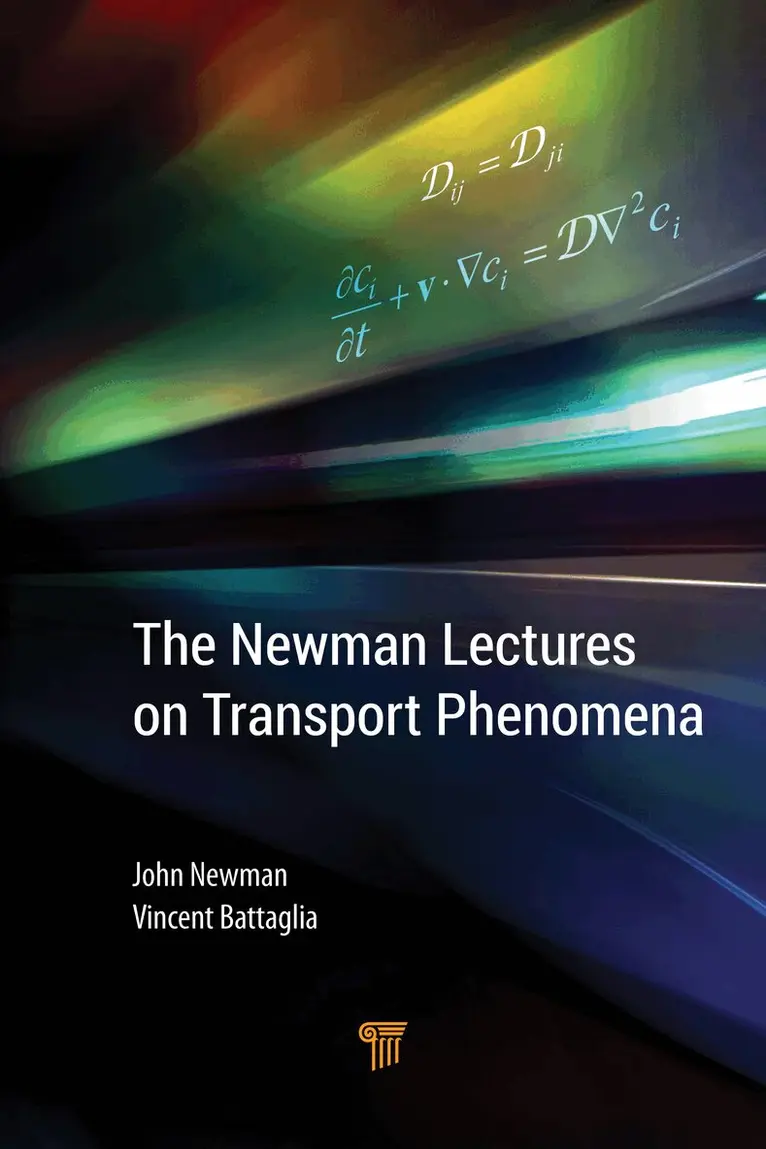
    Newman Lectures on Transport Phenomena

    AvJohn Newman,Vincent Battaglia

    Inbunden, Engelska, 2020

    541 kr

    Beställningsvara. Skickas inom 10-15 vardagar. Fri frakt över 249 kr.

    Beskrivning

    Prof. Newman is considered one of the great chemical engineers of his time. His reputation derives from his mastery of all phases of the subject matter, his clarity of thought, and his ability to reduce complex problems to their essential core elements. He is a member of the National Academy of Engineering, Washington, DC, USA, and has won numerous national awards including every award offered by the Electrochemical Society, USA. His motto, as known by his colleagues, is "do it right the first time." He has been teaching undergraduate and graduate core subject courses at the University of California, Berkeley (UC Berkeley), USA, since joining the faculty in 1966. His method is to write out, in long form, everything he expects to convey to his class on a subject on any given day. He has maintained and updated his lecture notes from notepad to computer throughout his career. This book is an exact reproduction of those notes.This book demonstrates how to solve the classic problems of fluid mechanics, starting with the Navier–Stokes equation. It explains when it is appropriate to simplify a problem by neglecting certain terms through proper dimensional analysis. It covers concepts such as microscopic interpretation of fluxes, multicomponent diffusion, entropy production, nonnewtonian fluids, natural convection, turbulent flow, and hydrodynamic stability. It amply arms any serious problem solver with the tools to address any problem.

    Produktinformation

    • Utgivningsdatum:2020-11-02
    • Mått:155 x 231 x 25 mm
    • Vikt:617 g
    • Format:Inbunden
    • Språk:Engelska
    • Antal sidor:314
    • Förlag:Pan Stanford Publishing Pte Ltd
    • ISBN:9789814774277

    Utforska kategorier

    • Biokemisk teknik inom Naturvetenskap och teknik
    • Materietillstånd inom Naturvetenskap och teknik
    • Klassisk mekanik inom Naturvetenskap och teknik

    Mer om författaren

    John Newman is Charles W. Tobias Chair of Electrochemistry (emeritus), Department of Chemical Engineering, UC Berkeley. At the same time, he was also a senior scientist and principal investigator at the Energy Technologies Area (ETA), Lawrence Berkeley National Laboratory (LBNL), Berkeley, California, USA. He received his BS degree from Northwestern University, Illinois, USA, and MS degree and PhD from UC Berkeley. He has been a recipient of the Onsager Professorship, 2002, of the Norwegian University of Science and Technology, Trondheim, Norway. His current research focuses on the analysis and design of electrochemical systems, with batteries, fuel cells, turbulence, and renewable energy receiving the most attention. He is the author of over 300 technical publications, numerous plenary and invited lectures, and the book Electrochemical Systems.Vincent Battaglia is a research scientist at LBNL, where he heads the Energy Storage Group of the ETA. He received his BS degree in chemical engineering from Johns Hopkins University, Baltimore, USA, and his MS degree and PhD in chemical engineering from UC Berkeley with an emphasis in electrochemical engineering. He joined Argonne National Laboratory, Washington, DC, as a postdoctoral fellow and was later appointed as a chemical engineer, then technical coordinator for DOC PNGV office and coordinator of DOE VTO Battery Research there. He specializes in battery design, fabrication, and testing, and his current research focuses on the science of electrode formulation as it relates to manufacturing and performance. He has received the Pacesetter Award from Argonne National Laboratory, the DOE R&D Award, the 2013 R&D 100 Award, and the FMC Corporation external research collaboration award.

    Recensioner i media

    "These lecture notes are invaluable and belong in the hands of teachers and researchers of transport phenomena. Prof. Newman presents the material in a clear and coherent manner that will offer insights and new perspectives even for experienced practitioners. The classic solutions for laminar and turbulent flow are described concisely and are always well referenced to the original work. Though often thought of as a mature field, the remaining challenges and discrepancies are identified."—Prof. Tom Fuller, Georgia Institute of Technology, USA"This treatise distinguishes itself from other treatments of this subject in two ways. First, it provides extensive breadth and depth to key topics in transport phenomena. Second, it focuses on how to formulate general equation systems and how to solve several important problems using various mathematical methods. In this context, the treatment is complemented by The Newman Lectures on Mathematics. In addition, The Newman Lectures on Thermodynamics provides a foundation for understanding the thermodynamics of irreversible processes, which are central to formulating transport equations. The historical underpinnings add a welcome texture to the exposition." —Dr. Mark Verbrugge, General Motors, USA

    Innehållsförteckning

    • 1. Conservation Laws and Transport Laws. 2. Fluid Mechanics. 3. Microscopic Interpretation of the Momentum Flux. 4. Heat Transfer in a Pure Fluid. 5. Concentrations and Velocities in Mixtures. 6. Material Balances and Diffusion. 7. Relaxation Time for Diffusion. 8. Multicomponent Diffusion. 9. Heat Transfer in Mixtures. 10. Transport Properties. 11. Entropy Production. 12. Coupled Transport Processes. 13. Introduction. 14. Simple Flow Solutions. 15. Stokes Flow Past a Sphere. 16. Flow to a Rotating Disk. 17. Singular-Perturbation Expansions. 18. Creeping Flow Past a Sphere. 19. Mass Transfer to a Sphere in Stokes Flow. 20. Mass Transfer to a Rotating Disk. 21. Boundary-Layer Treatment of a Flat Plate. 22. Boundary-Layer Equations of Fluid Mechanics. 23. Curved Surfaces and Blasius Series. 24. The Diffusion Boundary Layer. 25. Blasius Series for Mass Transfer. 26. Graetz–Nusselt–Lévêque Problem. 27. Natural Convection. 28. High Rates of Mass Transfer. 29. Heterogeneous Reaction at a Flat Plate. 30. Mass Transfer to the Rear of a Sphere in Stokes Flow. 31. Spin Coating. 32. Stefan–Maxwell Mass Transport. 33. Turbulent Flow and Hydrodynamic Stability. 34. Time Averages and Turbulent Transport. 35. Universal Velocity Profile and Eddy Viscosity. 36. Turbulent Flow in a Pipe. 37. Integral Momentum Method for Boundary Layers. 38. Use of Universal Eddy Viscosity for Turbulent Boundary Layers. 39. Mass Transfer in Turbulent Flow. 40. Mass Transfer in Turbulent Pipe Flow. 41. Mass Transfer in Turbulent Boundary Layers. 42. New Perspective in Turbulence.