• Fri frakt över 249 kr
  • •
  • Snabba leveranser
  • •
  • Billiga böcker
Kundservice

Du är på sajten för privatpersoner.

Företag, bibliotek eller offentlig verksamhet?

Du handlar på classic.bokus.com, där alla dina funktioner finns intakta.
Till classic.bokus.com
Bokus logotyp. Gå till startsidan.
  • Erbjudanden
  • Nyheter
  • Student
  • Topplistor
  • Barn & ungdom
  • Bokus Play
  • E-böcker
  • Pocketböcker
  • Spel & pussel

10% rabatt på allt med kod: NYSTART10 →

Sidfot

Mina sidor

    Hjälp

    • Kundservice
    • Vanliga frågor och svar
    • Frakt och leverans
    • Retur vid ångerrätt
    • Reklamera vara
    • Betalning
    • Köpvillkor
    • Allmänna villkor
    • Information om webbplatsens tillgänglighet

    Om Bokus

    • Om oss
    • Pressrum
    • För studenter
    • För företag
    • För bibliotek och offentlig verksamhet
    • För leverantörer
    • Hållbarhet

    Populärt

    • Aktuella erbjudanden
    • Presentkort
    • Studentlitteratur
    • Nya böcker
    • Topplistor
    • Signerade böcker
    • Engelska böcker

    Inspiration

    • Boktips
    • BookTok
    • Populära bokserier
    • Barnbokskaraktärer
    • Populära författare
    Logotyp för Bokus
    Följ oss på Facebook (extern länk)Följ oss på Instagram (extern länk)Följ oss på YouTube (extern länk)Följ oss på TikTok (extern länk)
    bokus @ CookiesAnpassa cookiesIntegritetspolicyKöpvillkor
    Till Citymail hemsida (extern länk)Till Budbee hemsida (extern länk)Till Postnord hemsida (extern länk)Till Schenker hemsida (extern länk)Till Early Bird hemsida (extern länk)Till Walleys hemsida (extern länk)
    1. Samhälle och politik
    2. Samhälle och kultur
    3. Kultur och medier
    4. Referensverk och tvärvetenskap

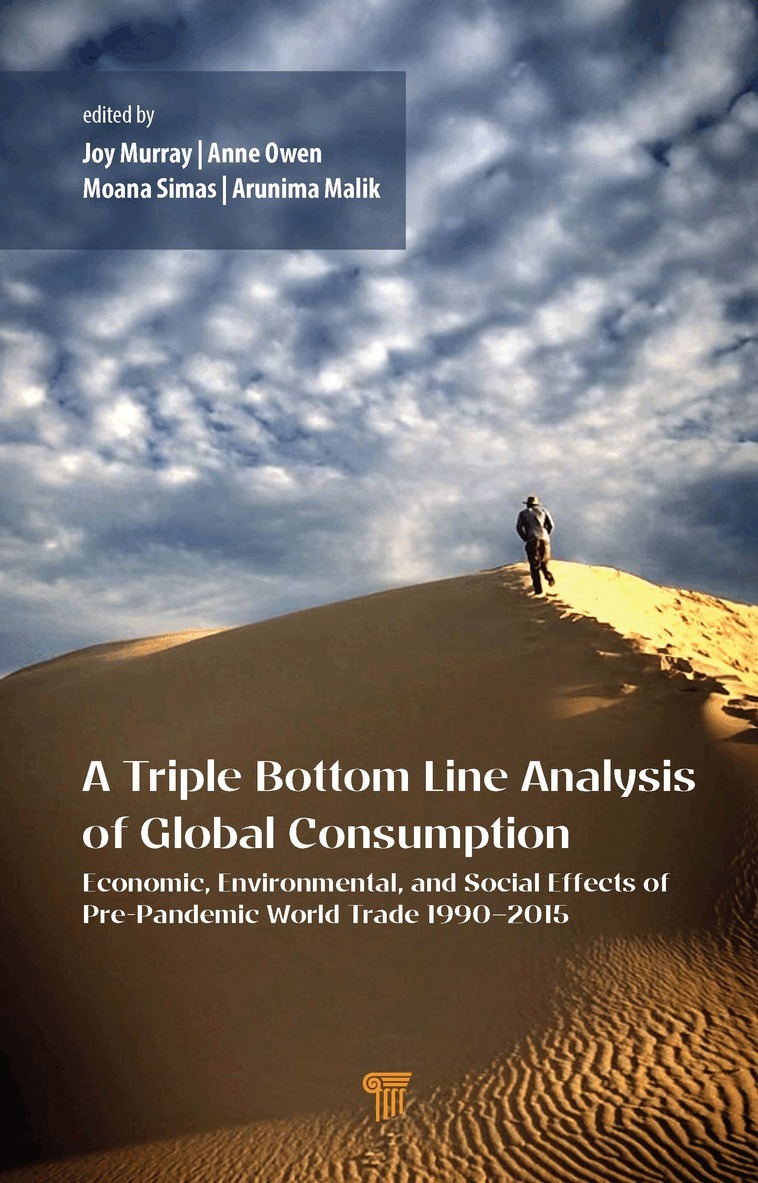
    Triple Bottom Line Analysis of Global Consumption

    Economic, Environmental, and Social Effects of Pre-Pandemic World Trade 1990–2015

    AvJoy Murray,Anne Owen

    Inbunden, Engelska, 2022

    1 684 kr

    Beställningsvara. Skickas inom 10-15 vardagar. Fri frakt över 249 kr.

    Beskrivning

    This book adds a whole new dimension to the editors’ previous work on the social, economic, and environmental effects of global trade. For the first time it brings all three pillars of sustainability together into one coherent multiregional input–output (MRIO) framework. It shows the power of MRIO analysis to illuminate the local and global interdependencies of economic, environmental, and social systems and the benefits to be gained through analysing all three together. Change one thing and everything else changes. With chapters from around 60 researchers across 34 countries, this book illustrates the effect of natural resources and government policy settings 1990–2015 on the balancing act that was—and is—global trade. It provides a holistic systems’ view of how supply chains work, revealing how easily they can become fragmented and out of kilter. And within all the chaos of COVID-19 it shows how MRIO is the one tool that can help rebuild a post-pandemic global economy into a fairer, safer world.

    Produktinformation

    • Utgivningsdatum:2022-05-26
    • Mått:152 x 229 x 34 mm
    • Vikt:1 120 g
    • Format:Inbunden
    • Språk:Engelska
    • Antal sidor:530
    • Förlag:Jenny Stanford Publishing
    • ISBN:9789814968010

    Utforska kategorier

    • Referensverk och tvärvetenskap inom Samhälle och politik
    • Internationell ekonomi inom Ekonomi och Ledarskap
    • Miljöekonomi inom Ekonomi och Ledarskap

    Mer om författaren

    Joy Murray is a senior research fellow with the Integrated Sustainability Analysis (ISA) group at the School of Physics, University of Sydney, Australia. Before joining ISA, Dr. Murray worked for over 25 years in education, preschool to postgraduate. She has also worked with residents of government housing estates to collaboratively develop leadership capacity.Anne Owen is an academic fellow at the Sustainability Research Institute at the School of Earth and Environment, University of Leeds, UK. Dr. Owen has a background in end-use energy demand and consumption-based energy and carbon accounting using state-of-the-art MRIO databases. She is responsible for constructing the model being used to calculate the UK’s carbon and material footprint—the statistics reported annually by the UK Government.Moana Simas is a researcher at the Sustainable Energy Technologies group at SINTEF, one of the largest independent research organizations in Europe. She has a background in environmental sciences and energy systems. Her current work focusses on assessing triple bottom line impacts of technology change, climate policies, and circular economy strategies on local and global value chains.Arunima Malik is an academic at the University of Sydney. She has expertise in undertaking Big-Data modelling of sustainability performance of products, processes, and organisations, and to quantify sustainability impacts at local, national, and global scales. She works closely with the United Nations Sustainable Development Solutions Network for undertaking assessments for quantifying spillover effects in international supply chains.

    Innehållsförteckning

    • Part 1: Introduction 1. A Global Perspective on Sustainable Development 2. Deepening of Global Value Chains 3. Money Cannot Compensate for Entropy: Ecologically Unequal Exchange and the Decoupling of Economics from Reality 4. Is It the End of World (Trade) as We Know It? Changes in Global Trade Patterns after the Outbreak of COVID-19 5. Measuring Impacts in Global Value Chains through Consumption-Based Accounting Part 2: Europe 6. Europe: A Resource-Dependent Region with Strong Sustainability-Oriented Policies 7. European Union: Protecting the Environment while Securing Jobs and Growth 8. Austria 9. Bulgaria 10. France: International Resources for a Sustainable, Inclusive and Innovative future? 11. Germany 12. Italy 13. The Netherlands 14. Norway: Rich + Green = Sustainable? 15. Sweden: An Environmental Success Story 16. The UK: A Proud Leader, or Dishonest User of Statistics? 17. Poland 18. Transition of Slovakia toward a Modern Market Economy 19. Spain Part 3: Africa 20. Africa as Net Exporter of Natural Resources and Pollution 21. South Africa: The Sideways Drift of a Jobless Coal-and-Carbon Nexus 22. Ghana 23. Kenya 24. Morocco 25. Malawi Part 4: The Americas 26. The Americas: On Track toward Sustainable Development? 27. Ecuador: A Traditional Development Path 28. Bolivia 29. Nicaragua: Central America’s Green Lung. But How much Longer? 30. Brazil 31. Colombia 32. Mexico: 20 Years of North American Free-Trade Agreement. Socio-Environmental Trends and Unequal Exchange 33. Argentina: Energy Transition to a Cleaner Economy 34. Chile 35. United States of America Part 5: Asia and Oceania 36. Asia and Oceania: Mutual Outsourcing Partners 37. China 38. Japan 39. Indonesia 40. Russia 41. Australia: The Good, the Bad, and the Ugly 42. New Zealand Part 6: Middle East 43. Middle East: The Dilemma of Oil, Water and Development 44. Iran 45. Iraq