• Fri frakt över 249 kr
  • •
  • Snabba leveranser
  • •
  • Billiga böcker
Kundservice

Du är på sajten för privatpersoner.

Företag, bibliotek eller offentlig verksamhet?

Du handlar på classic.bokus.com, där alla dina funktioner finns intakta.
Till classic.bokus.com
Bokus logotyp. Gå till startsidan.
  • Erbjudanden
  • Nyheter
  • Student
  • Topplistor
  • Barn & ungdom
  • Bokus Play
  • E-böcker
  • Pocketböcker
  • Spel & pussel

10% rabatt på allt med kod NYSTART10 →

Sidfot

Mina sidor

    Hjälp

    • Kundservice
    • Vanliga frågor och svar
    • Frakt och leverans
    • Retur vid ångerrätt
    • Reklamera vara
    • Betalning
    • Köpvillkor
    • Allmänna villkor
    • Information om webbplatsens tillgänglighet

    Om Bokus

    • Om oss
    • Pressrum
    • För studenter
    • För företag
    • För bibliotek och offentlig verksamhet
    • För leverantörer
    • Hållbarhet

    Populärt

    • Aktuella erbjudanden
    • Presentkort
    • Studentlitteratur
    • Nya böcker
    • Topplistor
    • Signerade böcker
    • Engelska böcker

    Inspiration

    • Boktips
    • BookTok
    • Populära bokserier
    • Barnbokskaraktärer
    • Populära författare
    Logotyp för Bokus
    Följ oss på Facebook (extern länk)Följ oss på Instagram (extern länk)Följ oss på YouTube (extern länk)Följ oss på TikTok (extern länk)
    bokus @ CookiesAnpassa cookiesIntegritetspolicyKöpvillkor
    Till Citymail hemsida (extern länk)Till Budbee hemsida (extern länk)Till Postnord hemsida (extern länk)Till Schenker hemsida (extern länk)Till Early Bird hemsida (extern länk)Till Walleys hemsida (extern länk)
    1. Naturvetenskap och teknik
    2. Matematik och naturvetenskap
    3. Matematik
    4. Beräkning och matematisk analys
    • Nyhet

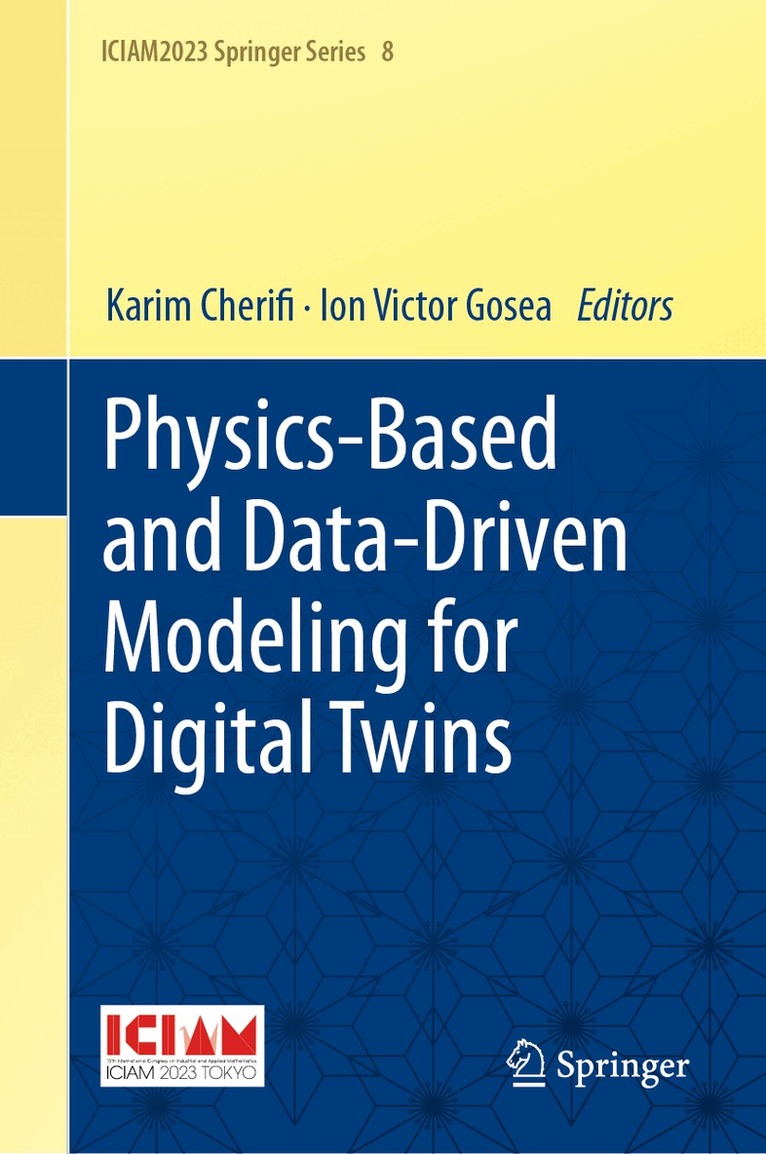
    Physics-Based and Data-Driven Modeling for Digital Twins

    AvKarim Cherifi,Ion Victor Gosea

    Inbunden, Engelska, 2026

    Del 8 i serien ICIAM2023 Springer Series

    2 162 kr

    Beställningsvara. Skickas inom 10-15 vardagar. Fri frakt över 249 kr.

    Beskrivning

    This book presents a compelling and up-to-date exploration of modeling techniques for digital twins, a transformative concept revolutionizing how physical assets are designed, operated, optimized, and managed throughout their lifecycle. Digital twins are precise virtual counterparts of physical systems, capable of integrating real-time data to offer dynamic, predictive insights into system behavior. As this paradigm gains momentum across industries, it enhances decision-making and operational efficiency but also introduces new mathematical and engineering challenges in model development.At the core of this volume is a thorough investigation into the modeling frameworks essential for building effective digital twins. These systems must fulfill multifunctional roles, requiring models that are both robust and flexible enough to simulate complex physical processes with high fidelity. The book spans a wide spectrum of approaches from physics-based models grounded in the laws of nature to data-driven techniques that harness large-scale datasets. It also highlights the growing importance of hybrid methods that combine the interpretability of physical models with the adaptability of machine learning. Throughout the book, real-world case studies illustrate how these modeling advancements are applied to solve pressing challenges in sectors such as manufacturing, energy and transportation.This volume brings together contributions from leading researchers who are shaping the future of digital twins. The chapters are designed to be accessible to a broad audience. Whether you just started or want to deepen your expertise, this volume offers the insights and tools needed to engage with one of the most exciting developments in modern applied mathematics and engineering. Chapter 1  is available open access under licensed under the Creative Commons Attribution-NonCommercial-NoDerivatives 4.0 International License in  link.springer.com.

    Produktinformation

    • Utgivningsdatum:2026-08-03
    • Mått:155 x 235 x 15 mm
    • Vikt:416 g
    • Format:Inbunden
    • Språk:Engelska
    • Serie:ICIAM2023 Springer Series
    • Antal sidor:154
    • Förlag:Springer Nature Switzerland AG
    • ISBN:9789819691074

    Utforska kategorier

    • Beräkning och matematisk analys inom Naturvetenskap och teknik
    • Databaser inom Data och IT

    Mer om författaren

    Karim Cherifi is a researcher at the University of Wuppertal, Germany. His main research interests include model order reduction, data-driven modeling, Port Hamiltonian modeling, and modeling for digital twins. He obtained his Ph.D. in Control theory in 2019 from the Institute of Electrical and Electronic Engineering in Boumerdes (Algeria). Afterward, he was a postdoctoral researcher at the Max Planck Institute (MPI) for Dynamics of Complex Technical Systems in Magdeburg (Germany)and later at the Technical University of Berlin (Germany) where he was involved in the design of digital twins for Large Drive Applications within the project ’Elektrische Antriebe 2.0’ as part of the Werner-von-Siemens Centre for Industry and Science in Berlin. Recently, he has been involved in multiple projects that implement digital twins in different domains: electrical machines, Building information modeling (BIM), and gas networks.  Bio Ion Victor Gosea is a senior scientist at the Max Planck Institute (MPI) for Dynamics of Complex Technical Systems in Magdeburg, Germany, in the Computational Methods in Systems and Control Theory Group led by Prof. Peter Benner. His main research interests include data-driven model reduction and reduced-order modeling of dynamical systems, system identification, rational approximation, and surrogate modeling for efficient and predictive digital twins. He obtained a Ph.D. in Electrical Engineering in 2017 at the Jacobs University Bremen, Germany. Afterward, he was a postdoctoral researcher at the MPI Magdeburg, specializing in frequency-domain data-driven methods. In the last years, he has been part of research endeavors and projects that aim at constructing digital twins for process, chemical, and electrochemical engineering applications, with an emphasis on developing green carbon processes in the context of the Power-to-X conversion framework.

    Innehållsförteckning

    • Chapter 1 The (Executable) Digital Twin: merging the digital and the physical worlds.- Chapter 2 Digital Twins: modeling hierarchy and basic approaches.- Chapter 3 Adaptive planning for risk-aware predictive digital twins.- Chapter 4 Recurrent deep Kernel Learning of Dynamical Systems.-Chapter 5 Hierarchical modeling for an industrial implementation of a digital twin for electrical drives.-Chapter 6 Deviation-sensitive black-box anomaly attribution.