E-bok, Engelska, 2025
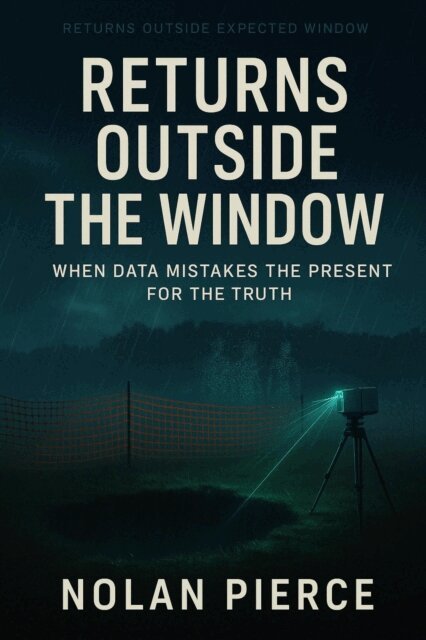
Returns Outside the Window: When Data Mistakes the Present for the Truth
Av Nolan Pierce
42 kr
Läs direkt i Bokus Reader – eller ladda ned till din enhet
Beskrivning
When a spring storm leans hard on Missouri's Sink Ridge, a farm road vanishes into a widening mouth of limestone. A small ad-hoc team is sent to map the danger before the next cell hits: Maya Caldwell, a graduate engineer with a laser LIDAR scanner nicknamed Etta; Dr. Ken Levin, a hydrologist who can hear what water intends; ropewise rescuer Rory Ames; farmer Ruth Bell; drone pilot Beck Crane; and Deputy Del, a young cop taught to stand only where the ground looks honest. What begins as routine documentation becomes a nightmare of eco-horror and disaster thriller as Etta starts returning eerie, human-shaped clusters in the point cloud.There are no ghosts here—only physics, procedure, and pressure. In rain and turbulent air, the scanner's laser paths run long and arrive late; the solver, primed by a human prior, snaps those delayed echoes into the present with high confidence. On the tablet, dots reorganize into the team's own postures seconds "e;ahead,"e; and everyone begins to move as if the map knows more than the ground. Officials arrive, radios fail, orange fencing goes up, and a unified-command mantra repeats: One more pass, for record. Each sweep tightens the knot.Returns Outside the Window is a razor-edged techno-thriller with the dread of a psychological thriller and the fatalism of cli-fi. It's also a small-town mystery at storm scale: an oak that finally lets go, an old culvert "e;temporarily"e; capped to shunt water, budgets that wandered for years, and a ridge that keeps adjusting whether anyone measures it or not. The story's terror is procedural—checklists, liability, and data confidence edging out common sense. When the team must choose between killing a scan mid-sweep (and "e;corrupting the dataset"e;) or finishing the high-density arc that might seal their fates, the novel asks a blunt question: What do we owe the living when the record wants to be clean?Told in crisp, tactile prose and punctuated by incident-log appendices, this is a catastrophe told from the inside out—about how good tools, used under the wrong incentives, can manufacture inevitability. No jump scares, no miracles; just a storm, a sink, and a device that keeps humming. The ground doesn't care, the dataset persists, and somewhere beyond the orange fence the ridge is still practicing its next exhale.
Produktinformation
- Utgivningsdatum: 2025-10-23
- Språk: Engelska
- Filformat: EPUB
- Kopieringsskydd: LCP
- ISBN: 9798232110987
- Förlag: Distributed via Draft2Digital
Utforska kategorier
- Inga kategorier tillgängliga.
Betyg & recensioner
0 recensioner
Inga recensioner tillgängliga.