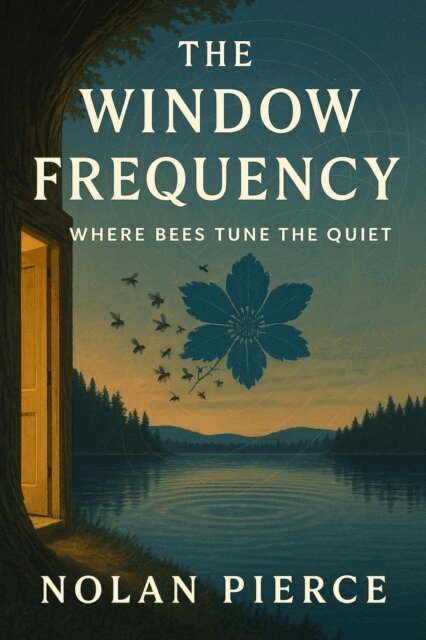
E-bok, Engelska, 2025
Window Frequency: Where Bees Tune the Quiet
Av Nolan Pierce
256 kr
Läs direkt i Bokus Reader – eller ladda ned till din enhet
Beskrivning
When the Boreal Ring—a decommissioned particle accelerator buried beneath iron hills and cedar—falls silent, whistleblower-turned-beekeeper Mira Halden leases a hundred yards of tunnel and fills it with hives, wood, and a yellow door the bees can learn. The hum she hears is real: a lake-quiet frequency braided into stone, answered by her colonies. With Dr. Lucien Park, a physicist who stayed behind after the lab closed, and Noa, her eight-year-old niece who draws blue flowers like maps, Mira builds a way to listen without taking: an aeolian coil that never injects energy, a cedar-and-iron "e;attentional lens,"e; and a choir of quiet led by children.Then Kestrel Dynamics arrives with money, fences, and a story about inevitability. Their corporate conspiracy is elegant: "e;quantum sampling,"e; a hard push that turns a window of observation into a door-shaped corridor. The county wants jobs; the company wants access; the bees begin to point at places no flower grows. What follows isn't a shootout but a civic experiment—a cozy science fiction drama set in a small-town sci-fi landscape, where hearings matter, ledgers matter, and cocoa after meetings matters. Lucien publishes an evidence chain; Joy, the librarian, makes the rules public; Noa's "e;Not There Flower"e; corrects the community's hurry. Together they draft Window Rules—we listen; we don't push; nobody is the instrument—and refuse the perfect lie.Blending near-future thriller stakes with a hopepunk pulse, The Window Frequency — Where Bees Tune the Quiet asks what it means to practice science as a public narrative rather than a spectacle. It's an ethical technology tale that prefers verbs to gadgets—listen, stop, correct—and an unexpectedly tender beekeeping novel about grief you can live with among others. The showdown isn't about opening a portal; it's about whether a town can keep a window, on paper and in practice, when a company offers a door "e;just once."e;By the spring equinox, the community names a commons, seeds blue flowers, and shelves the coil in a school case with a sign-out ledger children manage. The antagonist redeploys to a new county with a familiar slide deck—but someone in the back asks, "e;What if windows are enough?"e; The silence that follows is the answer the book leaves you to keep.For readers of Ursula K. Le Guin's steadiness, Becky Chambers's tenderness, and anyone searching for a science fiction novel where attention—not spectacle—is the instrument.
Produktinformation
- Utgivningsdatum: 2025-09-16
- Språk: Engelska
- Filformat: EPUB
- Kopieringsskydd: LCP
- ISBN: 9798232207625
- Förlag: Distributed via Draft2Digital
Utforska kategorier
- Inga kategorier tillgängliga.
Betyg & recensioner
0 recensioner
Inga recensioner tillgängliga.