• Fri frakt över 249 kr
  • •
  • Snabba leveranser
  • •
  • Billiga böcker
Kundservice

Du är på sajten för privatpersoner.

Företag, bibliotek eller offentlig verksamhet?

Du handlar på classic.bokus.com, där alla dina funktioner finns intakta.
Till classic.bokus.com
Bokus logotyp. Gå till startsidan.
  • Erbjudanden
  • Nyheter
  • Student
  • Topplistor
  • Barn & ungdom
  • Bokus Play
  • E-böcker
  • Pocketböcker
  • Spel & pussel

10% rabatt på allt med kod: NYSTART10 →

Sidfot

Mina sidor

    Hjälp

    • Kundservice
    • Vanliga frågor och svar
    • Frakt och leverans
    • Retur vid ångerrätt
    • Reklamera vara
    • Betalning
    • Köpvillkor
    • Allmänna villkor
    • Information om webbplatsens tillgänglighet

    Om Bokus

    • Om oss
    • Pressrum
    • För studenter
    • För företag
    • För bibliotek och offentlig verksamhet
    • För leverantörer
    • Hållbarhet

    Populärt

    • Aktuella erbjudanden
    • Presentkort
    • Studentlitteratur
    • Nya böcker
    • Topplistor
    • Signerade böcker
    • Engelska böcker

    Inspiration

    • Boktips
    • BookTok
    • Populära bokserier
    • Barnbokskaraktärer
    • Populära författare
    Logotyp för Bokus
    Följ oss på Facebook (extern länk)Följ oss på Instagram (extern länk)Följ oss på YouTube (extern länk)Följ oss på TikTok (extern länk)
    bokus @ CookiesAnpassa cookiesIntegritetspolicyKöpvillkor
    Till Citymail hemsida (extern länk)Till Budbee hemsida (extern länk)Till Postnord hemsida (extern länk)Till Schenker hemsida (extern länk)Till Early Bird hemsida (extern länk)Till Walleys hemsida (extern länk)
    1. Historia och arkeologi
    2. Historia
    3. Övriga länders och regioners historia

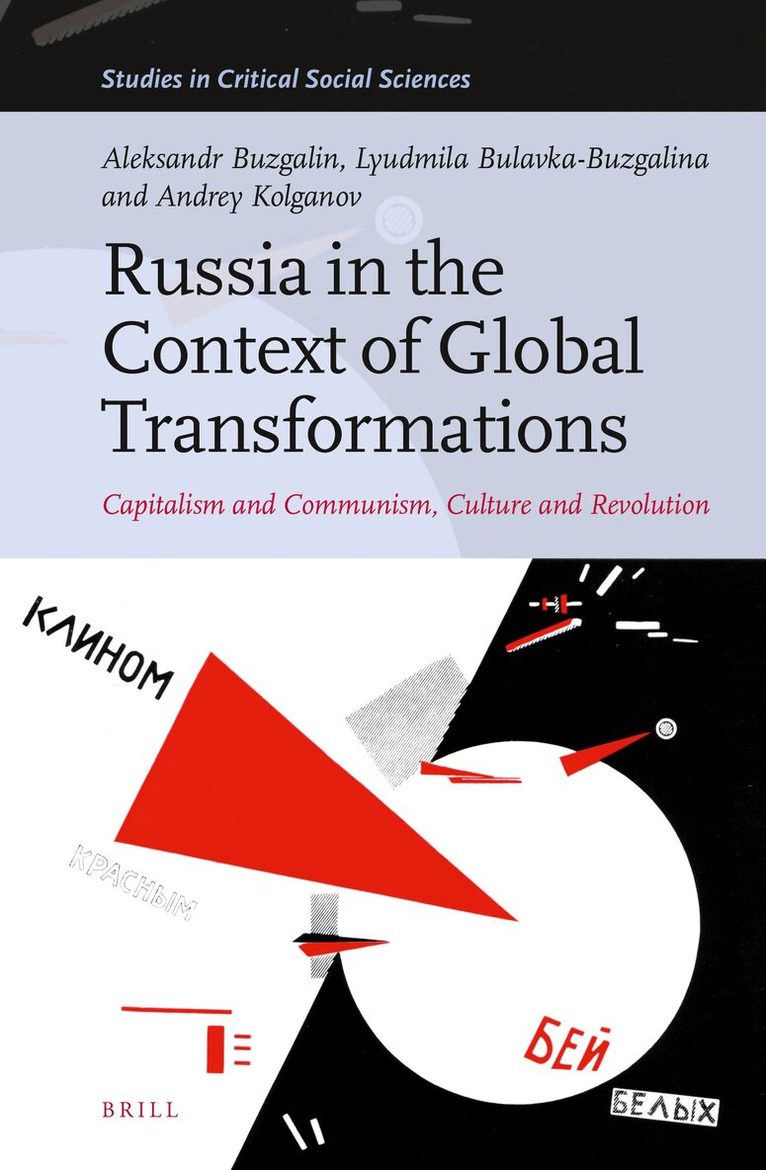
    Russia in the Context of Global Transformations

    Capitalism and Communism, Culture and Revolution

    AvAleksandr Buzgalin,Lyudmila Bulavka-Buzgalina

    Häftad, Engelska, 2024

    Del i serien Studies in Critical Social Sciences

    295 kr

    Beställningsvara. Skickas inom 5-8 vardagar. Fri frakt över 249 kr.

    Fler format och utgåvor

    Inbunden

    3 360 kr

    Beskrivning

    In Russia in the Context of Global Transformations (Capitalism and Communism, Culture and Revolution) the authors focus on the dramatic changes in Russia’s socio-economic system over the past hundred years.The contradictions of Russia’s triumphs and tragedies are studied in connection with shifts in the world economic system.Basing themselves on the views of the Post-Soviet School of Critical Marxism, the authors show the causes and consequences of the main shifts in Russia’s development during the twentieth and twenty-first centuries. Topics addressed include the October Revolution, the contradictions of post-revolutionary development, the disintegration of the USSR, the collapse and stagnation during the post-USSR period and the prospects for overcoming contemporary problems.

    Produktinformation

    • Utgivningsdatum:2024-05-21
    • Mått:152 x 228 x 20 mm
    • Vikt:522 g
    • Format:Häftad
    • Språk:Engelska
    • Serie:Studies in Critical Social Sciences
    • Antal sidor:372
    • Förlag:Haymarket Books
    • ISBN:9798888902257

    Utforska kategorier

    • Övriga länders och regioners historia inom Historia och arkeologi

    Mer om författaren

    Aleksandr Buzgalin has published monographs and numerous articles on the capitalist and socialist economic systems, including Twenty-First-Century Capital (with co-author Andrey Kolganov).Lyudmila Bulavka-Buzgalina has published monographs and numerous articles on Soviet culture, including The Phenomenon of Soviet Culture.Andrey Kolganov is Head of the Laboratory for Comparative Studies of Socio-Economic Systems at Lomonosov Moscow State University. Among his recent publications on capitalist and socialist economic systems is Twenty-First-Century Capital (with co-author Aleksandr Buzgalin).

    Innehållsförteckning

    • PrefaceAcknowledgementsList of Diagrams, Figures and TablesIntroduction How Should the Global Transition Be Understood? Toward a Methodology of the Post-Soviet School of Critical Marxism1 Marxism in Post-Soviet Russia: From Orthodoxy to the Post-Soviet School of Critical Marxism1.1 Russia Since 2000: The Spectre of Marxist Studies1.2 The Post-Soviet School of Critical Marxism: An Introduction2 Obsolete Postmodernism: The Dialectics of Non-linear, Multi-scenario Social Transformations2.1 On Some of the Reasons for “Forgetting” Dialectics2.2 New Answers to the Challenges of new Problems: The Dialectics of the Decline and Genesis of Social Systems3 Beyond the “Pyatichlenka” and “The Collapse of Civilisations”: The Social Creativity of Free Association vs. Activism3.1 Beyond the Realm of Economic Necessity: The Dialectics of Progress/Regression3.2 The Individual in History: The Activism of Agents of Progress and RegressionPart 1Context: Culture and Revolution1 Revolution From October 1917 Towards Communism1 Toward a Theory of Communist Revolution: Some Additions to the Traditional Positions of Marx and Lenin2 Revolution as the Practice of Social Creativity: The Masses and the Intelligentsia, the Social Creator and the Boor3 The October Revolution: Practice as the Impulse for the Development of Theory2 Culture Bakhtin and Dialectics1 Why Bakhtin?2 The World of Bakhtin: Prologue3 Dialectics as the Basis of Bakhtin’s World4 Dialogue: A Window into the World of Collaborative Creativity5 Vivat Carnival!6 Why do they Need Bakhtin?7 Bakhtin Versus Post-modernism: Integrity and Responsible Activity8 Bakhtin Versus Post-modernism: “Oneness” and the “Philosophy of the Deed”9 Bakhtin Versus Post-modernism: Humanism10 Bakhtin Versus Post-modernism: Epistemology11 Bakhtin Versus Post-modernism: Historicism3 Revolution and Culture Bakhtin, Mayakovsky and Lenin1 Revealing the Concept (in Place of a Foreword)2 Culture as Revolution: Creation vs. Alienation. Bakhtin and Lenin3 Revolution as Culture: The Proletkult and/or Soviet Culture. Lenin and Mayakovsky4 P.S. Revolution, that Gives Birth to Culture: The Renaissance, the ussr and the End of the “End of History” (in Place of a Conclusion)Part 2ussr : Birth, Death and Future4 The Birth Lenin1 Creating the Impossible: Lessons of Lenin’s Legacy (to Mark the 150th Anniversary of the Birth of V.I. Ulyanov-Lenin)2 But at the Same Time as the Revolution was Inevitable, it Lacked Sufficient Preconditions5 Death The Contradictions of the System and the Lessons of its Collapse1 Why and How the ussr Departed from the Scene: Toward a Systematisation of the Main Approaches2 The Path to the “Realm of Freedom”, or the Red Line of History: A Theoretical-Methodological Interpretation3 The ussr : The Hypothesis of Mutant Socialism4 The Social Forces of Development and the Downfall of the ussr : The Creators of the Future, the “Red” Bureaucracy and Philistinism5 The Immediate Reason for the Demise of the ussr : The Strengthening and Subsequent Degeneration of the “Red” Bureaucracy as the Social Creativity of the Masses Expired6 The Underlying Causes of the Downfall of the ussr7 The Degradation of the “Red Line”, and the Reasons for the Disintegration of the ussr8 The Tragedy of Socialism6 The Future Soviet Culture and its Renaissance1 The Question of Subjecthood2 The Renaissance and Soviet Culture: Fundamental Traits3 The Renaissance and Soviet Culture: Contradictions in CommonPart 3Russia- xxi : Why Stagnation?7 Political Economy The Jurassic Park of Russian Capitalism1 The Russian Market: Those Who Win Are Not the Best Runners, but the Best Sack-Racers2 The Owners of Russia: the Anatomy of the “Dinosaurs” Property Relations and Rights: The Peculiarities of Russia3 Clan-Corporate Groups: Their Structure and Channels of Power4 The Process of Reproduction in Russia: How Capital Prefers to Parasitise Social and Natural Resources, and Acts as a Brake on Social Development5 The Parasitising of Natural Rent and the Ageing of Fixed Capital6 Social Obstacles to the Transition to an Intensive Type of Reproduction8 Culture The Destruction of Individuality in a World of Simulacra1 Introduction2 Negation as a Simulacrum of Transition3 Culture as Market4 The Present-Day Basis of Our Existence Has Already Exhausted Itself5 Cultures and the Market: What Relations between Them Are Possible?6 Simulative Consumption7 Culture as an Industry of Alienation8 Breaking the Tie with the Ancestral Human9 The Abstract Nature of the Being of the Individual10 The Negation of Subjecthood – the Rejection of the Idea of the Individual11 Culture as Market12 The Media Industry – the Production of the Private Person13 ConclusionPart 4The History of the Future9 The End of the “End of the History”1 The Red and the Black: The Conflict Has Never Ended2 The Measure of the Socialisation of Capitalism: Growth ‒ Contraction ‒ Renewed Growth?3 Why Has the Liberal Project, Whose Triumph Was Celebrated Thirty Years Ago, Been Unable to Clinch its Final Victory?4 The “End of History” Had Come to an End5 In Search of Alternatives to Conservative Liberalism6 An era of Growing Economic, Social, Political and Ideological Conflicts Is Approaching7 Toward a Criticism of Our Critics10 The Contradictions of Globalization and the Future of Alterglobalism1 From Neoliberal Globalization to a New Empire2 The Phenomenology of Alterglobalism3 The Technological, Economic and Social Preconditions for Alterglobalism4 Principles and Contradictions of the Alterglobalist Movement5 The Positive Program of Alterglobalism.11 Communism as It Is Today1 Žižek from a Different Angle: Communism as a Question for Our Times (in Place of an Introduction)2 Towards a Practical Strategy for Abolishing Intellectual Private Property and the Exploitation of Creative Activity3 Associated Social Creativity: Communism as the Practice of Consciously Changing the World4 Beyond the State: Free, Voluntary Working Association as an Abstraction of the Practical and Timely Forms for Doing Away with the State5 Doing Away with Social Alienation: The Struggle for Nature, Society, Humanity and Culture as Communism6 Communism as TheoryPostscript12 The Coronavirus is Stirring the Impulse to Communism1 Self-isolation as the Road to … Solidarity2 The Virus Is “Democratic” – Consequently, Social Justice Is to Everyone’s Advantage3 Closed Borders as a Prologue to … InternationalismConclusionIndex