A. T. Panter – författare
Visar alla böcker från författaren A. T. Panter. Handla med fri frakt och snabb leverans.
3 produkter
3 produkter
2 849 kr
Skickas inom 3-6 vardagar
"I like the premise and the resulting organizing theme. The organizational structure fits the described theme well and promises to provide a valuable resource both for educating researchers and for helping them through the myriad types of research methods that are available today...Achieves a nice balance, running the gamut of issues from the conceptual to the practical to the statistical....This book could easily become a classic."--Donal Carlston, Purdue University"The book′s emphasis on the conceptual decisions that have to be made in doing research is enticing….I believe that this book has a niche as an advanced undergraduate or graduate-level text. I would certainly consider this book for my advanced undergraduate social psychology research methods class; in fact, I′m desperately in need of such a book."--John Edwards, Oregon State University"The handbook will contribute greatly to the training of graduate students and will also be used as reference by social psychologists working in multiple domains….It could be adopted for most advanced methods courses."--Dolores Albarracin, University of Florida"All chapters are solid contributions, a few are gems, and every author wrote with an eye to having the work used. This is a handbook to take off the shelf and dog-ear in the classroom, lab, or field. Highly recommended." -CHOICE The genius of social psychology as a field has been its ability to investigate the seemingly complicated behaviors that characterize humans as social creatures. The SAGE Handbook of Methods in Social Psychology simplifies this complexity by providing researchers and students with an overview of the rich history of methodological innovation in both basic and applied research within social psychology.Editors Carol Sansone, Carolyn C. Morf, and A.T. Panter have chosen a particular methodological approach that is essential for optimal consideration of the "big picture" concept of a program of research. In this approach, research questions guide the methods rather than the reverse. Based on this "top-down" perspective, chapters in this unique volume emphasize the conceptual basis of the methodology, with an explicit focus on the meaning of data when obtained via a particular methodology.Features and Benefits: "Big Picture" Understanding. This volume focuses on the decision-making process, highlighting how methodological decisions are inextricably tied to what the researcher ultimately wants to know. "Top-down" Perspective. Beginning chapters explore issues of selecting and identifying research questions and populations; middle chapters address design and analysis; and later chapters expand social psychological questions to other disciplines within and outside of psychology. Straightforward Statistical Analysis. Statistical analysis is considered only to the extent that it helps to illuminate the meaning of data obtained through a particular methodological approach or design decision. Interdisciplinary Approach. Innovative chapters explore such issues as ethics, diversity, individual differences, and how social psychology is moving into new areas that cross disciplinary bounds such as social neuroscience, social development, program evaluation, health, and education. This Handbook is a vital resource for behavioral scientists in the academic and research settings who are interested in learning about modern perspectives on classic and innovative methodological approaches in social psychology. Also recommended for undergraduate and graduate students enrolled in social psychology methods courses.
2 265 kr
Skickas inom 10-15 vardagar
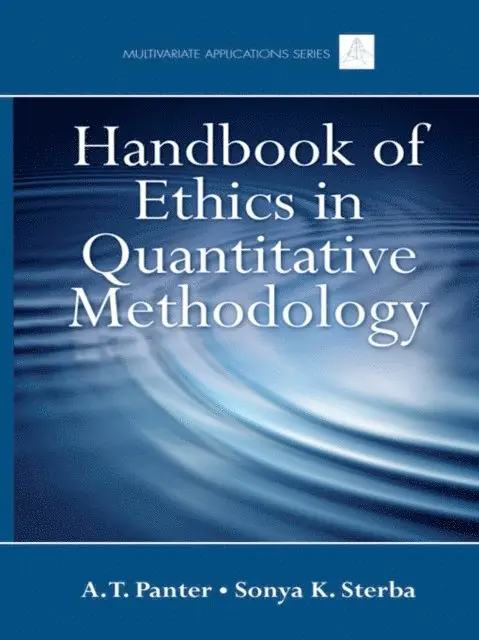
This comprehensive Handbook is the first to provide a practical, interdisciplinary review of ethical issues as they relate to quantitative methodology including how to present evidence for reliability and validity, what comprises an adequate tested population, and what constitutes scientific knowledge for eliminating biases. The book uses an ethical framework that emphasizes the human cost of quantitative decision making to help researchers understand the specific implications of their choices. The order of the Handbook chapters parallels the chronology of the research process: determining the research design and data collection; data analysis; and communicating findings. Each chapter:Explores the ethics of a particular topicIdentifies prevailing methodological issuesReviews strategies and approaches for handling such issues and their ethical implicationsProvides one or more case examplesOutlines plausible approaches to the issue including best-practice solutions.Part 1 presents ethical frameworks that cross-cut design, analysis, and modeling in the behavioral sciences. Part 2 focuses on ideas for disseminating ethical training in statistics courses. Part 3 considers the ethical aspects of selecting measurement instruments and sample size planning and explores issues related to high stakes testing, the defensibility of experimental vs. quasi-experimental research designs, and ethics in program evaluation. Decision points that shape a researchers’ approach to data analysis are examined in Part 4 – when and why analysts need to account for how the sample was selected, how to evaluate tradeoffs of hypothesis-testing vs. estimation, and how to handle missing data. Ethical issues that arise when using techniques such as factor analysis or multilevel modeling and when making causal inferences are also explored. The book concludes with ethical aspects of reporting meta-analyses, of cross-disciplinary statistical reform, and of the publication process.This Handbook appeals to researchers and practitioners in psychology, human development, family studies, health, education, sociology, social work, political science, and business/marketing. This book is also a valuable supplement for quantitative methods courses required of all graduate students in these fields.
1 056 kr
Skickas inom 10-15 vardagar
This comprehensive Handbook is the first to provide a practical, interdisciplinary review of ethical issues as they relate to quantitative methodology including how to present evidence for reliability and validity, what comprises an adequate tested population, and what constitutes scientific knowledge for eliminating biases. The book uses an ethical framework that emphasizes the human cost of quantitative decision making to help researchers understand the specific implications of their choices. The order of the Handbook chapters parallels the chronology of the research process: determining the research design and data collection; data analysis; and communicating findings. Each chapter:Explores the ethics of a particular topicIdentifies prevailing methodological issuesReviews strategies and approaches for handling such issues and their ethical implicationsProvides one or more case examplesOutlines plausible approaches to the issue including best-practice solutions.Part 1 presents ethical frameworks that cross-cut design, analysis, and modeling in the behavioral sciences. Part 2 focuses on ideas for disseminating ethical training in statistics courses. Part 3 considers the ethical aspects of selecting measurement instruments and sample size planning and explores issues related to high stakes testing, the defensibility of experimental vs. quasi-experimental research designs, and ethics in program evaluation. Decision points that shape a researchers’ approach to data analysis are examined in Part 4 – when and why analysts need to account for how the sample was selected, how to evaluate tradeoffs of hypothesis-testing vs. estimation, and how to handle missing data. Ethical issues that arise when using techniques such as factor analysis or multilevel modeling and when making causal inferences are also explored. The book concludes with ethical aspects of reporting meta-analyses, of cross-disciplinary statistical reform, and of the publication process.This Handbook appeals to researchers and practitioners in psychology, human development, family studies, health, education, sociology, social work, political science, and business/marketing. This book is also a valuable supplement for quantitative methods courses required of all graduate students in these fields.