Ajay Vasudeo Rane – författare
1 963 kr
Skickas inom 10-15 vardagar
Recycling of Polyethylene Terephthalate Bottles provides an overview of PET chemistry, highlighting the main degradation, depolymerization processes and pathways of PET, along with the applications of recycled monomers derived from PET waste. The latest methodologies of recycling and feedstock recovery are covered, providing critical foundational information. In addition, the book discusses a range of established methods of polymer recycling, with an emphasis on real world industrial case studies and the latest academic research. Users will find in-depth lifecycle and cost analysis of each waste management method, comparing the suitability and feasibility of each to support the decision -making process.
Polyethylene Terephthalate (PET) is the most recycled plastic in the world, but still represents a significant amount of landfill waste. This book presents an update on new regulations, providing recommendations for new opportunities in this area, including new processing methods and applications for recycled PET.
Features a comprehensive introduction to the waste management of PET bottles, from regulatory concerns, to the range of different methods of materials recovery Enables practitioners to choose the most efficient and effective waste management process Includes detailed lifecycle and cost analysis information Compares traditional thermal recycling methods with more recently developed monomer recovery and chemical recycling methods1 477 kr
Skickas inom 10-15 vardagar
2 759 kr
Läs direkt efter köp
2 662 kr
Läs direkt efter köp
1 963 kr
Skickas inom 10-15 vardagar
Recycling of Polyurethane Foams introduces the main degradation/depolymerization processes and pathways of polyurethane foam materials, focusing on industrial case studies and academic reviews from recent research and development projects. The book can aid practitioners in understanding the basis of polymer degradation and its relationship with industrial processes, which can be of substantial value to industrial complexes the world over. The main pathways of polymer recycling via different routes and industrial schemes are detailed, covering all current techniques, including regrinding, rebinding, adhesive pressing and compression moulding of recovered PU materials that are then compared with depolymerization approaches.
The book examines life cycle assessment and cost analysis associated with polyurethane foams waste management, showing the potential of various techniques. This book will help academics and researchers identify and improve on current depolymerization processes, and it will help industry sustainability professionals choose the appropriate approach for their own waste management systems, thus minimizing the costs and environmental impact of their PU-based end products.
Offers a comprehensive review of all polyurethane foam recycling processes, including both chemical and mechanical approaches Assesses the potential of each recycling process Helps industry-based practitioners decide which approach to take to minimize the cost and environmental impact of their end product Enables academics and researchers to identify and improve upon current processes of degradation and depolymerization2 759 kr
Läs direkt efter köp
1 938 kr
Kommande
2 337 kr
Läs direkt efter köp
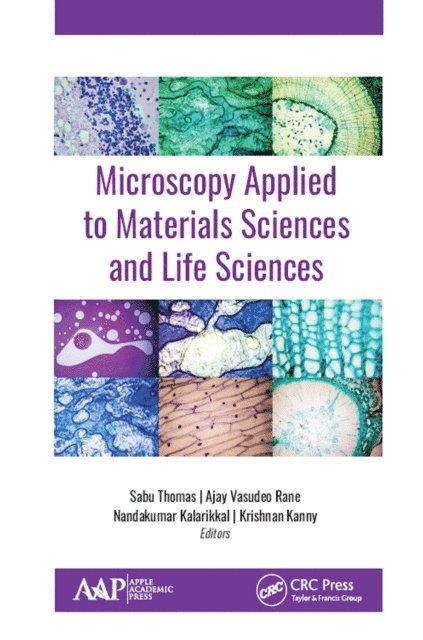
This new volume, Microscopy Applied to Materials Sciences and Life Sciences. focuses on recent theoretical and practical advances in polymers and their blends, composites, and nanocompos¬ites related to their microscopic characterization. It highlights recent accomplishments and trends in the field of polymer nanocomposites and filled polymers related to microstructural characterization. This book gives an insight and better understanding into the development in microscopy as a tool for characterization.
The book emphasizes recent research work in the field of microscopy in life sciences and materials sciences mainly related to its synthesis, characterizations, and applications. The book explains the application of microscopic techniques in life sciences and materials sciences, and their applications and state of current research carried out.
The book aims to foster a better understanding of the properties of polymer composites by describing new techniques to measure microstructure property relationships and by utilizing techniques and expertise developed in the conventional filled polymer composites. Characterization techniques, particularly microstructural characterization, have proven to be extremely difficult because of the range of length-scales associated with these materials.
Topics include:
•Instrumentation and Techniques: advances in scanning probe microscopy, SEM, TEM, OM. 3D imaging and tomography, electron diffraction techniques and analytical microscopy, advances in sample preparation techniques in-situ microscopy, correlative microscopy in life and material sciences, low voltage electron microscopy.
•Life Sciences: Structure and imaging of biomolecules, live cell imaging, neurobiology, organelles and cellular dynamics, multi-disciplinary approaches for medical and biological sciences, microscopic application in plants, microorganism and environmental science, super resolution microscopy in biological sciences.
•Materials Sciences: materials for nanotechnology, metals alloys and inter-metallic, ceramics, composites, minerals and microscopy in cultural heritage, thin films, coatings, surfaces and interfaces, carbon based materials, polymers and soft materials and self-assembled materials, semiconductors and magnetic materials. Polymers and inorganic nanoparticles.
The volume will be of significant interest to scientists working on the basic issues surrounding polymers, nanocomposites, and nanoparticulate-filled polymers, as well as those working in industry on applied problems, such as processing. Because of the multidisciplinary nature of this research, the book will be valuable to chemists, materials scientists, physicists, chemical engineers, and processing specialists who are involved and interested in the future frontiers of blends.
2 337 kr
Läs direkt efter köp
This new volume, Microscopy Applied to Materials Sciences and Life Sciences. focuses on recent theoretical and practical advances in polymers and their blends, composites, and nanocompos¬ites related to their microscopic characterization. It highlights recent accomplishments and trends in the field of polymer nanocomposites and filled polymers related to microstructural characterization. This book gives an insight and better understanding into the development in microscopy as a tool for characterization.
The book emphasizes recent research work in the field of microscopy in life sciences and materials sciences mainly related to its synthesis, characterizations, and applications. The book explains the application of microscopic techniques in life sciences and materials sciences, and their applications and state of current research carried out.
The book aims to foster a better understanding of the properties of polymer composites by describing new techniques to measure microstructure property relationships and by utilizing techniques and expertise developed in the conventional filled polymer composites. Characterization techniques, particularly microstructural characterization, have proven to be extremely difficult because of the range of length-scales associated with these materials.
Topics include:
•Instrumentation and Techniques: advances in scanning probe microscopy, SEM, TEM, OM. 3D imaging and tomography, electron diffraction techniques and analytical microscopy, advances in sample preparation techniques in-situ microscopy, correlative microscopy in life and material sciences, low voltage electron microscopy.
•Life Sciences: Structure and imaging of biomolecules, live cell imaging, neurobiology, organelles and cellular dynamics, multi-disciplinary approaches for medical and biological sciences, microscopic application in plants, microorganism and environmental science, super resolution microscopy in biological sciences.
•Materials Sciences: materials for nanotechnology, metals alloys and inter-metallic, ceramics, composites, minerals and microscopy in cultural heritage, thin films, coatings, surfaces and interfaces, carbon based materials, polymers and soft materials and self-assembled materials, semiconductors and magnetic materials. Polymers and inorganic nanoparticles.
The volume will be of significant interest to scientists working on the basic issues surrounding polymers, nanocomposites, and nanoparticulate-filled polymers, as well as those working in industry on applied problems, such as processing. Because of the multidisciplinary nature of this research, the book will be valuable to chemists, materials scientists, physicists, chemical engineers, and processing specialists who are involved and interested in the future frontiers of blends.
1 959 kr
Skickas inom 5-8 vardagar
1 172 kr
Skickas inom 10-15 vardagar