Alan Swinbank – författare
Visar alla böcker från författaren Alan Swinbank. Handla med fri frakt och snabb leverans.
5 produkter
5 produkter
Ideas, Institutions, and Trade
The WTO and the Curious Role of EU Farm Policy in Trade Liberalization
E-bok
PDF, Engelska, 20091 185 kr
Läs direkt efter köp
Agriculture has a small, and declining, importance in employment and income generation within the EU, but a political importance well beyond its economic impact. The EU''s common agricultural policy (CAP) has often been the source of conflict between the EU and its trade partners within first the GATT, and then the WTO. In the Doha Round agriculture was again a sticking point, resulting in setbacks and delays. The position of the EU is pivotal. Due to thecomparatively limited competitiveness of the EU''s agricultural sector, and the EU''s institutionally constrained ability to undertake CAP reform, the CAP sets limits for agricultural trade liberalization blocking progress across the full compass of the WTO agenda. Therefore, the farm trade negotiation, with theCAP at its core, is the key to understanding the dynamics of trade rounds in the WTO. The book, written by a political scientist and an agricultural economist, applies theory on ideas to explain how the agricultural sector came to be included in the Single Undertaking that resulted in the Uruguay Round agreements, and how this led to a dynamic interplay between CAP reform and the possibility of further agricultural trade liberalization within the WTO, thereby providing useful insights intointernational trade relations.
Ideas, Institutions, and Trade
The WTO and the Curious Role of EU Farm Policy in Trade Liberalization
Inbunden, Engelska, 2009
1 294 kr
Skickas inom 5-8 vardagar
Agriculture has a small, and declining, importance in employment and income generation within the EU, but a political importance well beyond its economic impact. The EU's common agricultural policy (CAP) has often been the source of conflict between the EU and its trade partners within first the GATT, and then the WTO. In the Doha Round agriculture was again a sticking point, resulting in setbacks and delays. The position of the EU is pivotal. Due to the comparatively limited competitiveness of the EU's agricultural sector, and the EU's institutionally constrained ability to undertake CAP reform, the CAP sets limits for agricultural trade liberalization blocking progress across the full compass of the WTO agenda. Therefore, the farm trade negotiation, with the CAP at its core, is the key to understanding the dynamics of trade rounds in the WTO. The book, written by a political scientist and an agricultural economist, applies theory on ideas to explain how the agricultural sector came to be included in the Single Undertaking that resulted in the Uruguay Round agreements, and how this led to a dynamic interplay between CAP reform and the possibility of further agricultural trade liberalization within the WTO, thereby providing useful insights into international trade relations.
Inbunden, Engelska, 2011
1 269 kr
Skickas inom 5-8 vardagar
An Inside View of the CAP Reform Process is about EU decision-making, in particular for the EU's Common Agricultural Policy (CAP). From its formation in the 1960s through to 1992 the CAP was almost immune to change; but from 1992 a series of major reforms took place. Many authors have asked why and how this change came about, including academics writing from political economy and political science traditions, and EU officials themselves. With the benefit of Arlindo Cunha's intimate insider's knowledge, this book delves into the mysteries of the policy making process by assessing the MacSharry, Agenda 2000, and Fischler reforms, explaining how, and why, CAP reform became part of the political agenda, and the decisions that were taken. It focuses in particular on the role of the Commission and the Commissioner for Agriculture, the Council of Ministers and its Presidency, and the European Parliament. It adopts a heuristic political economy approach, drawing upon the economics and political science literatures as appropriate. The MacSharry reform was much influenced by the Uruguay Round of GATT negotiations, and the 2003 Fischler reform by the Doha Round of WTO negotiations. A Delphi survey of key decision-makers, assessing their perception of the drivers of policy reform, and an analysis of subsequent CAP reform, including the Health Check in 2008 and preparations for the post-2013 CAP review, round-off the discussion. The former EU Commissioner for Agriculture and Rural Development, Franz Fischler, contributes a Foreword.
E-bok
Engelska, 20251 212 kr
Läs direkt efter köp
One of the most complex parts of the Uruguay Round of GATT negotiations was the agricultural dossier. The European Communities' Common Agricultural Policy (CAP) and EC-U.S. relations posed many of the difficult issues. Alan Swinbank and Carolyn Tanner give a compact, clear description and interpretation of the negotiations and the issues.This Thames Essay reviews the history of agriculture in the GATT through the previous rounds of negotiation, provides a succinct overview of the present state of world agriculture, and summarizes the history and present state of the CAP. The next three chapters chart the stages by which the Uruguay Round moved to agreement and simultaneous evolution of the CAP. A thorough description of the agricultural elements in the last Uruguay Round agreement precedes a final chapter looking forward to the desirable features of future world agricultural trade agreements.This will be a valuable source of information for agricultural economists, international trade economists working in governments, international organizations, financial institutions, and universities.
Inbunden, Engelska, 2004
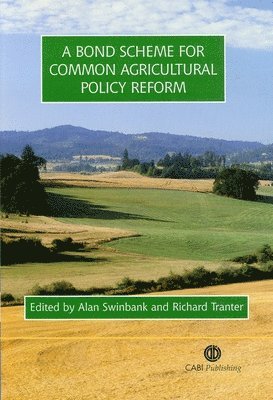
1 141 kr
Skickas inom 11-20 vardagar
The Common Agricultural Policy (CAP) is at an impasse. While it is said that existing policies are not tenable, all recent reform plans have been condemned as unacceptable. However, a “bond scheme”, as part of reform that pays more attention to society’s aspirations for the environment and rural development, offers a way forward. This book demystifies the bond scheme proposal and explores concerns expressed by farmers and policy makers. Written by economists, a political scientist and a practising politician, it offers rare insights into EU farm policy.