Ana Teresa Ribeiro – författare
Visar alla böcker från författaren Ana Teresa Ribeiro. Handla med fri frakt och snabb leverans.
6 produkter
6 produkter
Inbunden, Engelska, 2025
2 036 kr
Skickas inom 10-15 vardagar
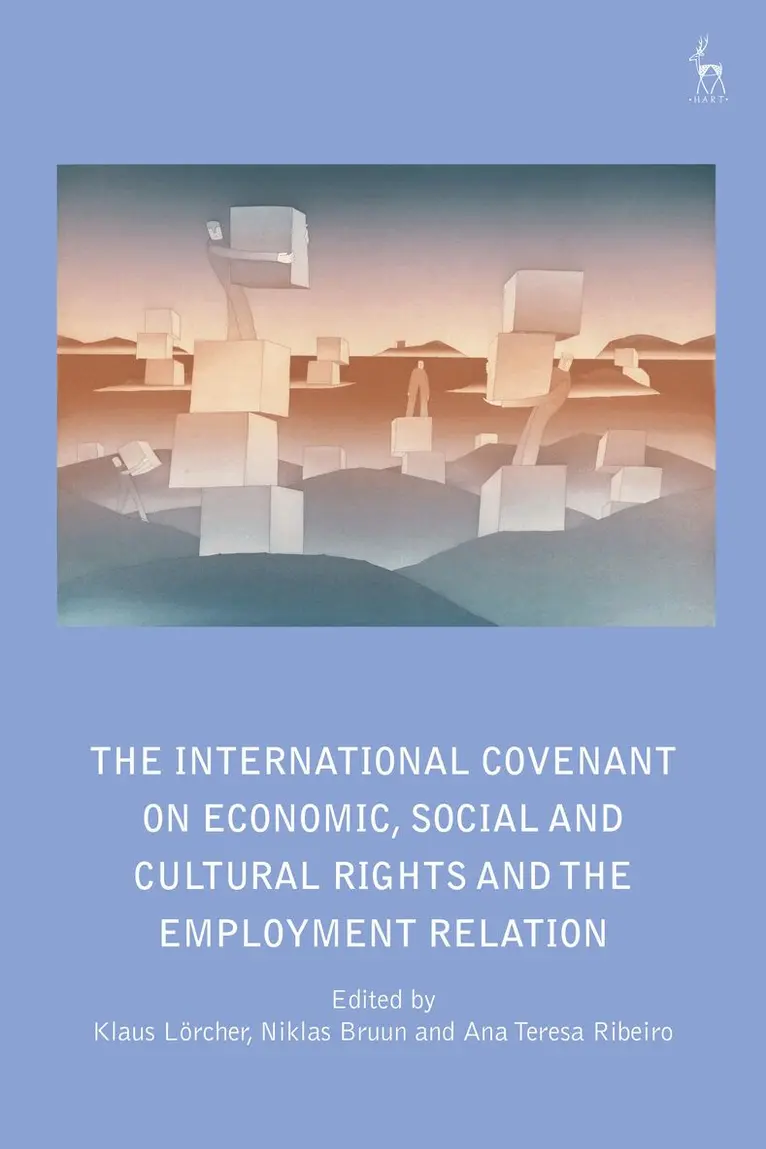
This book is the first comprehensive academic treatment of the International Covenant on Economic, Social and Cultural Rights (ICESCR) and employment rights, which has a global vocation demonstrated by having been ratified by 173 States since it was adopted in 1966.Workers’ rights need protection and reinforcement. To achieve this aim, international human rights standards can play an important role. The ICESCR is the most important global UN instrument in this respect. It covers a wide range of employment rights, including the right to strike, and has global application. But it is not sufficiently developed and used, and national implementation often needs improvement.Part 1 of the book analyses general issues related to the Covenant, such as context, development, challenges, influences at the global and regional levels, interpretation and procedural elements. Part 2 deals with the specific provisions which are directly linked to the employment relation. The book is based on a thorough analysis, mainly, but not exclusively, of the case law of the Committee on Economic, Social and Cultural Rights (CESCR), that is monitoring the national implementation of the Covenant. Together, the chapters in this book will empower academics and practitioners in labour law to find answers to relevant and practical problems in order to better enforce and improve workers’ rights.The book is the result of a project by the ‘Transnational Trade Union Rights’ experts Network (TTUR), linked to the European Trade Union Institute (ETUI).
E-bok
Engelska, 20251 896 kr
Läs direkt efter köp
This book is the first comprehensive academic treatment of the International Covenant on Economic, Social and Cultural Rights (ICESCR) and employment rights, which has a global vocation demonstrated by having been ratified by 173 States since it was adopted in 1966.Workers' rights need protection and reinforcement. To achieve this aim, international human rights standards can play an important role. The ICESCR is the most important global UN instrument in this respect. It covers a wide range of employment rights, including the right to strike, and has global application. But it is not sufficiently developed and used, and national implementation often needs improvement.Part 1 of the book analyses general issues related to the Covenant, such as context, development, challenges, influences at the global and regional levels, interpretation and procedural elements. Part 2 deals with the specific provisions which are directly linked to the employment relation. The book is based on a thorough analysis, mainly, but not exclusively, of the case law of the Committee on Economic, Social and Cultural Rights (CESCR), that is monitoring the national implementation of the Covenant. Together, the chapters in this book will empower academics and practitioners in labour law to find answers to relevant and practical problems in order to better enforce and improve workers' rights.The book is the result of a project by the 'Transnational Trade Union Rights' experts Network (TTUR), linked to the European Trade Union Institute (ETUI).
E-bok
PDF, Engelska, 20251 896 kr
Läs direkt efter köp
This book is the first comprehensive academic treatment of the International Covenant on Economic, Social and Cultural Rights (ICESCR) and employment rights, which has a global vocation demonstrated by having been ratified by 173 States since it was adopted in 1966.Workers' rights need protection and reinforcement. To achieve this aim, international human rights standards can play an important role. The ICESCR is the most important global UN instrument in this respect. It covers a wide range of employment rights, including the right to strike, and has global application. But it is not sufficiently developed and used, and national implementation often needs improvement.Part 1 of the book analyses general issues related to the Covenant, such as context, development, challenges, influences at the global and regional levels, interpretation and procedural elements. Part 2 deals with the specific provisions which are directly linked to the employment relation. The book is based on a thorough analysis, mainly, but not exclusively, of the case law of the Committee on Economic, Social and Cultural Rights (CESCR), that is monitoring the national implementation of the Covenant. Together, the chapters in this book will empower academics and practitioners in labour law to find answers to relevant and practical problems in order to better enforce and improve workers' rights.The book is the result of a project by the 'Transnational Trade Union Rights' experts Network (TTUR), linked to the European Trade Union Institute (ETUI).
Häftad, Engelska, 2027
976 kr
Kommande
This book is the first comprehensive academic treatment of the International Covenant on Economic, Social and Cultural Rights (ICESCR) and employment rights, which has a global vocation demonstrated by having been ratified by 173 States since it was adopted in 1966.Workers’ rights need protection and reinforcement. To achieve this aim, international human rights standards can play an important role. The ICESCR is the most important global UN instrument in this respect. It covers a wide range of employment rights, including the right to strike, and has global application. But it is not sufficiently developed and used, and national implementation often needs improvement.Part 1 of the book analyses general issues related to the Covenant, such as context, development, challenges, influences at the global and regional levels, interpretation and procedural elements. Part 2 deals with the specific provisions which are directly linked to the employment relation. The book is based on a thorough analysis, mainly, but not exclusively, of the case law of the Committee on Economic, Social and Cultural Rights (CESCR), that is monitoring the national implementation of the Covenant. Together, the chapters in this book will empower academics and practitioners in labour law to find answers to relevant and practical problems in order to better enforce and improve workers’ rights.The book is the result of a project by the ‘Transnational Trade Union Rights’ experts Network (TTUR), linked to the European Trade Union Institute (ETUI).
Del 4 - European Social Charter, A Commentary
European Social Charter: A Commentary
Volume 4, Part II (Articles 20-31)
Inbunden, Engelska, 2025
1 855 kr
Skickas inom 3-6 vardagar
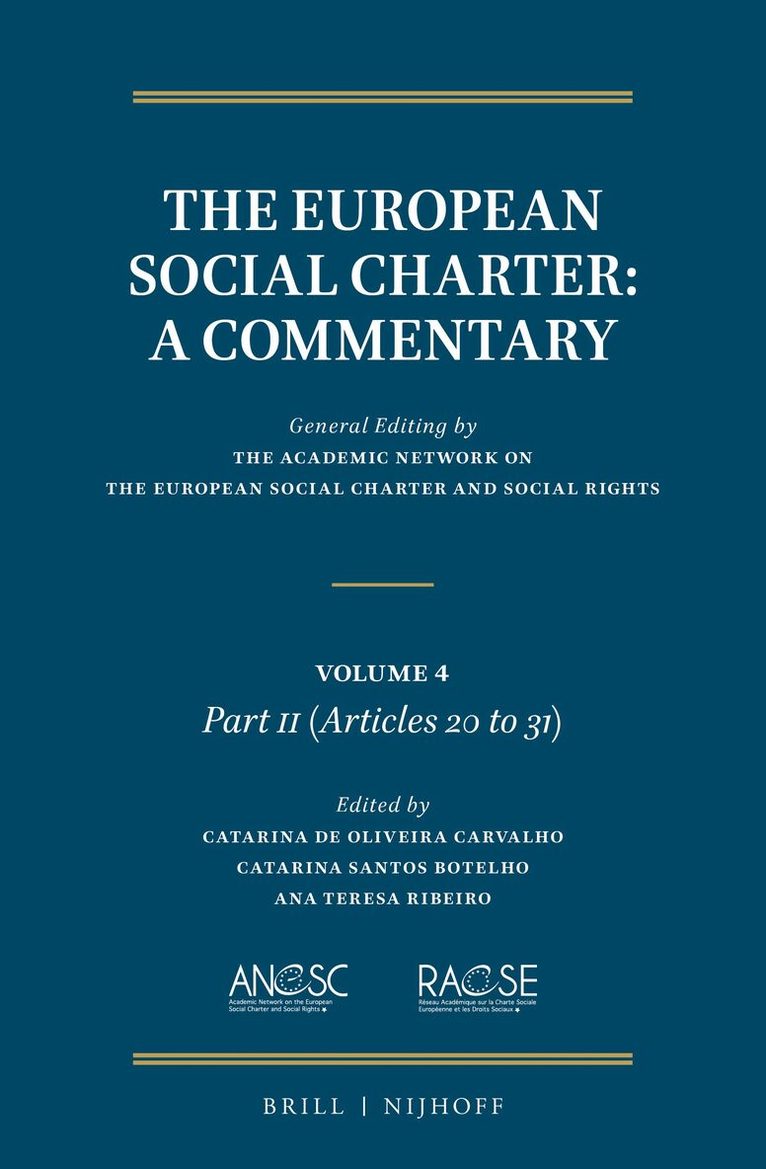
This authoritative commentary prepared by scholars from the Academic Network on the European Social Charter and Social Rights (ANESC) is intended for academic researchers studying social and economic rights in Europe and legal practitioners, civil society organisations, trade unions and state representatives engaging with the procedures of the European Committee of Social Rights. The text comprises contributions from a diverse group of experts, bringing together senior and young scholars from various countries and legal traditions, expertise in social and economic rights, coupled with a commitment to enhancing the European system for regulating these rights. The commentary consists of 106 chapters, organised into eight volumes on the substantive obligations of State Parties to the European Social Charter and the practice of the European Committee of Social Rights. Other chapters delve into the procedures that state representatives, international bodies and applicants must follow to engage with the Charter system.Volume 4 encompasses Articles 20 to 31, which enshrine several rights of workers, of the elderly, the right to housing, as well as the right to protection against poverty and social exclusion. In this commentary, these provisions are tackled not only through doctrinal lenses, but also taking into account the jurisprudence of the European Committee of Social Rights and other international standards.
E-bok
PDF, Engelska, 20251 758 kr
Läs direkt efter köp
This authoritative commentary prepared by scholars from the Academic Network on the European Social Charter and Social Rights (ANESC) is intended for academic researchers studying social and economic rights in Europe and legal practitioners, civil society organisations, trade unions and state representatives engaging with the procedures of the European Committee of Social Rights. The text comprises contributions from a diverse group of experts, bringing together senior and young scholars from various countries and legal traditions, expertise in social and economic rights, coupled with a commitment to enhancing the European system for regulating these rights. The commentary consists of 106 chapters, organised into eight volumes on the substantive obligations of State Parties to the European Social Charter and the practice of the European Committee of Social Rights. Other chapters delve into the procedures that state representatives, international bodies and applicants must follow to engage with the Charter system. Volume 4 encompasses Articles 20 to 31, which enshrine several rights of workers, of the elderly, the right to housing, as well as the right to protection against poverty and social exclusion. In this commentary, these provisions are tackled not only through doctrinal lenses, but also taking into account the jurisprudence of the European Committee of Social Rights and other international standards.