Andrew E Blechman – författare
Visar alla böcker från författaren Andrew E Blechman. Handla med fri frakt och snabb leverans.
2 produkter
2 produkter
Inbunden, Engelska, 2027
1 023 kr
Kommande
This primer is meant to be both an introduction and summary of many mathematical methods that are needed to solve problems in advanced undergraduate or early graduate physics courses. The material is presented through example to demonstrate how it would be useful in the context of solving physics problems, with minimal use of formalism or proof. Topics include linear algebra; vector and tensor analysis; geometric tools such as metrics and curvature; mathematical groups, with emphasis on representation theory and Lie groups/algebras; complex calculus; integral transforms and differential equations; and an introduction to algebraic topology. An appendix is also included that summarizes various mathematical results which are useful to have in one place. This book would be ideal as a study guide to help students through difficult courses. Alternatively, it could be used as a supplementary text in a mathematical physics course, or even as a stand-alone book in its own right.
Inbunden, Engelska, 2016
1 511 kr
Skickas inom 5-8 vardagar
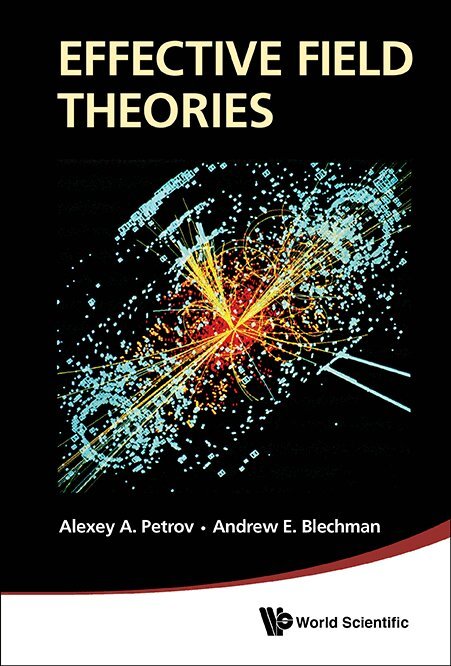
This book is a broad-based text intended to help the growing student body interested in constructing and applying methods of effective field theory to solve problems in their research. It begins with a review of using symmetries to identify the relevant degrees of freedom in a problem, and then presents a variety of methods that can be used to construct various effective theories. A detailed discussion of canonical applications of effective field theory techniques with increasing complexity is given, including Fermi's weak interaction, heavy-quark effective theory, and soft-collinear effective theory. Applications of these techniques to study physics beyond the standard model, dark matter, and quantum and classical gravity are explored. Although most examples come from questions in high-energy physics, many of the methods can also be applied in condensed-matter settings. Appendices include various factoids from group theory and other topics that are used throughout the text, in an attempt to make the book self-contained.