Branislav Kisacanin - Böcker
Visar alla böcker från författaren Branislav Kisacanin. Handla med fri frakt och snabb leverans.
11 produkter
11 produkter
1 064 kr
Skickas inom 10-15 vardagar
A gentle introduction to the highly sophisticated world of discrete mathematics, Mathematical Problems and Proofs presents topics ranging from elementary definitions and theorems to advanced topics -- such as cardinal numbers, generating functions, properties of Fibonacci numbers, and Euclidean algorithm. This excellent primer illustrates more than 150 solutions and proofs, thoroughly explained in clear language. The generous historical references and anecdotes interspersed throughout the text create interesting intermissions that will fuel readers' eagerness to inquire further about the topics and some of our greatest mathematicians. The author guides readers through the process of solving enigmatic proofs and problems, and assists them in making the transition from problem solving to theorem proving. At once a requisite text and an enjoyable read, Mathematical Problems and Proofs is an excellent entrée to discrete mathematics for advanced students interested in mathematics, engineering, and science.
2 311 kr
Skickas inom 10-15 vardagar
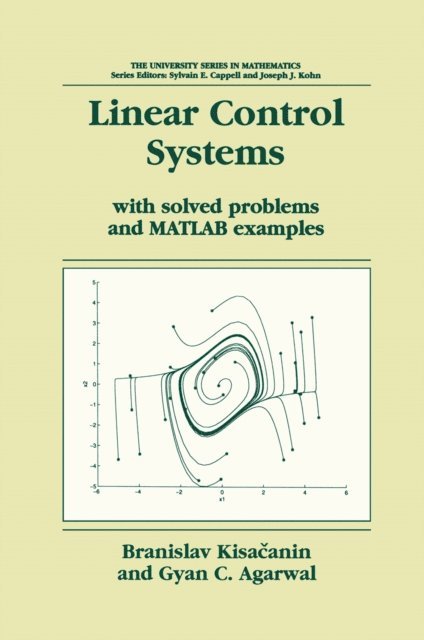
This work aims to be a gentle introduction to the methods of modern control theory and engineering, written at the level of a first-year graduate course. It contains: a historical overview of automatic control, from Ancient Greece to the 1970s, when this discipline matured into an essential field for electrical, mechanical, aerospace, chemical, and biomedical engineers, as well as mathematicians, and more recently, computer scientists; a balanced presentation of the relevant theory: the main state-space methods for description, analysis, and design of linear control systems are derived, without overwhelming theoretical arguments; over 250 solved and exercise problems for both continuous- and discrete-time systems, often including MATLAB simulations; and appendixes on MATLAB, advanced matrix theory, and the history of mathematical tools such as differential calculus, transform methods, and linear algebra.Another noteworthy feature is the frequent use of an inverted pendulum on a cart to illustrate the most important concepts of automatic control, such as: linearization and discretization; stability, controllability, and observability; state feedback, controller design, and optimal control; and observer design, reduced order observers, and Kalman filtering. Most of the problems are given with solutions or MATLAB simulations. All MATLAB programs from the book are available on the enclosed CD.
1 625 kr
Skickas inom 10-15 vardagar
200Ts Vision of Vision One of my formative childhood experiences was in 1968 stepping into the Uptown Theater on Connecticut Avenue in Washington, DC, one of the few movie theaters nationwide that projected in large-screen cinerama. I was there at the urging of a friend, who said I simply must see the remarkable film whose run had started the previous week. "You won't understand it," he said, "but that doesn't matter. " All I knew was that the film was about science fiction and had great special eflPects. So I sat in the front row of the balcony, munched my popcorn, sat back, and experienced what was widely touted as "the ultimate trip:" 2001: A Space Odyssey. My friend was right: I didn't understand it. . . but in some senses that didn't matter. (Even today, after seeing the film 40 times, I continue to discover its many subtle secrets. ) I just had the sense that I had experienced a creation of the highest aesthetic order: unique, fresh, awe inspiring. Here was a film so distinctive that the first half hour had no words whatsoever; the last half hour had no words either; and nearly all the words in between were banal and irrelevant to the plot - quips about security through Voiceprint identification, how to make a phonecall from a space station, government pension plans, and so on.
1 625 kr
Skickas inom 10-15 vardagar
The need for natural and effective Human-Computer Interaction (HCI) is increasingly important due to the prevalence of computers in human activities. Computer vision and pattern recognition continue to play a dominant role in the HCI realm. However, computer vision methods often fail to become pervasive in the field due to the lack of real-time, robust algorithms, and novel and convincing applications. This state-of-the-art contributed volume is comprised of articles by prominent experts in computer vision, pattern recognition and HCI. It is the first published text to capture the latest research in this rapidly advancing field with exclusive focus on real-time algorithms and practical applications in diverse and numerous industries, and it outlines further challenges in these areas. Real-Time Vision for Human-Computer Interaction is an invaluable reference for HCI researchers in both academia and industry, and a useful supplement for advanced-level courses in HCI and Computer Vision.
2 311 kr
Skickas inom 10-15 vardagar
Anyone seeking a gentle introduction to the methods of modern control theory and engineering, written at the level of a first-year graduate course, should consider this book seriously. It contains: A generous historical overview of automatic control, from Ancient Greece to the 1970s, when this discipline matured into an essential field for electrical, mechanical, aerospace, chemical, and biomedical engineers, as well as mathematicians, and more recently, computer scientists; A balanced presentation of the relevant theory: the main state-space methods for description, analysis, and design of linear control systems are derived, without overwhelming theoretical arguments; Over 250 solved and exercise problems for both continuous- and discrete-time systems, often including MATLAB simulations; and Appendixes on MATLAB, advanced matrix theory, and the history of mathematical tools such as differential calculus, transform methods, and linear algebra. Another noteworthy feature is the frequent use of an inverted pendulum on a cart to illustrate the most important concepts of automatic control, such as: Linearization and discretization; Stability, controllability, and observability; State feedback, controller design, and optimal control; and Observer design, reduced order observers, and Kalman filtering. Most of the problems are given with solutions or MATLAB simulations. Whether the book is used as a textbook or as a self-study guide, the knowledge gained from it will be an excellent platform for students and practising engineers to explore further the recent developments and applications of control theory.
1 064 kr
Skickas inom 10-15 vardagar
A gentle introduction to the highly sophisticated world of discrete mathematics, Mathematical Problems and Proofs presents topics ranging from elementary definitions and theorems to advanced topics -- such as cardinal numbers, generating functions, properties of Fibonacci numbers, and Euclidean algorithm. This excellent primer illustrates more than 150 solutions and proofs, thoroughly explained in clear language. The generous historical references and anecdotes interspersed throughout the text create interesting intermissions that will fuel readers' eagerness to inquire further about the topics and some of our greatest mathematicians. The author guides readers through the process of solving enigmatic proofs and problems, and assists them in making the transition from problem solving to theorem proving. At once a requisite text and an enjoyable read, Mathematical Problems and Proofs is an excellent entrée to discrete mathematics for advanced students interested in mathematics, engineering, and science.
1 096 kr
Skickas inom 10-15 vardagar
Embedded Computer Vision, exemplified by the migration from powerful workstations to embedded processors in computer vision applications, is a new and emerging field that enables an associated shift in application development and implementation. This comprehensive volume brings together a wealth of experiences from leading researchers in the field of embedded computer vision, from both academic and industrial research centers, and covers a broad range of challenges and trade-offs brought about by this paradigm shift. Part I provides an exposition of basic issues and applications in the area necessary for understanding the present and future work. Part II offers chapters based on the most recent research and results. Finally, the last part looks ahead, providing a sense of what major applications could be expected in the near future, describing challenges in mobile environments, video analytics, and automotive safety applications.Features: / Discusses the latest state-of-the-art techniques in embedded computer vision / Presents a thorough introductory section on hardware and architectures, design methodologies, and video analytics to aid the reader's understanding through the following chapters / Offers emphasis on tackling important problems for society, safety, security, health, mobility, connectivity, and energy efficiency / Discusses evaluation of trade-offs required to design cost-effective systems for successful products / Explores the advantages of various architectures, development of high-level software frameworks and cost-effective algorithmic alternatives / Examines issues of implementation on fixed-point processors, presented through an example of an automotive safety application / Offers insights from leaders in the field on what future applications will be This book is a welcome collection of stand-alone articles, ideal for researchers, practitioners, and graduate students.It provides historical perspective, the latest research results, and a vision for future developments in the emerging field of embedded computer vision. Supplementary material can be found at http://www.embeddedvisioncentral.com.
1 096 kr
Skickas inom 10-15 vardagar
As a graduate student at Ohio State in the mid-1970s, I inherited a unique c- puter vision laboratory from the doctoral research of previous students. They had designed and built an early frame-grabber to deliver digitized color video from a (very large) electronic video camera on a tripod to a mini-computer (sic) with a (huge!) disk drive—about the size of four washing machines. They had also - signed a binary image array processor and programming language, complete with a user’s guide, to facilitate designing software for this one-of-a-kindprocessor. The overall system enabled programmable real-time image processing at video rate for many operations. I had the whole lab to myself. I designed software that detected an object in the eldofview,trackeditsmovementsinrealtime,anddisplayedarunningdescription of the events in English. For example: “An object has appeared in the upper right corner...Itismovingdownandtotheleft...Nowtheobjectisgettingcloser...The object moved out of sight to the left”—about like that. The algorithms were simple, relying on a suf cient image intensity difference to separate the object from the background (a plain wall). From computer vision papers I had read, I knew that vision in general imaging conditions is much more sophisticated. But it worked, it was great fun, and I was hooked.
1 096 kr
Skickas inom 10-15 vardagar
This illuminating collection offers a fresh look at the very latest advances in the field of embedded computer vision. Emerging areas covered by this comprehensive text/reference include the embedded realization of 3D vision technologies for a variety of applications, such as stereo cameras on mobile devices. Recent trends towards the development of small unmanned aerial vehicles (UAVs) with embedded image and video processing algorithms are also examined. Topics and features: discusses in detail three major success stories – the development of the optical mouse, vision for consumer robotics, and vision for automotive safety; reviews state-of-the-art research on embedded 3D vision, UAVs, automotive vision, mobile vision apps, and augmented reality; examines the potential of embedded computer vision in such cutting-edge areas as the Internet of Things, the mining of large data streams, and in computational sensing; describes historical successes, current implementations, and future challenges.
1 096 kr
Skickas inom 10-15 vardagar
This illuminating collection offers a fresh look at the very latest advances in the field of embedded computer vision. Emerging areas covered by this comprehensive text/reference include the embedded realization of 3D vision technologies for a variety of applications, such as stereo cameras on mobile devices. Recent trends towards the development of small unmanned aerial vehicles (UAVs) with embedded image and video processing algorithms are also examined. Topics and features: discusses in detail three major success stories – the development of the optical mouse, vision for consumer robotics, and vision for automotive safety; reviews state-of-the-art research on embedded 3D vision, UAVs, automotive vision, mobile vision apps, and augmented reality; examines the potential of embedded computer vision in such cutting-edge areas as the Internet of Things, the mining of large data streams, and in computational sensing; describes historical successes, current implementations, and future challenges.
Computer Vision in Human-Computer Interaction
ECCV 2006 Workshop on HCI, Graz, Austria, May 13, 2006, Proceedings
Häftad, Engelska, 2006
552 kr
Skickas inom 10-15 vardagar
The interests and goals of HCI (human–computer interaction) include understanding, designing, building, and evaluating complex interactive systems - involving many people and technologies. Developments in software and hardware technologies are continuously driving applications in supporting our collaborative and communicative needs as social beings, both at work and at play. At the same time, similar developments are pushing the human–computer interface beyond the desktop and into our pockets, streets, and buildings. Developments in mobile, wearable, and pervasive communications and computing technologies provide exciting challenges and opportunities for HCI. This volume presents the proceedings of the HCI 2006 Workshop, held in conjunction with ECCV 2006 (European Conference on Computer Vision) in Graz, Austria. The goal of this workshop was to bring together researchers from the field of computer vision whose work is related to human–computer interaction.The 11 papers presented in this volume were carefully reviewed and selected from 27 submissions. They address a wide range of theoretical and application issues in human–computer interaction. There were four thematic sessions named: face analysis; gesture and emotion recognition; event detection; and applications.