Bryan Sullivan – författare
639 kr
Läs direkt efter köp
Security Smarts for the Self-Guided IT Professional
“Get to know the hackers—or plan on getting hacked. Sullivan and Liu have created a savvy, essentials-based approach to web app security packed with immediately applicable tools for any information security practitioner sharpening his or her tools or just starting out.”—Ryan McGeehan, Security Manager, Facebook, Inc.
Secure web applications from today''s most devious hackers. Web Application Security: A Beginner''s Guide helps you stock your security toolkit, prevent common hacks, and defend quickly against malicious attacks.
This practical resource includes chapters on authentication, authorization, and session management, along with browser, database, and file security--all supported by true stories from industry. You''ll also get best practices for vulnerability detection and secure development, as well as a chapter that covers essential security fundamentals. This book''s templates, checklists, and examples are designed to help you get started right away.
Web Application Security: A Beginner''s Guide features:
Lingo--Common security terms defined so that you''re in the know on the jobIMHO--Frank and relevant opinions based on the authors'' years of industry experienceBudget Note--Tips for getting security technologies and processes into your organization''s budgetIn Actual Practice--Exceptions to the rules of security explained in real-world contextsYour Plan--Customizable checklists you can use on the job nowInto Action--Tips on how, why, and when to apply new skills and techniques at work625 kr
Skickas inom 3-6 vardagar
Publisher's Note: Products purchased from Third Party sellers are not guaranteed by the publisher for quality, authenticity, or access to any online entitlements included with the product.
Security Smarts for the Self-Guided IT Professional
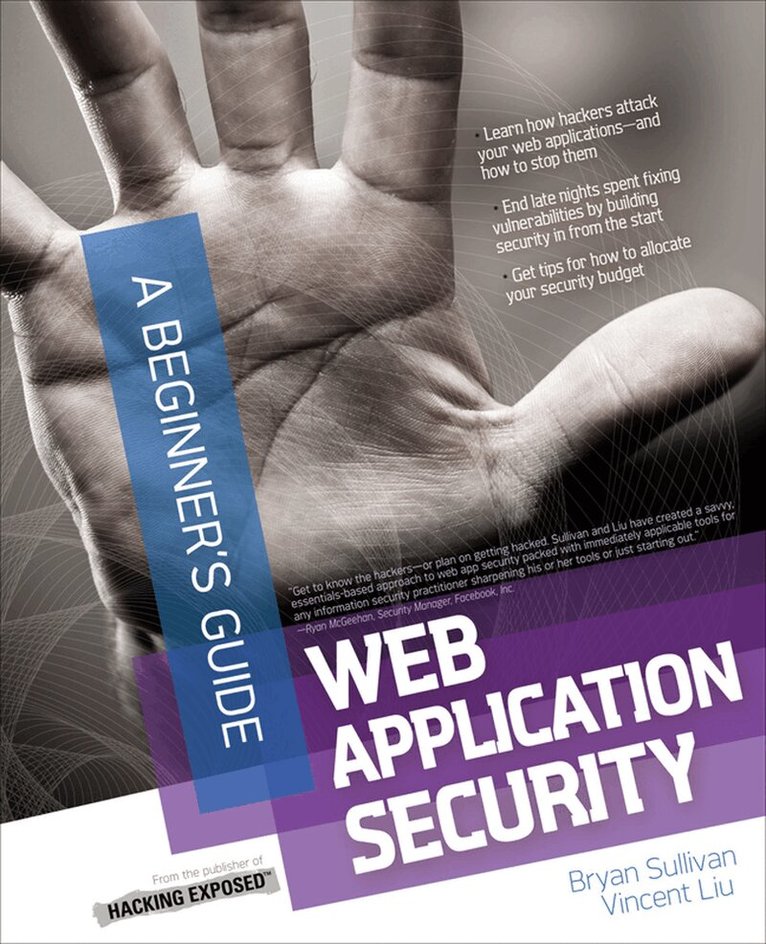
“Get to know the hackers—or plan on getting hacked. Sullivan and Liu have created a savvy, essentials-based approach to web app security packed with immediately applicable tools for any information security practitioner sharpening his or her tools or just starting out.” —Ryan McGeehan, Security Manager, Facebook, Inc.
Secure web applications from today's most devious hackers. Web Application Security: A Beginner's Guide helps you stock your security toolkit, prevent common hacks, and defend quickly against malicious attacks.
This practical resource includes chapters on authentication, authorization, and session management, along with browser, database, and file security--all supported by true stories from industry. You'll also get best practices for vulnerability detection and secure development, as well as a chapter that covers essential security fundamentals. This book's templates, checklists, and examples are designed to help you get started right away.
Web Application Security: A Beginner's Guide features:
Lingo--Common security terms defined so that you're in the know on the jobIMHO--Frank and relevant opinions based on the authors' years of industry experienceBudget Note--Tips for getting security technologies and processes into your organization's budgetIn Actual Practice--Exceptions to the rules of security explained in real-world contextsYour Plan--Customizable checklists you can use on the job nowInto Action--Tips on how, why, and when to apply new skills and techniques at work575 kr
Läs direkt efter köp
The Hands-On, Practical Guide to Preventing Ajax-Related Security Vulnerabilities
More and more Web sites are being rewritten as Ajax applications; even traditional desktop software is rapidly moving to the Web via Ajax. But, all too often, this transition is being made with reckless disregard for security. If Ajax applications aren’t designed and coded properly, they can be susceptible to far more dangerous security vulnerabilities than conventional Web or desktop software. Ajax developers desperately need guidance on securing their applications: knowledge that’s been virtually impossible to find, until now.
Ajax Security systematically debunks today’s most dangerous myths about Ajax security, illustrating key points with detailed case studies of actual exploited Ajax vulnerabilities, ranging from MySpace’s Samy worm to MacWorld’s conference code validator. Even more important, it delivers specific, up-to-the-minute recommendations for securing Ajax applications in each major Web programming language and environment, including .NET, Java, PHP, and even Ruby on Rails. You’ll learn how to:
· Mitigate unique risks associated with Ajax, including overly granular Web services, application control flow tampering, and manipulation of program logic
· Write new Ajax code more safely—and identify and fix flaws in existing code
· Prevent emerging Ajax-specific attacks, including JavaScript hijacking and persistent storage theft
· Avoid attacks based on XSS and SQL Injection—including a dangerous SQL Injection variant that can extract an entire backend database with just two requests
· Leverage security built into Ajax frameworks like Prototype, Dojo, and ASP.NET AJAX Extensions—and recognize what you still must implement on your own
· Create more secure “mashup” applications
Ajax Security will be an indispensable resource for developers coding or maintaining Ajax applications; architects and development managers planning or designing new Ajax software, and all software security professionals, from QA specialists to penetration testers.