Carolyn Collins Petersen - Böcker
Visar alla böcker från författaren Carolyn Collins Petersen. Handla med fri frakt och snabb leverans.
6 produkter
6 produkter
800 kr
Skickas inom 7-10 vardagar
This spectacularly illustrated book is a comprehensive exploration of astronomy through the eyes of the world's observatories and spacecraft missions. Featuring the latest and most stunning images, it provides a magnificent portrayal of the beauty of the cosmos. The accompanying text is an accessible guide to the science behind the wonders, with clear explanations of all the major themes in astronomy. An essential guide to understanding and appreciating the Universe, Visions of the Cosmos builds on the success of the authors' previous book, Hubble Vision, which became an international best-seller and won world-wide acclaim.
Astronomy 101
From the Sun and Moon to Wormholes and Warp Drive, Key Theories, Discoveries, and Facts about the Universe
Inbunden, Engelska, 2013
146 kr
Tillfälligt slut
Explore the curiosities of our galaxy with this comprehensive, digestible guide to astronomy!Too often, textbooks obscure the beauty and wonder of outer space with tedious discourse that even Galileo would oppose. Astronomy 101 cuts out the boring details and lengthy explanations, and instead, gives you a lesson in astronomy that keeps you engaged as you discover what's hidden beyond our starry sky. From the Big Bang and nebulae to the Milky Way and Sir Isaac Newton, this celestial primer is packed with hundreds of entertaining astronomy facts, charts, and photographs you won't be able to get anywhere else. So whether you’re looking to unravel the mystery behind black holes, or just want to learn more about your favorite planets, Astronomy 101 has all the answers—even the ones you didn’t know you were looking for.
214 kr
Tillfälligt slut
Humanity has always looked to the stars, but it hasn’t been until relatively recently that we have managed to travel into space. Carolyn Collins Petersen takes us on a journey from the first space pioneers and their work, through the First World Warled technological advances in rocketry that formed the basis for the Space Age, to the increasing corporate interest in space. This detailed examination of our steps into space is viewed from our potential future there – on Mars to be exact – and considers how we will reach that point.The author concludes with our current advances and our immediate ambitions in space exploration. The future and its scientific possibilities are enthralling: who will be the first to step on Mars? Will matter/antimatter annihilations take us to the Kuiper Belt, or will it be ion propulsion? What is the Alcubierre Warp Drive? Will it take us to the stars?
214 kr
Skickas inom 11-20 vardagar
Like time machines, observatories reveal distant objects as they once existed, almost too far away to imagine. They are our portals to the universe, to let us understand how it began and how it works.This book charts the progress of astronomy through the observatories used throughout history, from the earliest such as Stonehenge to places like Birr Castle with its Leviathan telescope used by Herschel, places where the secrets of the universe were first unlocked by science. Carolyn Collins Petersen then describes instruments now in use around the planet. These technological marvels range from the Mauna Kea Observatories in Hawaii to the South Pole Telescope in Antarctica that hunts for the faint emission of the cosmic microwave background (CMB). In addition, astronomers today use an array of orbiting observatories - the most famous being Hubble of course - and launching in the near future will be the James Webb Space Telescope. Ground-based observatories can now attain near ‘Hubble’ standards of accuracy, despite peering into space through our atmosphere.Astronomers can now routinely look across the cosmos at objects that existed at nearly the beginning of time. They have studied distant Earth-type planets, delved into stellar birthplaces, examined the minutiae of stellar explosions and galaxy collisions, and searched out the signatures of chemical elements that form the basis of the planets and ourselves. The Discovery of the Universe looks at the amazing science that has been done using the world’s suite of observatories. It presents examples of astronomical discoveries made across the widest spectrum as observatories extend humanity’s vision across the depths of space and time.
107 kr
Skickas
Humanity has always looked to the stars, but it hasn’t been until relatively recently that we have managed to travel into space. Carolyn Collins Petersen takes us on a journey from the first space pioneers and their work, through the First World War-led technological advances in rocketry that formed the basis for the Space Age, to the increasing corporate interest in space. This detailed examination of our steps into space is viewed from our potential future there – on Mars to be exact – and considers how we will reach that point.The author concludes with our current advances and our immediate ambitions in space exploration. The future and its scientific possibilities are enthralling: who will be the first to step on Mars? Will matter/antimatter annihilations take us to the Kuiper Belt, or will it be ion propulsion? What is the Alcubierre Warp Drive? Will it take us to the stars?
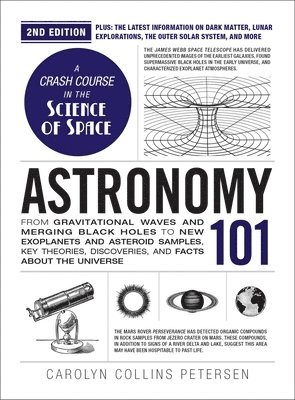
Astronomy 101, 2nd Edition
From Gravitational Waves and Merging Black Holes to New Exoplanets and Asteroid Samples, Key Theories, Discoveries, and Facts about the Universe
Inbunden, Engelska, 2026
138 kr
Kommande
Astronomy 101, 2nd Edition covers groundbreaking discoveries from the past decade—like the detection of gravitational waves, the imaging of black holes, and the James Webb Space Telescope’s revelations about early galaxies and exoplanet atmospheres. Part of the bestselling Adams 101 series, this fully updated edition with brand-new entries takes you on an entertaining and educational journey throughout the universe.Have you ever looked up at the night sky and wondered what’s really out there—or how we’ve come to understand so much about a universe so vast? Whether you're a lifelong stargazer or newly space-curious, Astronomy 101, 2nd Edition delivers a clear, engaging guide to the cosmos—now fully updated to include the most exciting discoveries of the 21st century. This expanded edition brings you the latest breakthroughs in modern astronomy, from the detection of gravitational waves and the imaging of black holes, to the extraordinary revelations of the James Webb Space Telescope. Learn how scientists are uncovering the atmospheres of distant exoplanets, mapping invisible dark matter, and rewriting our understanding of the early universe. Explore new space missions like Artemis, Europa Clipper, and OSIRIS-REx, and what they reveal about our own solar system’s origins—and its potential to harbor life. This book covers everything from stellar evolution and galaxy formation to the tools astronomers use and the questions we still can’t answer. Perfect for beginners, amateur astronomers, students, or anyone who wants to catch up on where space science is heading, Astronomy 101, 2nd Edition is your essential introduction to the universe—bigger, deeper, and more mysterious than ever before. Let the journey begin!