César Camacho – författare
Visar alla böcker från författaren César Camacho. Handla med fri frakt och snabb leverans.
5 produkter
5 produkter
Inbunden, Engelska, 1984
1 730 kr
Skickas inom 10-15 vardagar
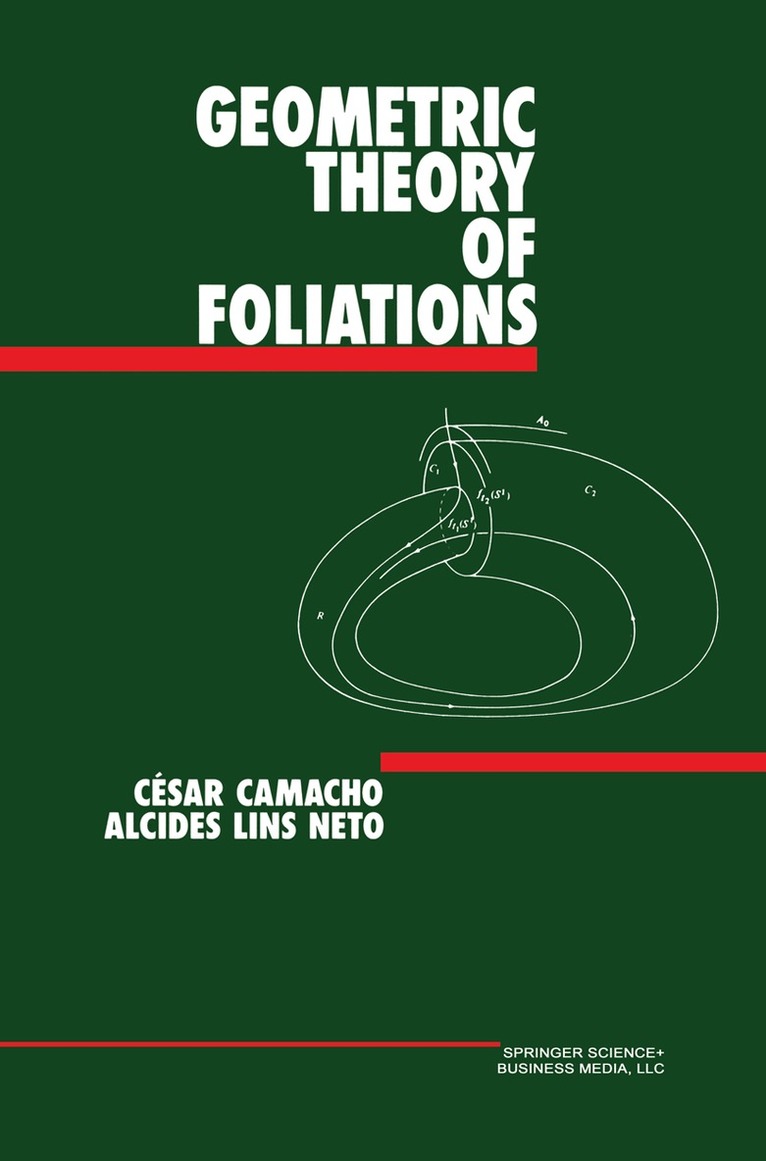
Intuitively, a foliation corresponds to a decomposition of a manifold into a union of connected, disjoint submanifolds of the same dimension, called leaves, which pile up locally like pages of a book. The theory of foliations, as it is known, began with the work of C. Ehresmann and G. Reeb, in the 1940's; however, as Reeb has himself observed, already in the last century P. Painleve saw the necessity of creating a geometric theory (of foliations) in order to better understand the problems in the study of solutions of holomorphic differential equations in the complex field. The development of the theory of foliations was however provoked by the following question about the topology of manifolds proposed by H. Hopf in the 3 1930's: "Does there exist on the Euclidean sphere S a completely integrable vector field, that is, a field X such that X· curl X • 0?" By Frobenius' theorem, this question is equivalent to the following: "Does there exist on the 3 sphere S a two-dimensional foliation?" This question was answered affirmatively by Reeb in his thesis, where he 3 presents an example of a foliation of S with the following characteristics: There exists one compact leaf homeomorphic to the two-dimensional torus, while the other leaves are homeomorphic to two-dimensional planes which accu mulate asymptotically on the compact leaf. Further, the foliation is C"".
E-bok
PDF, Engelska, 20132 130 kr
Läs direkt efter köp
Intuitively, a foliation corresponds to a decomposition of a manifold into a union of connected, disjoint submanifolds of the same dimension, called leaves, which pile up locally like pages of a book. The theory of foliations, as it is known, began with the work of C. Ehresmann and G. Reeb, in the 1940''s; however, as Reeb has himself observed, already in the last century P. Painleve saw the necessity of creating a geometric theory (of foliations) in order to better understand the problems in the study of solutions of holomorphic differential equations in the complex field. The development of the theory of foliations was however provoked by the following question about the topology of manifolds proposed by H. Hopf in the 3 1930''s: "Does there exist on the Euclidean sphere S a completely integrable vector field, that is, a field X such that X· curl X • 0?" By Frobenius'' theorem, this question is equivalent to the following: "Does there exist on the 3 sphere S a two-dimensional foliation?" This question was answered affirmatively by Reeb in his thesis, where he 3 presents an example of a foliation of S with the following characteristics: There exists one compact leaf homeomorphic to the two-dimensional torus, while the other leaves are homeomorphic to two-dimensional planes which accu mulate asymptotically on the compact leaf. Further, the foliation is C"".
Häftad, Engelska, 2013
1 730 kr
Skickas inom 10-15 vardagar
Intuitively, a foliation corresponds to a decomposition of a manifold into a union of connected, disjoint submanifolds of the same dimension, called leaves, which pile up locally like pages of a book. The theory of foliations, as it is known, began with the work of C. Ehresmann and G. Reeb, in the 1940's; however, as Reeb has himself observed, already in the last century P. Painleve saw the necessity of creating a geometric theory (of foliations) in order to better understand the problems in the study of solutions of holomorphic differential equations in the complex field. The development of the theory of foliations was however provoked by the following question about the topology of manifolds proposed by H. Hopf in the 3 1930's: "Does there exist on the Euclidean sphere S a completely integrable vector field, that is, a field X such that X· curl X • 0?" By Frobenius' theorem, this question is equivalent to the following: "Does there exist on the 3 sphere S a two-dimensional foliation?" This question was answered affirmatively by Reeb in his thesis, where he 3 presents an example of a foliation of S with the following characteristics: There exists one compact leaf homeomorphic to the two-dimensional torus, while the other leaves are homeomorphic to two-dimensional planes which accu mulate asymptotically on the compact leaf. Further, the foliation is C"".
Inbunden, Engelska, 2020
546 kr
Skickas inom 5-8 vardagar
This book contains all research papers published by the distinguished Brazilian mathematician Elon Lima. It includes the papers from his PhD thesis on homotopy theory, which are hard to find elsewhere. Elon Lima wrote more than 40 books in the field of topology and dynamical systems. He was a profound mathematician with a genuine vocation to teach and write mathematics.
E-bok
Spanska, 202246 kr
Läs direkt efter köp
En este libro, los autores destacan que México es una república representativa, democrática, laica y federal; dan énfasis en que la salvaguarda de la Constitución federal no es solamente obligación de la federación, sino que los estados cuentan igualmente con la obligación de protegerla y preservarla. Además, rescatan y subrayan algunas de las instituciones constitucionales de los estados y explican, a la luz del examen jurídico, la manera en que los textos fundamentales de los estados se han adaptado y anticipado, y cómo han aportado a la protección de los derechos humanos, la organización y el control de los poderes a lo largo de la historia constitucional de México.A partir del origen y análisis del artículo 133 constitucional y la explicación, hondura y trascendencia del federalismo como forma de estado, los autores revelan al lector el nacimiento de las constituciones de las entidades federativas, los sistemas de protección de los derechos humanos, los controles constitucionales locales, sin dejar de lado la institución municipal en el constitucionalismo estatal. A través de una minuciosa explicación jurídica exponen los pormenores constitucionales de los estados mexicanos en relación con la Constitución Federal, así como explicaciones en cada uno de los capítulos para ensanchar la perspectiva sobre el constitucionalismo de las entidades federativas de cara al siglo XXI, de la transición de un federalismo originario a uno de innovaciones normativas en el ámbito del régimen interior de los estados, basado en un control interno de la constitucionalidad. La obra es a un tiempo, repaso y prospectiva de una de las decisiones políticas fundamentales, su evolución y potencial: el tan arraigado federalismo y su esperanzador horizonte. El objetivo de la obra es recuperar las instituciones constitucionales de los estados, frente a la unificación y estandarización de conceptos que la Constitución federal ha propiciado, sobre todo, porque las entidades federativas tienen mucho que decir y aportar sobre los derechos humanos y la organización de poderes que se han dado en el marco de su autonomía.