• Fri frakt över 249 kr
  • •
  • Snabba leveranser
  • •
  • Billiga böcker
Kundservice

Du är på sajten för privatpersoner.

Företag, bibliotek eller offentlig verksamhet?

Du handlar på classic.bokus.com, där alla dina funktioner finns intakta.
Till classic.bokus.com
Bokus logotyp. Gå till startsidan.
  • Erbjudanden
  • Nyheter
  • Student
  • Topplistor
  • Barn & ungdom
  • Bokus Play
  • E-böcker
  • Pocketböcker
  • Spel & pussel

10% rabatt på allt med kod: NYSTART10 →

Sidfot

Mina sidor

    Hjälp

    • Kundservice
    • Vanliga frågor och svar
    • Frakt och leverans
    • Retur vid ångerrätt
    • Reklamera vara
    • Betalning
    • Köpvillkor
    • Allmänna villkor
    • Information om webbplatsens tillgänglighet

    Om Bokus

    • Om oss
    • Pressrum
    • För studenter
    • För företag
    • För bibliotek och offentlig verksamhet
    • För leverantörer
    • Hållbarhet

    Populärt

    • Aktuella erbjudanden
    • Presentkort
    • Studentlitteratur
    • Nya böcker
    • Topplistor
    • Signerade böcker
    • Engelska böcker

    Inspiration

    • Boktips
    • BookTok
    • Populära bokserier
    • Barnbokskaraktärer
    • Populära författare
    Logotyp för Bokus
    Följ oss på Facebook (extern länk)Följ oss på Instagram (extern länk)Följ oss på YouTube (extern länk)Följ oss på TikTok (extern länk)
    bokus @ CookiesAnpassa cookiesIntegritetspolicyKöpvillkor
    Till Citymail hemsida (extern länk)Till Budbee hemsida (extern länk)Till Postnord hemsida (extern länk)Till Schenker hemsida (extern länk)Till Early Bird hemsida (extern länk)Till Walleys hemsida (extern länk)
    1. Naturvetenskap och teknik
    2. Matematik och naturvetenskap
    3. Matematik
    4. Topologi

    Geometric Theory of Foliations

    AvCésar Camacho,Alcides Lins Neto

    Inbunden, Engelska, 1984

    1 734 kr

    Beställningsvara. Skickas inom 10-15 vardagar. Fri frakt över 249 kr.

    Fler format och utgåvor

    Häftad

    1 734 kr

    Beskrivning

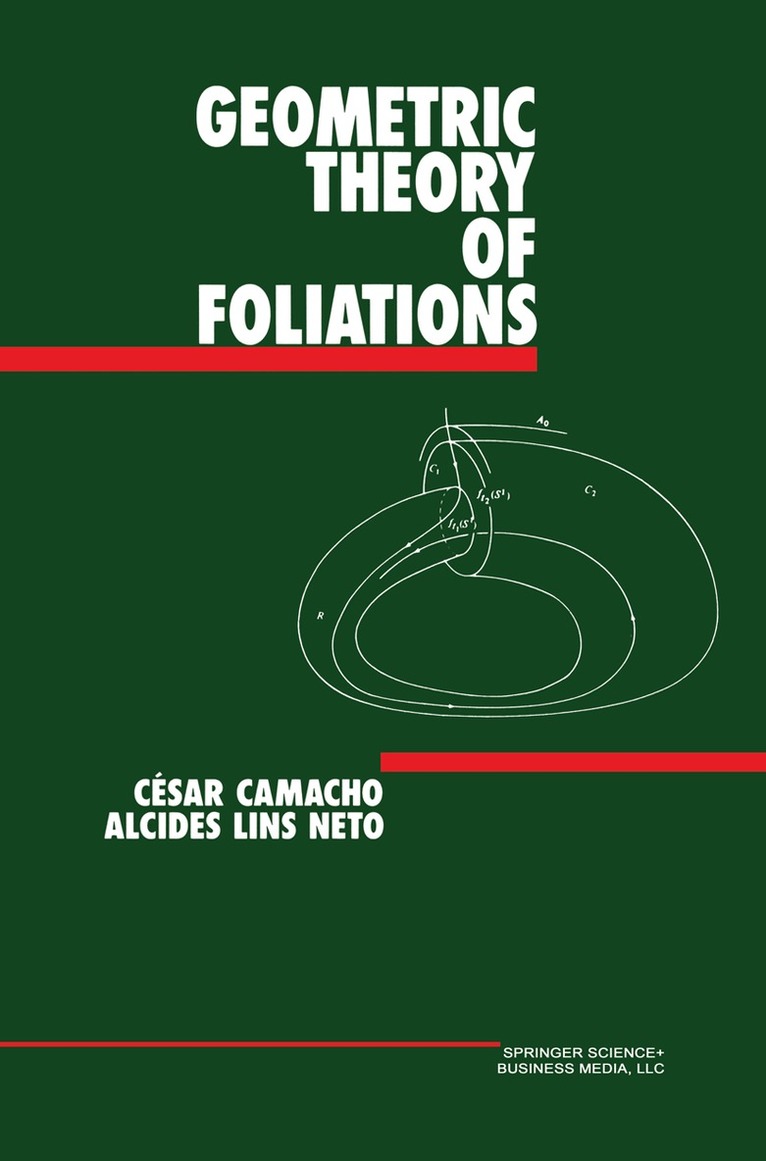
    Intuitively, a foliation corresponds to a decomposition of a manifold into a union of connected, disjoint submanifolds of the same dimension, called leaves, which pile up locally like pages of a book. The theory of foliations, as it is known, began with the work of C. Ehresmann and G. Reeb, in the 1940's; however, as Reeb has himself observed, already in the last century P. Painleve saw the necessity of creating a geometric theory (of foliations) in order to better understand the problems in the study of solutions of holomorphic differential equations in the complex field. The development of the theory of foliations was however provoked by the following question about the topology of manifolds proposed by H. Hopf in the 3 1930's: "Does there exist on the Euclidean sphere S a completely integrable vector field, that is, a field X such that X· curl X • 0?" By Frobenius' theorem, this question is equivalent to the following: "Does there exist on the 3 sphere S a two-dimensional foliation?" This question was answered affirmatively by Reeb in his thesis, where he 3 presents an example of a foliation of S with the following characteristics: There exists one compact leaf homeomorphic to the two-dimensional torus, while the other leaves are homeomorphic to two-dimensional planes which accu­ mulate asymptotically on the compact leaf. Further, the foliation is C"".

    Produktinformation

    • Utgivningsdatum:1984-01-01
    • Mått:178 x 254 x 17 mm
    • Vikt:500 g
    • Format:Inbunden
    • Språk:Engelska
    • Antal sidor:206
    • Upplaga:1985
    • Förlag:Birkhauser Boston
    • ISBN:9780817631390

    Utforska kategorier

    • Topologi inom Naturvetenskap och teknik
    • Matematik inom Naturvetenskap och teknik

    Innehållsförteckning

    • I — Differentiable Manifolds.- II — Foliations.- III — The Topology of the Leaves.- IV — Holonomy and the Stability Theorems.- V — Fiber Bundles and Foliations.- VI — Analytic Foliations of Codimension One.- VII — Novikov’s Theorem.- VIII — Topological Aspects of the Theory of Group Actions.- Appendix — Frobenius’ Theorem.- §1. Vector fields and the Lie bracket.- §2. Frobenius’ theorem.- §3. Plane fields defined by differential forms.- Exercises.