Christine Quigley – författare
Visar alla böcker från författaren Christine Quigley. Handla med fri frakt och snabb leverans.
6 produkter
6 produkter
351 kr
Skickas inom 5-8 vardagar
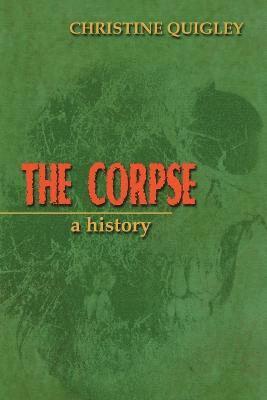
Throughout the centuries, different cultures have established a variety of procedures for handling and disposing of corpses. Often the methods are directly associated with the deceased's position in life, such as a pharaoh's mummification in Egypt or the cremation of a Buddhist.Treatment by the living of the dead over time and across cultures is the focus of this study. Burial arrangements and preparations are detailed, including embalming, the funeral service, storage and transport of the body, and forms of burial. Autopsies and the investigative process of causes of deliberate death are fully covered. Preservation techniques such as cryonic suspension and mummification are discussed, as well as a look at the "recycling" of the corpse through organ donation, donation to medicine, animal scavengers, cannibalism, and, of course, natural decay and decomposition. Mistreatments of a corpse are also covered.
361 kr
Skickas inom 5-8 vardagar
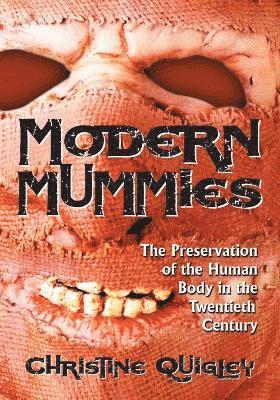
For many, a mummy is an Egyptian pharaoh, wrapped in cloth, found thousands of years later in a pyramid by archaeologists. But mummies need not be ancient. Modern-day mummies can be found under glass in special tombs built in their honor, in private collections where they have come to rest after decades on the carnival circuit, in dissecting rooms of medical schools, and in the basements of funeral homes waiting for decades to be claimed by the next of kin.Stories about the famous (Vladimir Ilyich Lenin, Ho Chi Minh, Eva Peron) and the not-so-famous (Leslie Hansell wanted her body mummified to bask in the sun rather than being buried in the cold ground) mummies are told here in great detail, along with a broader look at the history and process of mummification. The book includes a comprehensive study of the successful prolonged preservation of the human body, and delves into the law and science of modern mummification.
361 kr
Skickas inom 5-8 vardagar
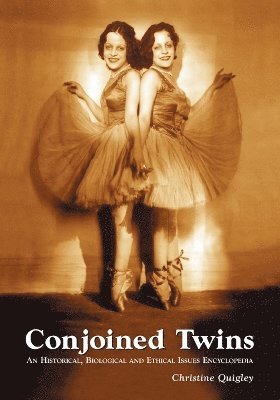
When two human ova fail to fully separate during pregnancy, the result is conjoined twins. The twins may be connected by ligament, bone, or just flesh, and they often share organs, but what captures most people's interest is whether the twins share sensations, thoughts and even souls.This encyclopedia presents entries on conjoined twins throughout history, the biological causes and effects of twins being born conjoined, and ethical issues such as self-support and separation surgery. It also includes entries on the modern standardized terminology used when discussing conjoined twins, the categories into which conjoined twins have been sorted, doctors past and present who have performed separation surgeries, and hospitals, such as Children's Hospital of Philadelphia, that are known for the separation of conjoined twins.This book even covers fraudulent conjoined twins and fictional ones in books written by such authors as Mark Twain, Vladimir Nabakov, and Katherine Dunn. Other entries cover relevant films, websites, and institutions.
412 kr
Skickas inom 5-8 vardagar
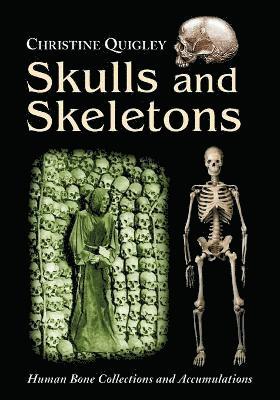
Of the parts of the human body, the bones have a unique durability that lends itself to collection. Skeletal remains can be recovered even millions of years after death, cleaned of debris, studied at length, and stored indefinitely.Motivations for collecting human skeletal material range from the practical (in anthropology, medicine, forensics) to the ritualistic (phrenology, in the relics of martyrs and saints). This book is an examination of those motivations and the collections they have brought about--catacombs, ossuaries, mass graves, prehistoric excavations, and institutional and private collections.The book contains sections on procuring, handling, storing, transporting, cleaning, and identifying skeletal remains. The repatriation of remains is also addressed.
351 kr
Skickas inom 5-8 vardagar
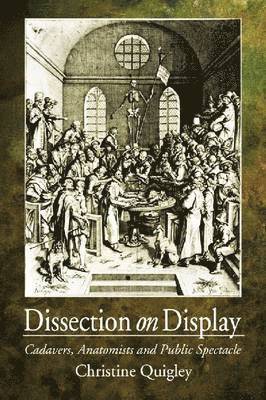
Since Herophilus, the "father of anatomy," performed the first public human dissection in the third century B.C.E., audiences have been spellbound by the cutting apart of cadavers. This volume traces the past and present of public dissection, from Herophilus's first cuts to the revival of anatomy as entertainment through spectacles like Gunther von Hagens' Body Worlds, including the attacks on anatomy in the Middle Ages, the influence of Renaissance anatomist Andreas Vesalius, the procurement of bodies through execution and body snatchers, and the withdrawal of dissectors behind medical school doors in the early 20th century. It reveals that the anatomical spectacle is not new, but has remained in the gray area between education and entertainment for centuries.
307 kr
Tillfälligt slut
From police jargon to medical terminology, from the coarse language of death row to literary euphemisms, over 5,550 words and terms associated directly with death and dying are defined in this unique dictionary. The entries have been collected from 65 cultures, nine religions and 20 fields of study, including archeology, cryonics, theology, theater and the military. Definitions are identified (e.g., archaic, obsolete, slang) and, when appropriate, the occupation it is most closely connected to and variants of the expression are provided. The appended thesaurus gives commonly used words and the terms that are synonymous with them.