Dariusz Kołodziejczyk – författare
Visar alla böcker från författaren Dariusz Kołodziejczyk. Handla med fri frakt och snabb leverans.
4 produkter
4 produkter
Del 71 - Harvard Ukrainian Research Institute Publications
Ottoman Survey Register of Podolia (ca. 1681), Part One
Defter-i Mufassal-i Eyalet-i Kamaniçe
Inbunden, Engelska, 2004
651 kr
Skickas inom 5-8 vardagar
Ottoman survey registers are recognized as unparalleled sources on the demographic, economic, and linguistic characteristics of the regions for which they were made. The register for Kamaniçe (the region of Podolia and the city of Kam'janec', which the Ottomans conquered in 1672) is the only surviving survey register of Ukrainian lands. The full text of the defter is given in transcription in the first part, with a facsimile edition given in the second part. All narrative documents are translated in appendices, while narrative segments of the registry portion of the defter are translated in the notes. Commentary includes extensive notes and an introduction. The Ottoman Survey Register of Podolia provides important new information on the Ottomans and their subjects living in Ukrainian territory. Interpretive maps keyed to the register and indices and glossaries are included.
Inbunden, Engelska, 2012
1 531 kr
Skickas inom 7-10 vardagar
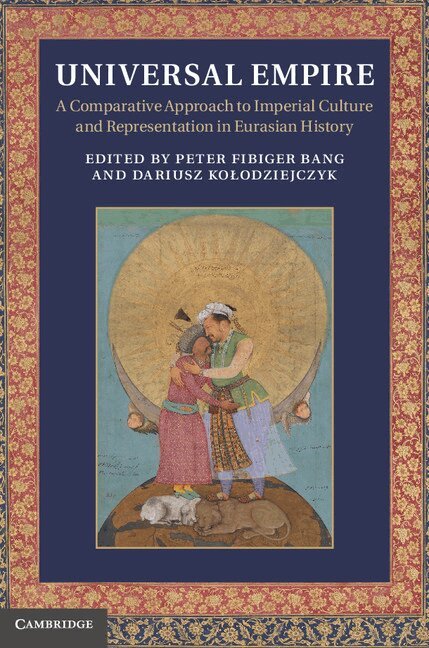
The claim by certain rulers to universal empire has a long history stretching as far back as the Assyrian and Achaemenid Empires. This book traces its various manifestations in classical antiquity, the Islamic world, Asia and Central America as well as considering seventeenth- and eighteenth-century European discussions of international order. As such it is an exercise in comparative world history combining a multiplicity of approaches, from ancient history, to literary and philosophical studies, to the history of art and international relations and historical sociology. The notion of universal, imperial rule is presented as an elusive and much coveted prize among monarchs in history, around which developed forms of kingship and political culture. Different facets of the phenomenon are explored under three, broadly conceived, headings: symbolism, ceremony and diplomatic relations; universal or cosmopolitan literary high-cultures; and, finally, the inclination to present universal imperial rule as an expression of cosmic order.
Häftad, Engelska, 2015
542 kr
Skickas inom 7-10 vardagar
The claim by certain rulers to universal empire has a long history stretching as far back as the Assyrian and Achaemenid Empires. This book traces its various manifestations in classical antiquity, the Islamic world, Asia and Central America as well as considering seventeenth- and eighteenth-century European discussions of international order. As such it is an exercise in comparative world history combining a multiplicity of approaches, from ancient history, to literary and philosophical studies, to the history of art and international relations and historical sociology. The notion of universal, imperial rule is presented as an elusive and much coveted prize among monarchs in history, around which developed forms of kingship and political culture. Different facets of the phenomenon are explored under three, broadly conceived, headings: symbolism, ceremony and diplomatic relations; universal or cosmopolitan literary high-cultures; and, finally, the inclination to present universal imperial rule as an expression of cosmic order.
E-bok
PDF, Engelska, 20116 122 kr
Läs direkt efter köp
This is an extensive study, supplemented by an edition of relevant sources, of the diplomatic contacts between Poland-Lithuania and the Crimean Khanate between the early 15th and the late 18th century. It contains a chronology of mutual relations, a formal analysis of various types of documents, and a glimpse into the working of the Crimean chancery, where Genghisid and Islamic forms mixed with those borrowed from Christian Europe. The book provides a fascinating insight into the intercultural exchange between Catholic Poland (with Latin and then Polish as the main chancery language) and predominantly Orthodox Lithuania (with Ruthenian as the main chancery language) on the one hand, and the Muslim Crimean Khanate (with Khwarezmian Turkic and then Ottoman Turkish as the main chancery language) on the other. It depicts Eastern Europe as a zone of contact, where the relations between Slavs and Tatars were by no means always hostile.