David Pacheco Aznar – författare
Visar alla böcker från författaren David Pacheco Aznar. Handla med fri frakt och snabb leverans.
2 produkter
2 produkter
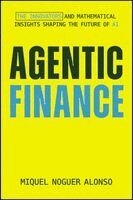
Agentic Finance
The Innovators and Mathematical Insights Shaping the Future of AI
Inbunden, Engelska, 2026
551 kr
Kommande
Explore how autonomous AI agents are transforming financial markets and decision-making In Agentic Finance: The Innovators and Mathematical Insights Shaping the Future of AI, Miquel Noguer Alonso and David Pacheco Aznar examine the emerging field where autonomous AI systems operate independently in financial contexts. The book explores how agentic technologies – AI systems capable of independent reasoning, planning, and action – are reshaping how financial institutions approach analysis, trading, and risk management. The book explores the mathematical foundations powering autonomous AI agents, from the algorithms enabling independent decision-making to the frameworks governing multi-agent financial systems. Readers gain insight into how innovators are applying these technologies across trading, portfolio management, and market analysis, along with the technical principles driving this transformation. Readers will also discover: The core mathematical concepts underlying autonomous AI systems, including reinforcement learning, optimization, and probabilistic reasoning frameworks How leading innovators are deploying agentic AI across trading, risk assessment, portfolio optimization, and financial forecasting applications Technical architectures enabling AI agents to operate autonomously while maintaining appropriate oversight and governance in financial environments Real-world applications demonstrating how autonomous systems analyze markets, execute strategies, and adapt to changing conditions The evolving regulatory and ethical landscape surrounding autonomous AI decision-making in high-stakes financial contexts Agentic Finance serves quantitative analysts, financial technologists, AI researchers, portfolio managers, and business leaders seeking to understand how autonomous AI systems are transforming financial services. It provides the technical foundation needed to evaluate and implement agentic technologies.
605 kr
Kommande
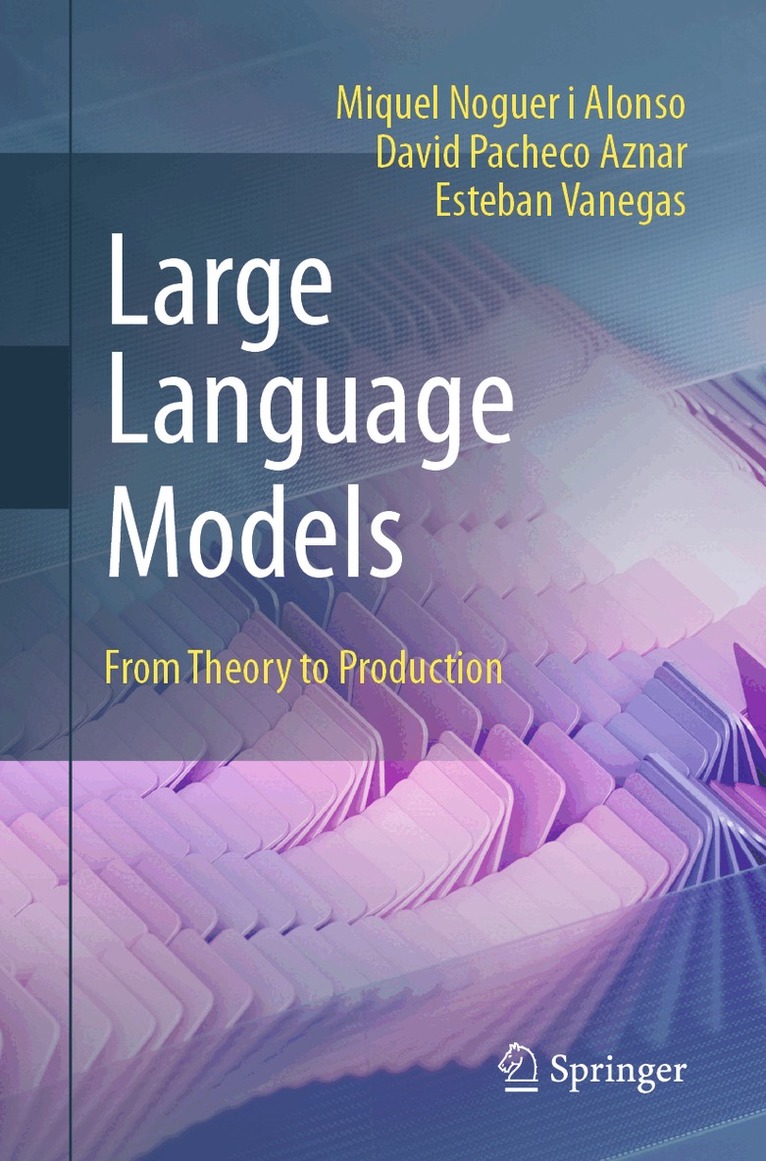
This book provides a technically rigorous yet accessible guide to Large Language Models (LLMs), charting their evolution from academic research projects into critical infrastructure for industries as diverse as finance, healthcare, and law. It offers readers a strong grounding in the conceptual foundations of machine learning and deep neural networks before moving into the architectures and methods that define today’s LLMs, including Transformers, tokenization strategies, and pre-training dynamics.Building on these foundations, the volume engages with the three central frontiers of LLM research: reasoning, alignment, and deployment. It examines structured reasoning approaches such as Tree of Thoughts and multi-agent systems, explores mechanisms for responsible alignment including reinforcement learning from human feedback (RLHF) and direct preference optimization (DPO), and provides practical strategies for large-scale deployment and inference efficiency in cloud environments. Alongside these advanced topics, the book highlights emerging methods like Parameter-Efficient Fine-Tuning (PEFT), Retrieval-Augmented Generation (RAG), and prompting innovations.Beyond text generation, dedicated chapters address LLMs in specialized and forward-looking domains, such as time series forecasting, domain-specific customization, and multimodal systems that integrate perception, reasoning, and action to form "unified cognitive agents." Written for developers, researchers, students, and policymakers alike, this book functions both as a comprehensive reference and as a forward-looking framework for engaging with the next era of AI-driven systems.Practical examples throughout make this an essential reference for developers and engineers building intelligent systems; the comprehensive coverage from foundational principles of deep learning and Transformers to advanced, state-of-the-art topics like agentic frameworks, reasoning, and multimodal systems makes it serve as a textbook for students, and a strategic framework for policymakers navigating the AI landscape.