Domingos Barbosa – författare
Visar alla böcker från författaren Domingos Barbosa. Handla med fri frakt och snabb leverans.
4 produkter
4 produkter
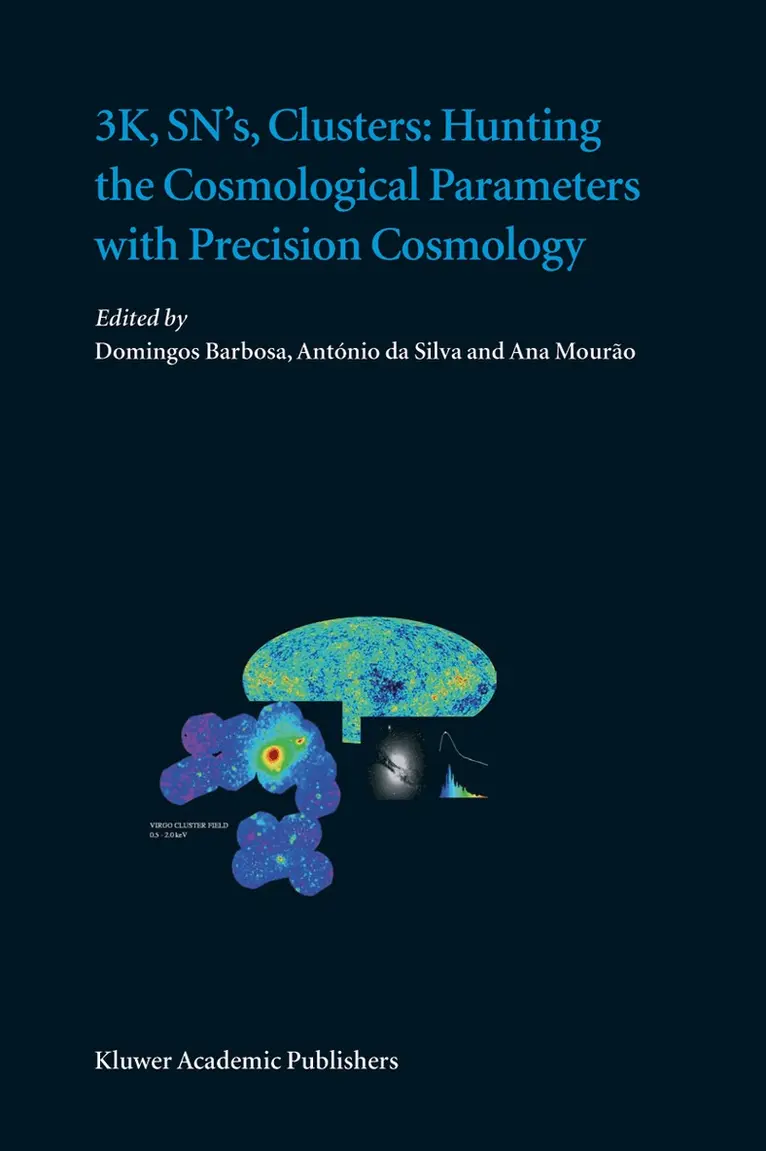
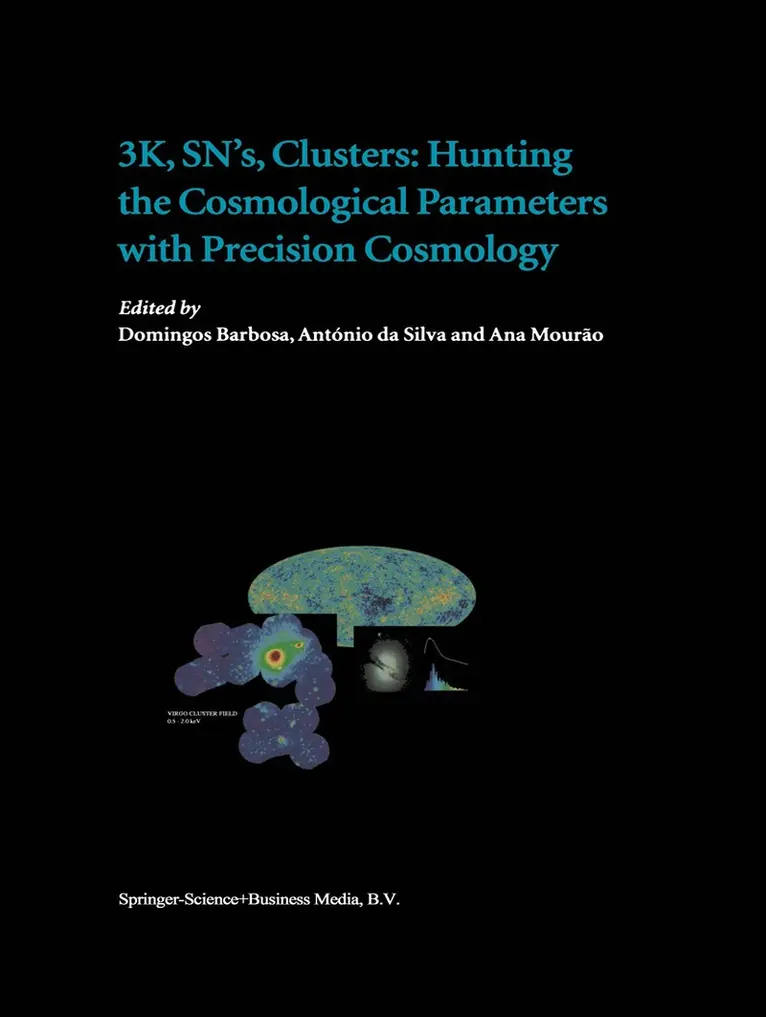
3K, SN's, Clusters: Hunting the Cosmological Parameters with Precision Cosmology
Inbunden, Engelska, 2004
1 062 kr
Skickas inom 10-15 vardagar
XMM satellites were also presented. Concerning extra-galactic cartography, res- ults from the local universe were discussed, like the distribution of super-clusters, and methods to be used with the VLT and the Planck and Hersehe! (ESA, 2007) satellites. The latest results from the 2dF galaxy redshift survey were also debated. The Organization of this workshop is indebted to the colleagues of the Local Organizing Comittee for the help and good humour provided before, during and after the workshop. Special thanks are due to Carlos Martins for the great help and effort provided in the critical moments. We acknowledge the financial support from FCT/Portugal under POCTI Pro- gram from Quadro Comunitario de Apoio III that also made possible the public- ation of these Proceedings and to Sociedade Portuguesa de Astronomia without which the organization of this workshop would not be possible. Guest Editors LIST OF PARTICIPANTS Barbosa, Domingos (barbosa@supernova. ist. utl. pt) CENTRA-Instituto Superior Tecnico, Av. Rovisco Pais, 1049-001 Lisbon, Por- tugal Bartlett, James G. (bartlett@cdf. in2p3. fr) APC-PCC/ College de France, 11 pl.Marrelin -Berthelot, 75231 Paris Cedex 05, France Blanchard, Alain (alain. blanchar@astro. obs-mip. fr) Observatoire Astronomique, Midi-Pyrenees, 14 Avenue Ed. Belin, 31400 Toulouse, France Blinnikov, Sergey (sergei. blinnikov@i tep. ru) Institute of Theoretical and Experimental Physics, B. Cheremushk 25, 117218, Moscow, Russia Bouchet, Fran
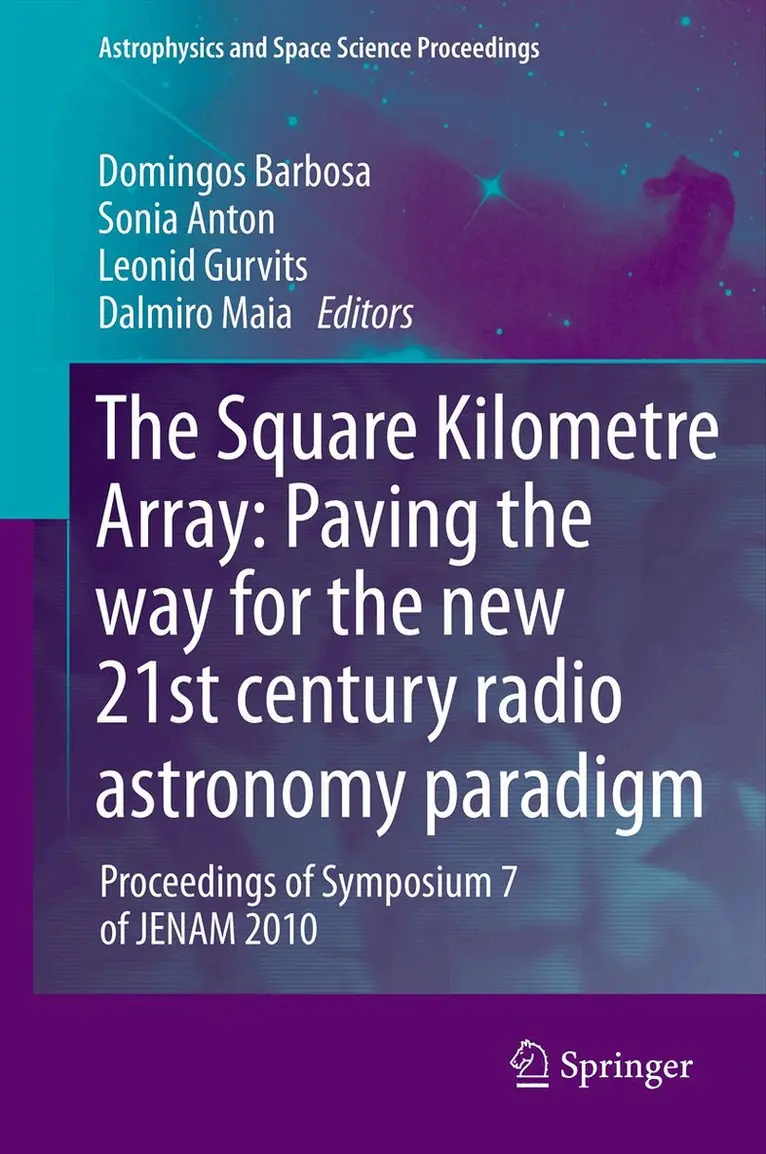
Square Kilometre Array: Paving the way for the new 21st century radio astronomy paradigm
Proceedings of Symposium 7 of JENAM 2010
Inbunden, Engelska, 2012
1 589 kr
Skickas inom 10-15 vardagar
: The Square Kilometre Array (SKA) will provide more than one order of magnitude improvement in sensitivity compared with any existing radio telescope over a wavelength range of several hundred to one, from decametric to microwave wavelengths. It will revolutionize the study of the most abundant element in the Universe, hydrogen, from the epoch of reionisation to the present-day, probing the onset formation period of the very first stars, will closely scan proto-planets and, through the precision timing of pulsars, will detect the distortions of space-time due to gravitational radiation. The SKA is a sensing network spanning 3000 km from its centre and with a collecting area of more than 1 square kilometre, using technologies of the 21st century. The SKA will make the study of a wide range of phenomena initially studied at other wavelengths possible at radio wavelengths, as well as opening a new discovery window on new phenomena at radio wavelengths. Symposium 7 of the JENAM 2010 aimed at bringing these diverse opportunities to the attention of both theoretical and observational astronomers working at all wavelengths, including the potential for synergies with other facilities. The meeting highlighted the scientific potential of the SKA, discussed scientific priorities and their impact on the design of the SKA, explored the synergies between the SKA and other next-generation astronomical facilities in different wavelength domains such as the ALMA, ELTs, LSST, JWST, GRE, IXO, Gaia and Euclid, and high-energy facilities (Auger), explored the “cyber–infrastructure” that may become available for the distribution and distributed analysis of SKA data.
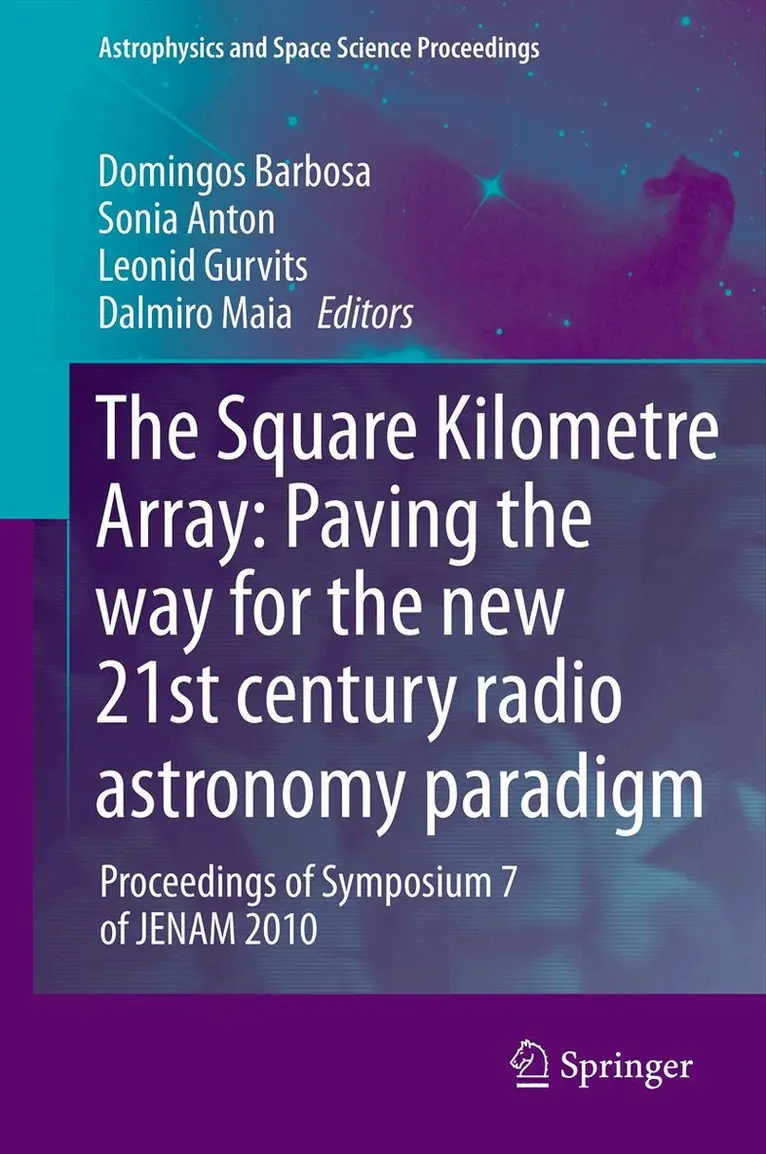
Square Kilometre Array: Paving the way for the new 21st century radio astronomy paradigm
Proceedings of Symposium 7 of JENAM 2010
Häftad, Engelska, 2014
1 589 kr
Skickas inom 10-15 vardagar
: The Square Kilometre Array (SKA) will provide more than one order of magnitude improvement in sensitivity compared with any existing radio telescope over a wavelength range of several hundred to one, from decametric to microwave wavelengths. It will revolutionize the study of the most abundant element in the Universe, hydrogen, from the epoch of reionisation to the present-day, probing the onset formation period of the very first stars, will closely scan proto-planets and, through the precision timing of pulsars, will detect the distortions of space-time due to gravitational radiation. The SKA is a sensing network spanning 3000 km from its centre and with a collecting area of more than 1 square kilometre, using technologies of the 21st century. The SKA will make the study of a wide range of phenomena initially studied at other wavelengths possible at radio wavelengths, as well as opening a new discovery window on new phenomena at radio wavelengths. Symposium 7 of the JENAM 2010 aimed at bringing these diverse opportunities to the attention of both theoretical and observational astronomers working at all wavelengths, including the potential for synergies with other facilities. The meeting highlighted the scientific potential of the SKA, discussed scientific priorities and their impact on the design of the SKA, explored the synergies between the SKA and other next-generation astronomical facilities in different wavelength domains such as the ALMA, ELTs, LSST, JWST, GRE, IXO, Gaia and Euclid, and high-energy facilities (Auger), explored the “cyber–infrastructure” that may become available for the distribution and distributed analysis of SKA data.
3K, SN's, Clusters: Hunting the Cosmological Parameters with Precision Cosmology
Häftad, Engelska, 2010
1 062 kr
Skickas inom 10-15 vardagar
XMM satellites were also presented. Concerning extra-galactic cartography, res- ults from the local universe were discussed, like the distribution of super-clusters, and methods to be used with the VLT and the Planck and Hersehe! (ESA, 2007) satellites. The latest results from the 2dF galaxy redshift survey were also debated. The Organization of this workshop is indebted to the colleagues of the Local Organizing Comittee for the help and good humour provided before, during and after the workshop. Special thanks are due to Carlos Martins for the great help and effort provided in the critical moments. We acknowledge the financial support from FCT/Portugal under POCTI Pro- gram from Quadro Comunitario de Apoio III that also made possible the public- ation of these Proceedings and to Sociedade Portuguesa de Astronomia without which the organization of this workshop would not be possible. Guest Editors LIST OF PARTICIPANTS Barbosa, Domingos (barbosa@supernova. ist. utl. pt) CENTRA-Instituto Superior Tecnico, Av. Rovisco Pais, 1049-001 Lisbon, Por- tugal Bartlett, James G. (bartlett@cdf. in2p3. fr) APC-PCC/ College de France, 11 pl.Marrelin -Berthelot, 75231 Paris Cedex 05, France Blanchard, Alain (alain. blanchar@astro. obs-mip. fr) Observatoire Astronomique, Midi-Pyrenees, 14 Avenue Ed. Belin, 31400 Toulouse, France Blinnikov, Sergey (sergei. blinnikov@i tep. ru) Institute of Theoretical and Experimental Physics, B. Cheremushk 25, 117218, Moscow, Russia Bouchet, Fran