E. N. Barron – författare
1 480 kr
Läs direkt efter köp
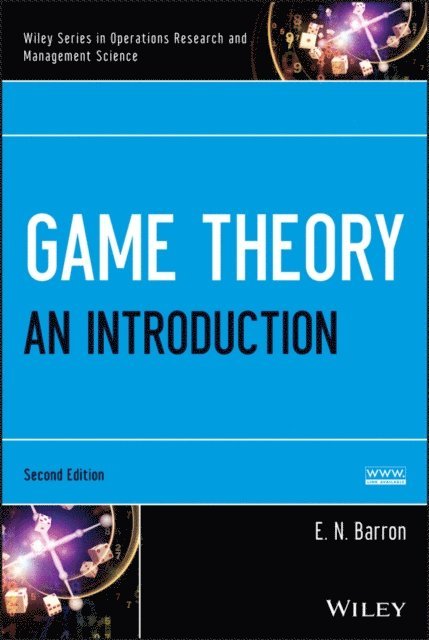
Game theory arises in almost every fact of human and inhuman interaction since oftentimes during these communications objectives are opposed or cooperation is viewed as an option. From economics and finance to biology and computer science, researchers and practitioners are often put in complex decision-making scenarios, whether they are interacting with each other or working with evolving technology and artificial intelligence. Acknowledging the role of mathematics in making logical and advantageous decisions, Game Theory: An Introduction uses modern software applications to create, analyze, and implement effective decision-making models.
While most books on modern game theory are either too abstract or too applied, this book provides a balanced treatment of the subject that is both conceptual and hands-on. Game Theory introduces readers to the basic theories behind games and presents real-world examples from various fields of study such as economics, political science, military science, finance, biological science as well as general game playing. A unique feature of this book is the use of Maple to find the values and strategies of games, and in addition, it aids in the implementation of algorithms for the solution or visualization of game concepts. Maple is also utilized to facilitate a visual learning environment of game theory and acts as the primary tool for the calculation of complex non-cooperative and cooperative games.
Important game theory topics are presented within the following five main areas of coverage:
Two-person zero sum matrix games
Nonzero sum games and the reduction to nonlinear programming
Cooperative games, including discussion of both the Nucleolus concept and the Shapley value
Bargaining, including threat strategies
Evolutionary stable strategies and population games
Although some mathematical competence is assumed, appendices are provided to act as a refresher of the basic concepts of linear algebra, probability, and statistics. Exercises are included at the end of each section along with algorithms for the solution of the games to help readers master the presented information. Also, explicit Maple and Mathematica® commands are included in the book and are available as worksheets via the book''s related Web site. The use of this software allows readers to solve many more advanced and interesting games without spending time on the theory of linear and nonlinear programming or performing other complex calculations.
With extensive examples illustrating game theory''s wide range of relevance, this classroom-tested book is ideal for game theory courses in mathematics, engineering, operations research, computer science, and economics at the upper-undergraduate level. It is also an ideal companion for anyone who is interested in the applications of game theory.
401 kr
Skickas inom 5-8 vardagar
1 526 kr
Läs direkt efter köp
An exciting new edition of the popular introduction to game theory and its applications
The thoroughly expanded Second Edition presents a unique, hands-on approach to game theory. While most books on the subject are too abstract or too basic for mathematicians, Game Theory: An Introduction, Second Edition offers a blend of theory and applications, allowing readers to use theory and software to create and analyze real-world decision-making models.
With a rigorous, yet accessible, treatment of mathematics, the book focuses on results that can be used to determine optimal game strategies. Game Theory: An Introduction, Second Edition demonstrates how to use modern software, such as Maple™, Mathematica®, and Gambit, to create, analyze, and implement effective decision-making models. Coverage includes the main aspects of game theory including the fundamentals of two-person zero-sum games, cooperative games, and population games as well as a large number of examples from various fields, such as economics, transportation, warfare, asset distribution, political science, and biology. The Second Edition features: • A new chapter on extensive games, which greatly expands the implementation of available models • New sections on correlated equilibria and exact formulas for three-player cooperative games • Many updated topics including threats in bargaining games and evolutionary stable strategies • Solutions and methods used to solve all odd-numbered problems • A companion website containing the related Maple and Mathematica data sets and code
A trusted and proven guide for students of mathematics and economics, Game Theory: An Introduction, Second Edition is also an excellent resource for researchers and practitioners in economics, finance, engineering, operations research, statistics, and computer science.
1 511 kr
Läs direkt efter köp
An exciting new edition of the popular introduction to game theory and its applications
The thoroughly expanded Second Edition presents a unique, hands-on approach to game theory. While most books on the subject are too abstract or too basic for mathematicians, Game Theory: An Introduction, Second Edition offers a blend of theory and applications, allowing readers to use theory and software to create and analyze real-world decision-making models.
With a rigorous, yet accessible, treatment of mathematics, the book focuses on results that can be used to determine optimal game strategies. Game Theory: An Introduction, Second Edition demonstrates how to use modern software, such as Maple™, Mathematica®, and Gambit, to create, analyze, and implement effective decision-making models. Coverage includes the main aspects of game theory including the fundamentals of two-person zero-sum games, cooperative games, and population games as well as a large number of examples from various fields, such as economics, transportation, warfare, asset distribution, political science, and biology. The Second Edition features: • A new chapter on extensive games, which greatly expands the implementation of available models • New sections on correlated equilibria and exact formulas for three-player cooperative games • Many updated topics including threats in bargaining games and evolutionary stable strategies • Solutions and methods used to solve all odd-numbered problems • A companion website containing the related Maple and Mathematica data sets and code
A trusted and proven guide for students of mathematics and economics, Game Theory: An Introduction, Second Edition is also an excellent resource for researchers and practitioners in economics, finance, engineering, operations research, statistics, and computer science.
1 323 kr
Skickas
1 488 kr
Läs direkt efter köp
Authoritative and quantitative approach to modern game theory with applications from areas including economics, political science, computer science, and engineering
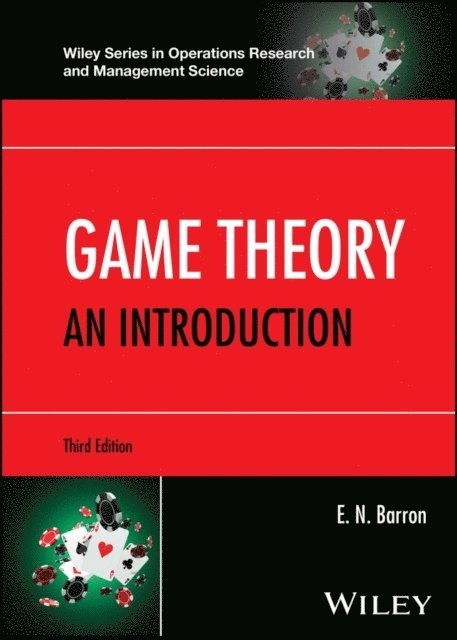
Game Theory acknowledges the role of mathematics in making logical and advantageous decisions in adversarial situations and provides a balanced treatment of the subject that is both conceptual and applied. This newly updated and revised Third Edition streamlines the text to introduce readers to the basic theories behind games in a less technical but still mathematically rigorous way, with many new real-world examples from various fields of study, including economics, political science, military science, finance, biological science, and general game playing.
The text introduces topics like repeated games, Bayesian equilibria, signaling games, bargaining games, evolutionary stable strategies, extensive games, and network and congestion games, which will be of interest across a wide range of disciplines. Separate sections in each chapter illustrate the use of Mathematica and Gambit software to create, analyze, and implement effective decision-making models.
A companion website contains the related Mathematica and Gambit data sets and code. Solutions, hints, and methods used to solve most problems to enable self-learning are in an Appendix.
Game Theory includes detailed information on:
The von Neumann Minimax Theorem and methods for solving any 2-person zero sum matrix game. Two-person nonzero sum games solved for a Nash Equilibrium using nonlinear programming software or a calculus method. Nash Equilibria and Correlated Equilibria. Repeated games and punishment strategies to enforce cooperation Games in Extensive Form for solving Bayesian and perfect information games using Gambit. N-Person nonzero sum games, games with a continuum of strategies and many models in economics applications, duels, auctions, of Nash Equilibria, and the Stable Matching problem Coalitions and characteristic functions of cooperative games, an exact nucleolus for three-player games, bargaining Game theory in evolutionary processes and population gamesA trusted and proven guide for students of mathematics, engineering, and economics, the Third Edition of Game Theory is also an excellent resource for researchers and practitioners in economics, finance, engineering, operations research, statistics, and computer science.
1 488 kr
Läs direkt efter köp
Authoritative and quantitative approach to modern game theory with applications from areas including economics, political science, computer science, and engineering
Game Theory acknowledges the role of mathematics in making logical and advantageous decisions in adversarial situations and provides a balanced treatment of the subject that is both conceptual and applied. This newly updated and revised Third Edition streamlines the text to introduce readers to the basic theories behind games in a less technical but still mathematically rigorous way, with many new real-world examples from various fields of study, including economics, political science, military science, finance, biological science, and general game playing.
The text introduces topics like repeated games, Bayesian equilibria, signaling games, bargaining games, evolutionary stable strategies, extensive games, and network and congestion games, which will be of interest across a wide range of disciplines. Separate sections in each chapter illustrate the use of Mathematica and Gambit software to create, analyze, and implement effective decision-making models.
A companion website contains the related Mathematica and Gambit data sets and code. Solutions, hints, and methods used to solve most problems to enable self-learning are in an Appendix.
Game Theory includes detailed information on:
The von Neumann Minimax Theorem and methods for solving any 2-person zero sum matrix game. Two-person nonzero sum games solved for a Nash Equilibrium using nonlinear programming software or a calculus method. Nash Equilibria and Correlated Equilibria. Repeated games and punishment strategies to enforce cooperation Games in Extensive Form for solving Bayesian and perfect information games using Gambit. N-Person nonzero sum games, games with a continuum of strategies and many models in economics applications, duels, auctions, of Nash Equilibria, and the Stable Matching problem Coalitions and characteristic functions of cooperative games, an exact nucleolus for three-player games, bargaining Game theory in evolutionary processes and population gamesA trusted and proven guide for students of mathematics, engineering, and economics, the Third Edition of Game Theory is also an excellent resource for researchers and practitioners in economics, finance, engineering, operations research, statistics, and computer science.
1 271 kr
Tillfälligt slut