E.J. Karjalainen – författare
Visar alla böcker från författaren E.J. Karjalainen. Handla med fri frakt och snabb leverans.
2 produkter
2 produkter
E-bok
PDF, Engelska, 19962 628 kr
Läs direkt efter köp
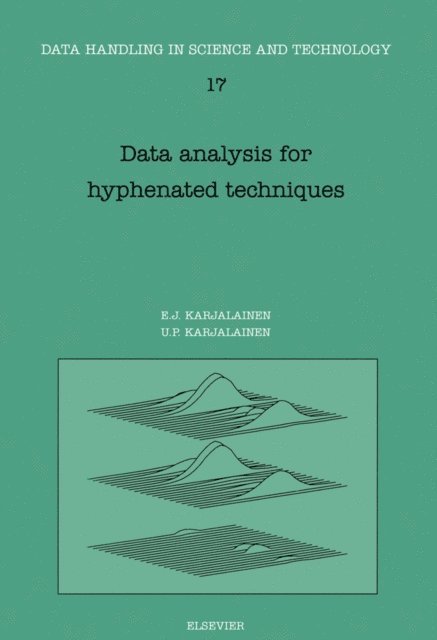
Based on a concrete set of working MATLAB programs, the book begins with a short program of snippets describing basic principles and proceeds to a complete application program filling a central analytical need: obtaining pure spectra from the observed overlapping spectra, with standard deviations for thesolutions obtained.The strength of the book is the open nature of the programs. All programs can be read, tested and modified by the user. The mathematical principles needed for the proper treatment of experimental data are thoroughly described. The first part of the book describes how data iscollected, converted and prepared for the actual deconvolution. Practical working algorithms such as the Savitzky-Golay smoothing method are emphasized. The reader can see how searches in spectral libraries can be greatly speeded up by proper formulation of the calculation. Basic signal processing is described by illustrative examples.The main part of the book describes the deconvolution of overlapping chromatographic peaks. Principle component analysis is described and used as a useful tool. The main emphasis is a discussion of a deconvolution method, OSCAR (Optimization by Stepwise Constraining of Alternating Regression), developed by the authors. The results can be validated as OSCAR calculates confidence intervals for the spectra and elution curves.For users who do not want to enter the programs by hand a separate CD-ROM is available. It contains the programs and extensive sample data files. The CD-ROM has instructional multimedia showing step by step how the programs are used for the problems in the book. The MATLAB programs and datafiles can be directly run on Windows® and Macintosh® computers having a MATLAB interpreter.
E-bok
PDF, Engelska, 1990672 kr
Läs direkt efter köp
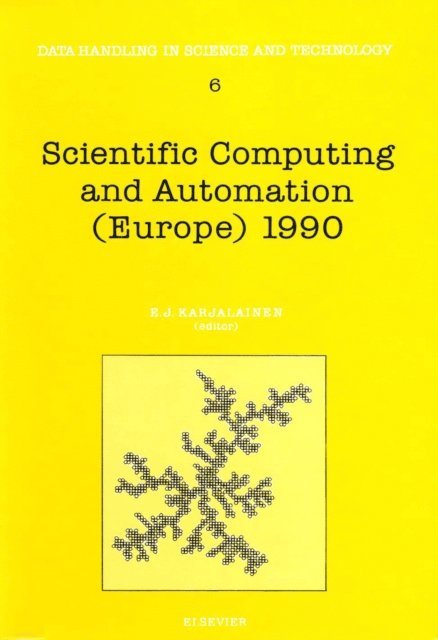
This book comprises a large selection of papers presented at the second European Scientific Computing and Automation meeting (SCA 90 (Europe)) which was held in June 1990 in Maastricht, The Netherlands. The increasing use of computers for making measurements, interpreting data, and filing results brings a new unity to science. SCA concentrates on common computer-based tools which are useful in several disciplines. Practical problems in laboratory automation, robotics and information management with LIMS are covered in depth. The process of designing and acquiring a LIMS is described and standards for data transfer between instruments, between LIMS and instruments and between different LIMS are discussed. The applications of statistics and expert systems are covered in several chapters. Strategies for drug design are discussed with various practical examples. Finally the display of scientific results as images and computer-based animations is demonstrated by several examples with their color illustrations. The book should be of interest to those managing R&D projects, doing research in laboratories, acquiring or planning LIMS, designing instruments and laboratory automation systems and those involved in data analysis of scientific results.