Emanuel Derman – författare
237 kr
Skickas inom 3-6 vardagar
172 kr
Skickas inom 5-8 vardagar
215 kr
Läs direkt efter köp
398 kr
Skickas inom 5-8 vardagar
215 kr
Läs direkt efter köp
671 kr
Skickas inom 5-8 vardagar
802 kr
Läs direkt efter köp
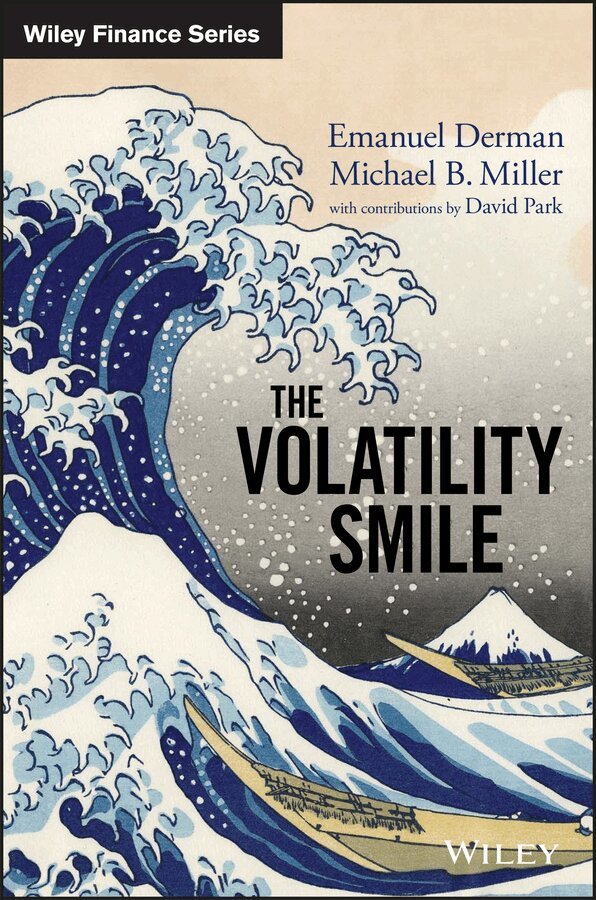
The Volatility Smile
The Black-Scholes-Merton option model was the greatest innovation of 20th century finance, and remains the most widely applied theory in all of finance. Despite this success, the model is fundamentally at odds with the observed behavior of option markets: a graph of implied volatilities against strike will typically display a curve or skew, which practitioners refer to as the smile, and which the model cannot explain. Option valuation is not a solved problem, and the past forty years have witnessed an abundance of new models that try to reconcile theory with markets.
The Volatility Smile presents a unified treatment of the Black-Scholes-Merton model and the more advanced models that have replaced it. It is also a book about the principles of financial valuation and how to apply them. Celebrated author and quant Emanuel Derman and Michael B. Miller explain not just the mathematics but the ideas behind the models. By examining the foundations, the implementation, and the pros and cons of various models, and by carefully exploring their derivations and their assumptions, readers will learn not only how to handle the volatility smile but how to evaluate and build their own financial models.
Topics covered include:
The principles of valuation Static and dynamic replication The Black-Scholes-Merton model Hedging strategies Transaction costs The behavior of the volatility smile Implied distributions Local volatility models Stochastic volatility models Jump-diffusion modelsThe first half of the book, Chapters 1 through 13, can serve as a standalone textbook for a course on option valuation and the Black-Scholes-Merton model, presenting the principles of financial modeling, several derivations of the model, and a detailed discussion of how it is used in practice. The second half focuses on the behavior of the volatility smile, and, in conjunction with the first half, can be used for as the basis for a more advanced course.
802 kr
Läs direkt efter köp
The Volatility Smile
The Black-Scholes-Merton option model was the greatest innovation of 20th century finance, and remains the most widely applied theory in all of finance. Despite this success, the model is fundamentally at odds with the observed behavior of option markets: a graph of implied volatilities against strike will typically display a curve or skew, which practitioners refer to as the smile, and which the model cannot explain. Option valuation is not a solved problem, and the past forty years have witnessed an abundance of new models that try to reconcile theory with markets.
The Volatility Smile presents a unified treatment of the Black-Scholes-Merton model and the more advanced models that have replaced it. It is also a book about the principles of financial valuation and how to apply them. Celebrated author and quant Emanuel Derman and Michael B. Miller explain not just the mathematics but the ideas behind the models. By examining the foundations, the implementation, and the pros and cons of various models, and by carefully exploring their derivations and their assumptions, readers will learn not only how to handle the volatility smile but how to evaluate and build their own financial models.
Topics covered include:
The principles of valuation Static and dynamic replication The Black-Scholes-Merton model Hedging strategies Transaction costs The behavior of the volatility smile Implied distributions Local volatility models Stochastic volatility models Jump-diffusion modelsThe first half of the book, Chapters 1 through 13, can serve as a standalone textbook for a course on option valuation and the Black-Scholes-Merton model, presenting the principles of financial modeling, several derivations of the model, and a detailed discussion of how it is used in practice. The second half focuses on the behavior of the volatility smile, and, in conjunction with the first half, can be used for as the basis for a more advanced course.
315 kr
Läs direkt efter köp
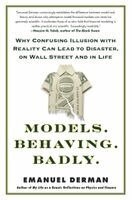
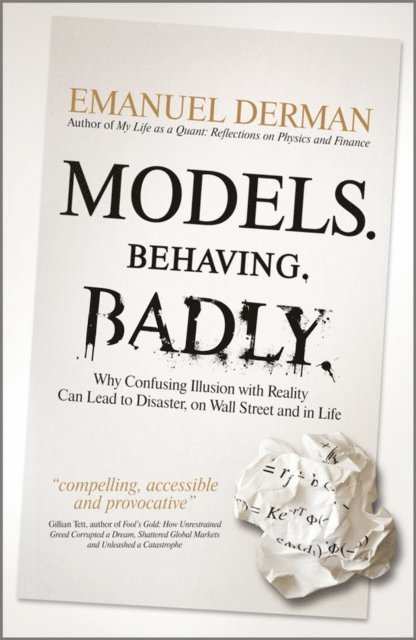
Though financial models imitate the style of physics and employ the language of mathematics, ultimately they deal with human beings. There is a fundamental difference between the aims and potential achievements of physics and those of finance. In physics, theories aim for a description of reality; in finance, at best, models can shoot only for a simplistic and very limited approximation to it. When we make a model involving human beings, we are trying to force the ugly stepsister''s foot into Cinderella''s pretty glass slipper. It doesn''t fit without cutting off some of the essential parts. Physicists and economists have been too enthusiastic to acknowledge the limits of their equations in the sphere of human behavior--which of course is what economics is all about.
Models.Behaving.Badly includes a personal account of Derman''s childhood encounters with failed models--the oppressions of apartheid and the utopia of the kibbutz. He describes his experience as a physicist on Wall Street, the models quants generated, the benefits they brought and the problems, practical and ethical, they caused. Derman takes a close look at what a model is, and then highlights the differences between the successes of modeling in physics and its failures in economics. Describing the collapse of the subprime mortgage CDO market in 2007, Derman urges us to stop the naïve reliance on these models, and offers suggestions for mending them. This is a fascinating, lyrical, and very human look behind the curtain at the intersection between mathematics and human nature.
326 kr
Läs direkt efter köp
Though financial models imitate the style of physics and employ the language of mathematics, ultimately they deal with human beings. There is a fundamental difference between the aims and potential achievements of physics and those of finance. In physics, theories aim for a description of reality; in finance, at best, models can shoot only for a simplistic and very limited approximation to it. When we make a model involving human beings, we are trying to force the ugly stepsister''s foot into Cinderella''s pretty glass slipper. It doesn''t fit without cutting off some of the essential parts. Physicists and economists have been too enthusiastic to acknowledge the limits of their equations in the sphere of human behavior--which of course is what economics is all about.
Models.Behaving.Badly includes a personal account of Derman''s childhood encounters with failed models--the oppressions of apartheid and the utopia of the kibbutz. He describes his experience as a physicist on Wall Street, the models quants generated, the benefits they brought and the problems, practical and ethical, they caused. Derman takes a close look at what a model is, and then highlights the differences between the successes of modeling in physics and its failures in economics. Describing the collapse of the subprime mortgage CDO market in 2007, Derman urges us to stop the naïve reliance on these models, and offers suggestions for mending them. This is a fascinating, lyrical, and very human look behind the curtain at the intersection between mathematics and human nature.