Erkan Celik – författare
Visar alla böcker från författaren Erkan Celik. Handla med fri frakt och snabb leverans.
5 produkter
Computational Intelligence and Soft Computing Applications in Healthcare Management Science
Av Muhammet Gul, Erkan Celik m. fl.
Inbunden, 2020
4378 kr
Lägg i varukorg
Computational Intelligence and Soft Computing Applications in Healthcare Management Science
Av Faruk Serin, Suleyman Mete m. fl.
E-bok, 2020
3843 kr
Lägg i varukorg
In today's modernized world, the field of healthcare has seen significant practical innovations with the implementation of computational intelligence approaches and soft computing methods. These two concepts present various solutions to complex scientific problems and imperfect data issues. This …
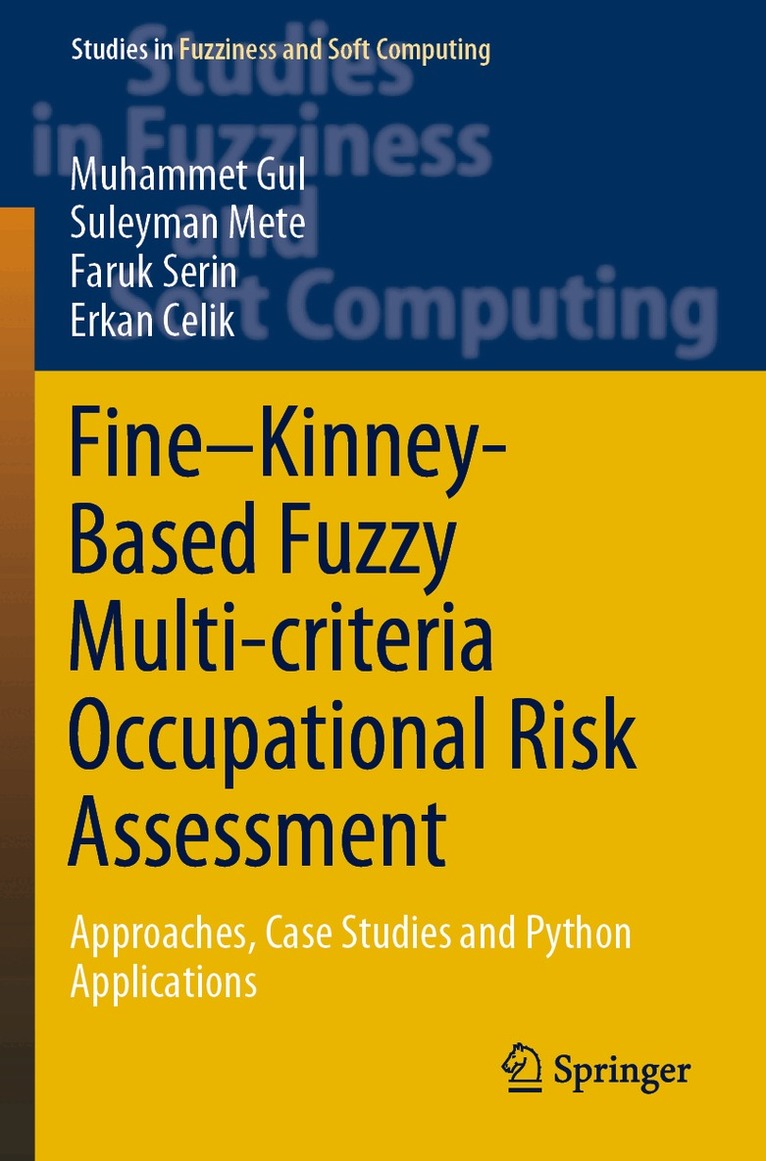
Fine–Kinney-Based Fuzzy Multi-criteria Occupational Risk Assessment
Approaches, Case Studies and Python Applications
Av Muhammet Gul, Suleyman Mete m. fl.
Inbunden, 2020
1093 kr
Lägg i varukorg
This book presents a number of approaches to Fine–Kinney–based multi-criteria occupational risk-assessment. For each proposed approach, it provides case studies demonstrating their applicability, as well as Python coding, which will enable readers to implement them into their own risk assessment …
Fine-Kinney-Based Fuzzy Multi-criteria Occupational Risk Assessment
Approaches, Case Studies and Python Applications
Av Erkan Celik, Faruk Serin m. fl.
E-bok, 2020
1427 kr
Lägg i varukorg
This book presents a number of approaches to Fine–Kinney–based multi-criteria occupational risk-assessment. For each proposed approach, it provides case studies demonstrating their applicability, as well as Python coding, which will enable readers to implement them into their own risk assessment …
Fine–Kinney-Based Fuzzy Multi-criteria Occupational Risk Assessment
Approaches, Case Studies and Python Applications
Av Muhammet Gul, Suleyman Mete m. fl.
Häftad, 2021
1093 kr
Lägg i varukorg
This book presents a number of approaches to Fine–Kinney–based multi-criteria occupational risk-assessment. For each proposed approach, it provides case studies demonstrating their applicability, as well as Python coding, which will enable readers to implement them into their own risk assessment …