Gao Xiaoshan Gao – författare
Visar alla böcker från författaren Gao Xiaoshan Gao. Handla med fri frakt och snabb leverans.
3 produkter
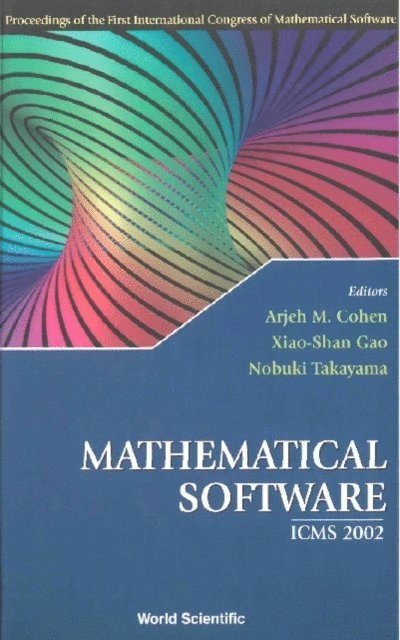
Mathematical Software - Proceedings Of The First International Congress Of Mathematical Software
Av Takayama Nobuki Takayama, Gao Xiaoshan Gao m. fl.
E-bok, 2002
917 kr
Lägg i varukorg
The advent of mathematical software has been one of the most important events in mathematics. Mathematical software systems are used to construct examples, to prove theorems, and to find new mathematical phenomena. On the other hand, mathematical research often motivates developments of new …
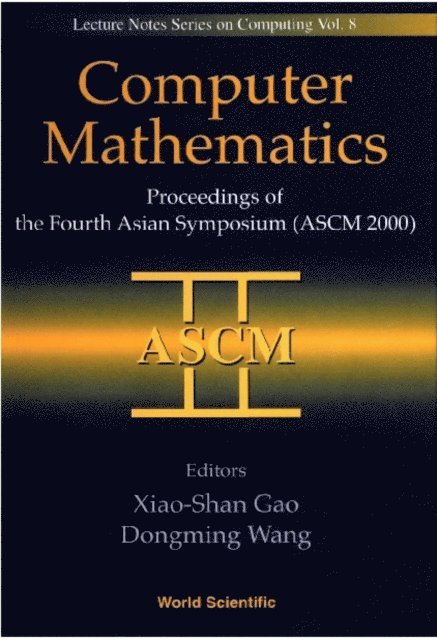
Computer Mathematics - Proceedings Of The Fourth Asian Symposium (Ascm 2000)
Av Wang Dongming Wang, Gao Xiaoshan Gao
E-bok, 2000
749 kr
Lägg i varukorg
This volume contains selected papers presented at the Fourth Asian Symposium on Computer Mathematics. 39 peer-reviewed original contributions together with full papers and extended abstracts by the four invited speakers, G H Gonnet, D Lazard, W McCune, and W-T Wu, cover some of the most recent and …
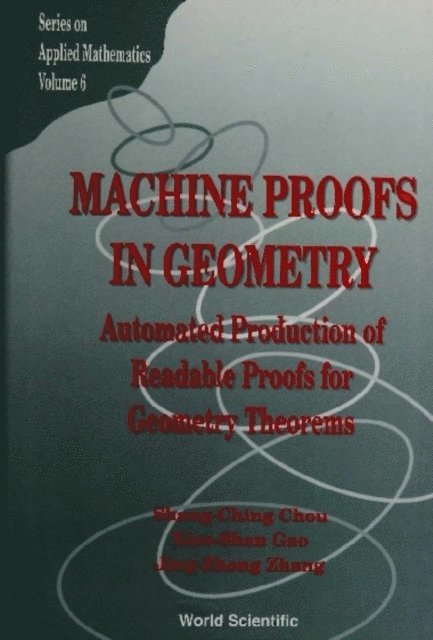
Machine Proofs In Geometry: Automated Production Of Readable Proofs For Geometry Theorems
Av Gao Xiaoshan Gao, Chou Shang-ching Chou m. fl.
E-bok, 1994
749 kr
Lägg i varukorg
This book reports recent major advances in automated reasoning in geometry. The authors have developed a method and implemented a computer program which, for the first time, produces short and readable proofs for hundreds of geometry theorems.The book begins with chapters introducing the method at …