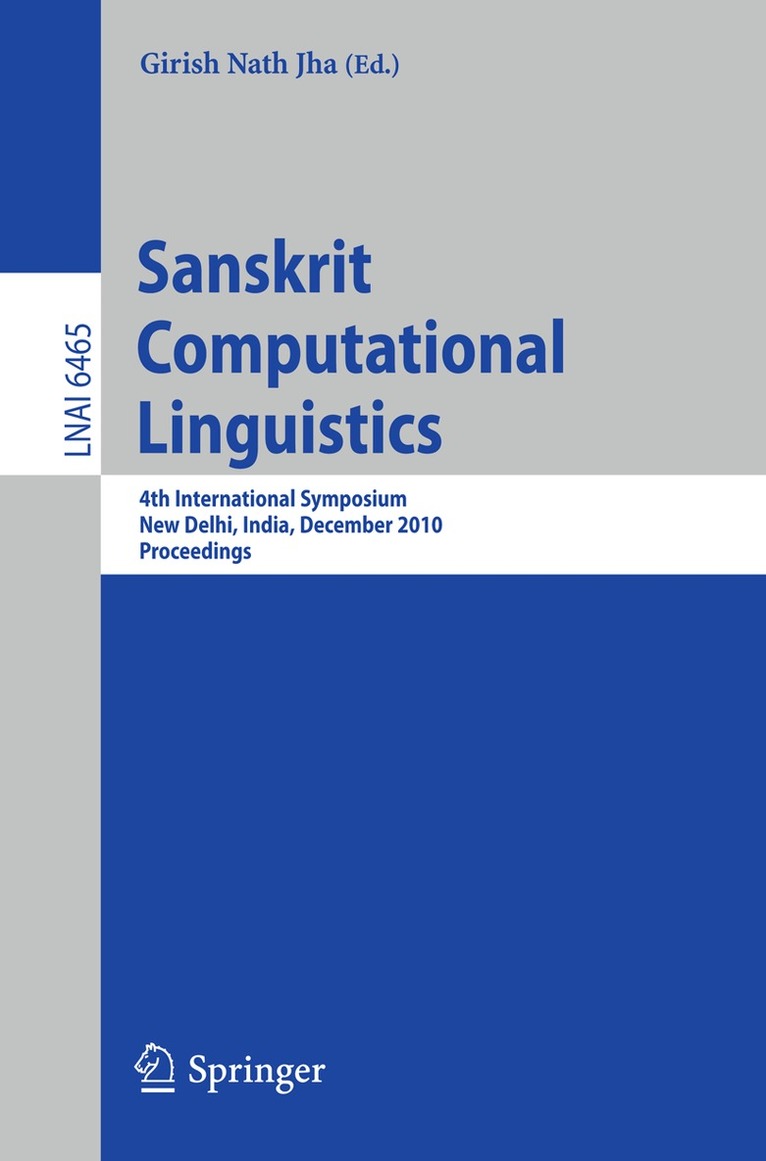
th It is with great pleasure that I present the selected papers from the 4 Int- national Sanskrit Computational Linguistics Symposium (4i-SCLS) to you. The event is being hosted by the Jawaharlal Nehru University, the premier research UniversityofIndiaduring(December10-12,2010)attheSpecialCenterforS- skrit Studies. The ?rst symposium was organized at INRIA, France, by G' erard Huet in 2007, the second at Brown University, USA, by Peter Scharf in 2008, and the third was organized at the University of Hyderabad by Amba Kulkarni in January2009. The Sanskrit computational linguistics community is relatively young, and the foundation for this kind of formal meeting to exchange ideas between Sanskritists, linguists and computer scientists was given by Prof. Huet and Prof. Amba Kulkarni. My hearty thanks to both of them for bringing about this uni?cation of scholars under one umbrella. The 4i-SCLS saw excellent response from the scholars. We received more than 31 papers, which were examined by our Program Committee members to shortlist 18 papers for publication presented in this volume. The papers can be categorized under the following broad areas: 1. Phonology and speech technology 2.Morphology and shallow parsing 3. Syntax, semantics and parsing 4. Lexical resources, annotation and search 5. Machine translation and ambiguity resolution 6. Computer simulation of Ast ~ adhyay ~ ~ ? . . Some of the notable misses were the speech corpora annotation, image p- cessingtechniques likeOCR,andalsothe paperswrittenin Sanskrit. E?orts will be made to ensure wider participation by scholars in future events.
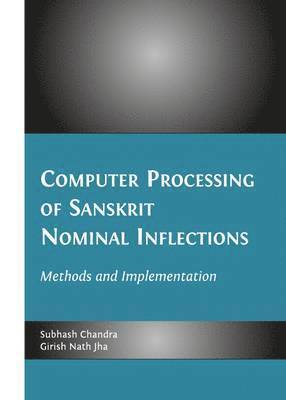
Computer Processing of Sanskrit Nominal Inflections: Methods and Implementation is the result of Research and Development (R&D) at the Master of Philosophy (MPhil) level at Jawaharlal Nehru University, New Delhi, India. The title of the dissertation was "Machine Recognition and Morphological Analysis of Subanta-Padas." The work, which is based on the reverse engineering implementation of Panini's Sanskrit Grammar, brings together new and original studies in the area of computational linguistics, language technology and natural language processing with reference to parsing Sanskrit nominal inflections.On the surface level, Panini has defined rules in a forward looking generative fashion which makes reverse analysis necessary for parsing. Since parsing inflections is the first basic step towards complete analysis, the present work has relevance for any larger system that may evolve in future.
th It is with great pleasure that I present the selected papers from the 4 Int- national Sanskrit Computational Linguistics Symposium (4i-SCLS) to you. The event is being hosted by the Jawaharlal Nehru University, the premier research UniversityofIndiaduring(December10-12,2010)attheSpecialCenterforS- skrit Studies. The ?rst symposium was organized at INRIA, France, by G' erard Huet in 2007, the second at Brown University, USA, by Peter Scharf in 2008, and the third was organized at the University of Hyderabad by Amba Kulkarni in January2009. The Sanskrit computational linguistics community is relatively young, and the foundation for this kind of formal meeting to exchange ideas between Sanskritists, linguists and computer scientists was given by Prof. Huet and Prof. Amba Kulkarni. My hearty thanks to both of them for bringing about this uni?cation of scholars under one umbrella. The 4i-SCLS saw excellent response from the scholars. We received more than 31 papers, which were examined by our Program Committee members to shortlist 18 papers for publication presented in this volume. The papers can be categorized under the following broad areas: 1. Phonology and speech technology 2.Morphology and shallow parsing 3. Syntax, semantics and parsing 4. Lexical resources, annotation and search 5. Machine translation and ambiguity resolution 6. Computer simulation of Ast ~ adhyay ~ ~ ? . . Some of the notable misses were the speech corpora annotation, image p- cessingtechniques likeOCR,andalsothe paperswrittenin Sanskrit. E?orts will be made to ensure wider participation by scholars in future events.
Computer Processing of Sanskrit Nominal Inflections: Methods and Implementation is the result of Research and Development (R&D) at the Master of Philosophy (MPhil) level at Jawaharlal Nehru University, New Delhi, India. The title of the dissertation was "Machine Recognition and Morphological Analysis of Subanta-Padas." The work, which is based on the reverse engineering implementation of Panini's Sanskrit Grammar, brings together new and original studies in the area of computational linguistics, language technology and natural language processing with reference to parsing Sanskrit nominal inflections.On the surface level, Panini has defined rules in a forward looking generative fashion which makes reverse analysis necessary for parsing. Since parsing inflections is the first basic step towards complete analysis, the present work has relevance for any larger system that may evolve in future.