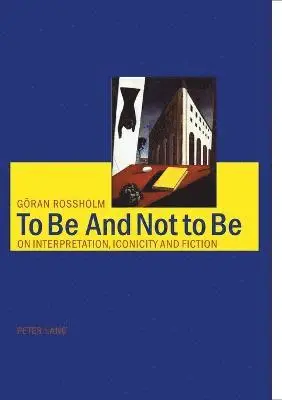
To Be And Not to Be is a study of the interrelated concepts interpretation, iconicity and fiction as applied to works of art in general and literary narratives in particular. Two perspectives run through the book: a semiotic one, focusing on the work of art and what it stands for – represents, expresses, alludes to, etc. – and a psychological one, focusing on the audience’s interpretation of the work.The book establishes an ongoing dialogue with recent research within analytic aesthetics, narratology and other relevant fields. In particular, the philosopher Nelson Goodman’s theory of symbols has proved to be fruitful in the development of new and original concept formations with respect to interpretation, iconicity and fictionality.In the first part some fundamental questions of literary theory are focused on, foremost what is meant by «intentional interpretation», the relation between literary interpretation and understanding of everyday spontaneous discourse as analyzed by Paul Grice, and how to locate aesthetic interpretation within the wider scope of interpretive practices. These discussions yield some conceptual tools deployed in the two following parts of the book. The second part opens with a suggestion on the concept of pictorial representation. This is generalized to apply to verbal and literary phenomena such as temporal matching, quotation, and uses of point of view in narratives. In the final part recent philosophical accounts of fictionality are discussed.
The book is the result of a conference about the interrelated concepts of fiction and perspective in Stockholm 2001. The concepts of fiction and perspective have played a number of crucial roles in the Humanities during the last fifty years, in particular in the intersection between linguistics, the aesthetic disciplines, and philosophy. The writers in this anthology discuss some of the most debated questions in this context, such as different conceptions of point of view in narrative fiction, historical counterfactual fiction, the relationship between fact and fiction in historiography, how to understand and analyze statements about an individual’s belief perspective, and how everyday discourse is anchored in perspective views of the world.
Hur särskiljer sig vår upplevelse och vår tolkning av ett konstverk en dikt, ett musikstycke, en målning, ett fotografi eller en film från vår upplevelse och tolkning av vardagsspråk, av ljud, färg och form i allmänhet? Detta centrala problem inom estetiken diskuteras i Konstverk och konstverkan tillsammans med frågor om skillnader och likheter mellan de olika konstarternas uttrycksmedel. Etablerade föreställningar, som att musiken till skillnad från litteraturen och det föreställande måleriet inte hänvisar till någonting utanför verket, att bilder liksom texter i någon mening måste läsas , ventileras mot bakgrund av de senaste decenniernas högkonjunktur för jämförande studier av de skilda konstarternas språk . Åtta forskare med hemhörighet i litteraturvetenskap, konstvetenskap, musikvetenskap, semiotik och filosofi behandlar dessa och andra frågor om vad som kännetecknar ett konstverk och vilket slags verkan det har på sina lyssnare och läsare och betraktare.