Grzegorz Lukaszewicz - Böcker
Visar alla böcker från författaren Grzegorz Lukaszewicz. Handla med fri frakt och snabb leverans.
4 produkter
4 produkter
1 064 kr
Skickas inom 10-15 vardagar
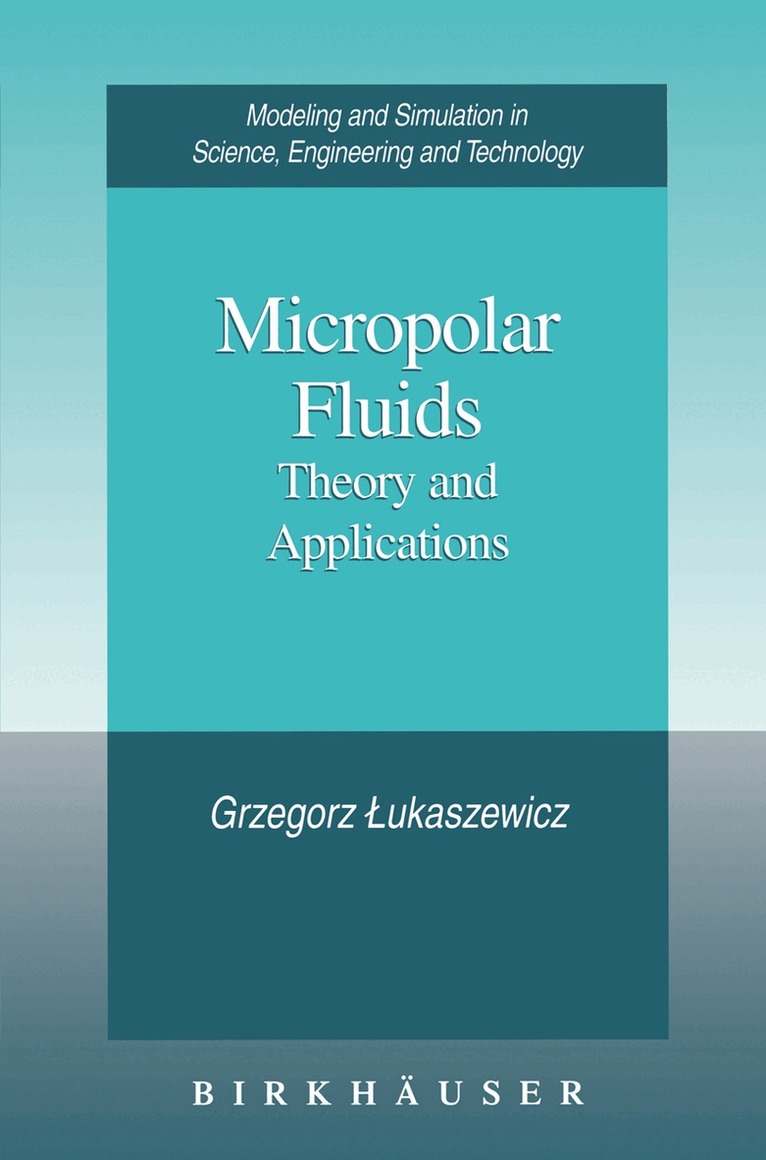
Micropolar fluids are fluids with microstructure. They belong to a class of fluids with nonsymmetric stress tensor that we shall call polar fluids, and include, as a special case, the well-established Navier-Stokes model of classical fluids that we shall call ordinary fluids. Physically, micropolar fluids may represent fluids consisting of rigid, randomly oriented (or spherical) particles suspended in a viscous medium, where the deformation of fluid particles is ignored. The model of micropolar fluids introduced in [65] by C. A. Eringen is worth studying as a very well balanced one. First, it is a well-founded and significant generalization of the classical Navier-Stokes model, covering, both in theory and applications, many more phenomena than the classical one. Moreover, it is elegant and not too complicated, in other words, man ageable to both mathematicians who study its theory and physicists and engineers who apply it. The main aim of this book is to present the theory of micropolar fluids, in particular its mathematical theory, to a wide range of readers. The book also presents two applications of micropolar fluids, one in the theory of lubrication and the other in the theory of porous media, as well as several exact solutions of particular problems and a numerical method. We took pains to make the presentation both clear and uniform.
1 064 kr
Skickas inom 10-15 vardagar
Micropolar fluids are fluids with microstructure. They belong to a class of fluids with nonsymmetric stress tensor that we shall call polar fluids, and include, as a special case, the well-established Navier-Stokes model of classical fluids that we shall call ordinary fluids. Physically, micropolar fluids may represent fluids consisting of rigid, randomly oriented (or spherical) particles suspended in a viscous medium, where the deformation of fluid particles is ignored. The model of micropolar fluids introduced in [65] by C. A. Eringen is worth studying as a very well balanced one. First, it is a well-founded and significant generalization of the classical Navier-Stokes model, covering, both in theory and applications, many more phenomena than the classical one. Moreover, it is elegant and not too complicated, in other words, man ageable to both mathematicians who study its theory and physicists and engineers who apply it. The main aim of this book is to present the theory of micropolar fluids, in particular its mathematical theory, to a wide range of readers. The book also presents two applications of micropolar fluids, one in the theory of lubrication and the other in the theory of porous media, as well as several exact solutions of particular problems and a numerical method. We took pains to make the presentation both clear and uniform.
1 381 kr
Skickas inom 10-15 vardagar
This volume is devoted to the study of the Navier–Stokes equations, providing a comprehensive reference for a range of applications: from advanced undergraduate students to engineers and professional mathematicians involved in research on fluid mechanics, dynamical systems, and mathematical modeling. Equipped with only a basic knowledge of calculus, functional analysis, and partial differential equations, the reader is introduced to the concept and applications of the Navier–Stokes equations through a series of fully self-contained chapters. Including lively illustrations that complement and elucidate the text, and a collection of exercises at the end of each chapter, this book is an indispensable, accessible, classroom-tested tool for teaching and understanding the Navier–Stokes equations.Incompressible Navier–Stokes equations describe the dynamic motion (flow) of incompressible fluid, the unknowns being the velocity and pressure as functions of location (space) and time variables. A solution to these equations predicts the behavior of the fluid, assuming knowledge of its initial and boundary states. These equations are one of the most important models of mathematical physics: although they have been a subject of vivid research for more than 150 years, there are still many open problems due to the nature of nonlinearity present in the equations. The nonlinear convective term present in the equations leads to phenomena such as eddy flows and turbulence. In particular, the question of solution regularity for three-dimensional problem was appointed by Clay Institute as one of the Millennium Problems, the key problems in modern mathematics. The problem remains challenging and fascinating for mathematicians, and the applications of the Navier–Stokes equations range from aerodynamics (drag and lift forces), to the design of watercraft and hydroelectric power plants, to medical applications such as modeling the flow of blood in the circulatory system.
1 381 kr
Skickas inom 10-15 vardagar
This volume is devoted to the study of the Navier–Stokes equations, providing a comprehensive reference for a range of applications: from advanced undergraduate students to engineers and professional mathematicians involved in research on fluid mechanics, dynamical systems, and mathematical modeling.