
Guido W. Imbens – författare
Visar alla böcker från författaren Guido W. Imbens. Handla med fri frakt och snabb leverans.
3 produkter
3 produkter
Inbunden, Engelska, 2015
770 kr
Skickas inom 7-10 vardagar
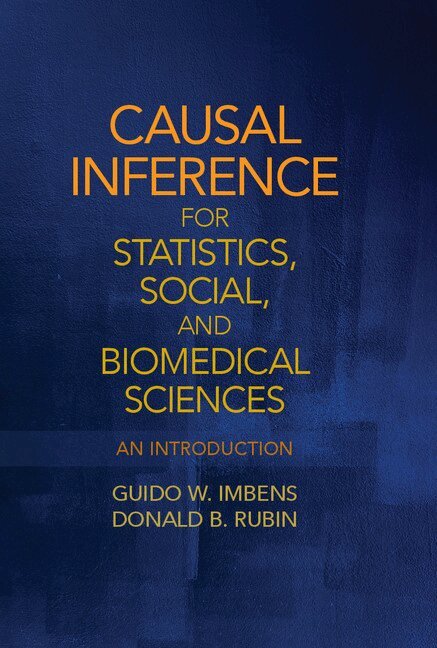
Most questions in social and biomedical sciences are causal in nature: what would happen to individuals, or to groups, if part of their environment were changed? In this groundbreaking text, two world-renowned experts present statistical methods for studying such questions. This book starts with the notion of potential outcomes, each corresponding to the outcome that would be realized if a subject were exposed to a particular treatment or regime. In this approach, causal effects are comparisons of such potential outcomes. The fundamental problem of causal inference is that we can only observe one of the potential outcomes for a particular subject. The authors discuss how randomized experiments allow us to assess causal effects and then turn to observational studies. They lay out the assumptions needed for causal inference and describe the leading analysis methods, including matching, propensity-score methods, and instrumental variables. Many detailed applications are included, with special focus on practical aspects for the empirical researcher.
840 kr
Läs direkt efter köp
Most questions in social and biomedical sciences are causal in nature: what would happen to individuals, or to groups, if part of their environment were changed? In this groundbreaking text, two world-renowned experts present statistical methods for studying such questions. This book starts with the notion of potential outcomes, each corresponding to the outcome that would be realized if a subject were exposed to a particular treatment or regime. In this approach, causal effects are comparisons of such potential outcomes. The fundamental problem of causal inference is that we can only observe one of the potential outcomes for a particular subject. The authors discuss how randomized experiments allow us to assess causal effects and then turn to observational studies. They lay out the assumptions needed for causal inference and describe the leading analysis methods, including matching, propensity-score methods, and instrumental variables. Many detailed applications are included, with special focus on practical aspects for the empirical researcher.
E-bok
PDF, Engelska, 2015840 kr
Läs direkt efter köp
Most questions in social and biomedical sciences are causal in nature: what would happen to individuals, or to groups, if part of their environment were changed? In this groundbreaking text, two world-renowned experts present statistical methods for studying such questions. This book starts with the notion of potential outcomes, each corresponding to the outcome that would be realized if a subject were exposed to a particular treatment or regime. In this approach, causal effects are comparisons of such potential outcomes. The fundamental problem of causal inference is that we can only observe one of the potential outcomes for a particular subject. The authors discuss how randomized experiments allow us to assess causal effects and then turn to observational studies. They lay out the assumptions needed for causal inference and describe the leading analysis methods, including matching, propensity-score methods, and instrumental variables. Many detailed applications are included, with special focus on practical aspects for the empirical researcher.