Hans W. Gatzke – författare
Visar alla böcker från författaren Hans W. Gatzke. Handla med fri frakt och snabb leverans.
2 produkter
2 produkter
887 kr
Tillfälligt slut
Beginning with Bismarck's forging of a nation with "iron and blood," Gatzke tells of Germany's relentless struggle for domination in Europe and in the West, its defeat in two world wars, its division, East Germany's travail, and West Germany's search for identity as a modern democratic state. A discerning statement about Germany and other nations, this book reevaluates for the general reader and the historian the impact of rapid industrialization, the origins of the world wars, the question of war guilt, the decade of Weimar democracy, and the rise and fall of Hitler. Gatzke looks anew at the economic miracle in West Germany and the consequences of making prosperity the cornerstone of a new republic. It is to the realities of these German characteristics as an evolving nation-state that Gatzke relates American foreign policy and perceptions. He recounts the American fluctuations, from favorable to hostile to friendly, as Germany's policies and fortunes changed, and he places the division of Germany in historical perspective.
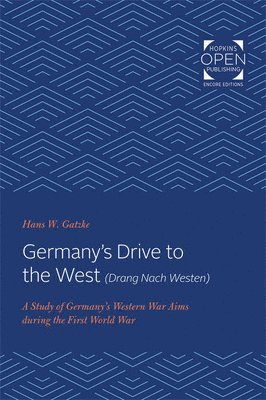
Germany's Drive to the West (Drang Nach Westen)
A Study of Germany's Western War Aims during the First World War
Häftad, Engelska, 2020
536 kr
Skickas inom 5-8 vardagar
Originally published in 1950. Hans Gatzke analyzes Germany's ambitions to expand westward during World War I. Germany's wartime plans for expansion to the west had important repercussions at home and abroad. Gatzke proceeds chronologically, starting with the German political parties' outlining of their war aims. Gatzke claims that a combination of interests, including those of industrialists, pan-Germans, the parties of the Right, and the Supreme Command was responsible for the stubborn propagation of Germany's large war aims, which condemned the German people to remain at war until the bitter end. Each of these forces had its own particular reasons for wanting to hold out for far-reaching territorial gains, yet one aim that most of them had in common was ensuring, through a successful peace settlement, the continuation of the existing order, to their own advantage and to the political and economic detriment of the majority of the German people.