Henryk Flakierski – författare
Visar alla böcker från författaren Henryk Flakierski. Handla med fri frakt och snabb leverans.
11 produkter
11 produkter
Häftad, Engelska, 1987
426 kr
Skickas inom 10-15 vardagar
Chapters include Economic Problems and Issues, Distribution of Wages, and Income.
Inbunden, Engelska, 1989
2 259 kr
Skickas inom 10-15 vardagar
This is the second volume in the author's ongoing inquiry into the extent of income inequality in the East European socialist countries and the effect of market-oriented reforms on patterns of income distribution. Although there has been remarkably little empirical research on this question (in part because of the problem of obtaining reliable data), both proponents and opponents of reforms voice strong views on this subject, with both sides, however, tending to grant the assumption that decentralization and the increased use of market mechanisms will increase inequality. In this study as in the preceding volume, "Economic Reform and Income Distribution: A Case Study of Hungary and Poland", Henryk Flakierski undertakes a study of the data in order to shed light on this question - this time with reference to the most decentralized of the East European economics and the one in which marketization of the economy has been most advanced.
E-bok
Engelska, 2017502 kr
Läs direkt efter köp
First Published in 2017. Chapters include Economic Problems and Issues, Distribution of Wages, and Income.
E-bok
PDF, Engelska, 2017485 kr
Läs direkt efter köp
First Published in 2017. Chapters include Economic Problems and Issues, Distribution of Wages, and Income.
E-bok
Engelska, 2017824 kr
Läs direkt efter köp
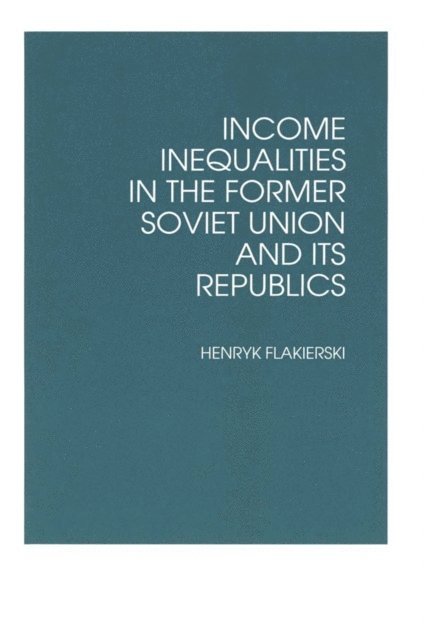
This study analyses the newly available statistical evidence on income distribution in the former Soviet Union both by social group and by republic, and considers the significance of inequalities as a factor contributing to the demise of the Communist regime. Among the topics covered are wage distribution (interbranch and skill differentials and distribution in terms of gender, education, and age), income distribution for the former USSR as a whole, and wage and income distribution patterns for each republic, with analysis of regional differences.
E-bok
PDF, Engelska, 2017824 kr
Läs direkt efter köp
This study analyses the newly available statistical evidence on income distribution in the former Soviet Union both by social group and by republic, and considers the significance of inequalities as a factor contributing to the demise of the Communist regime. Among the topics covered are wage distribution (interbranch and skill differentials and distribution in terms of gender, education, and age), income distribution for the former USSR as a whole, and wage and income distribution patterns for each republic, with analysis of regional differences.
E-bok
Engelska, 20192 758 kr
Läs direkt efter köp
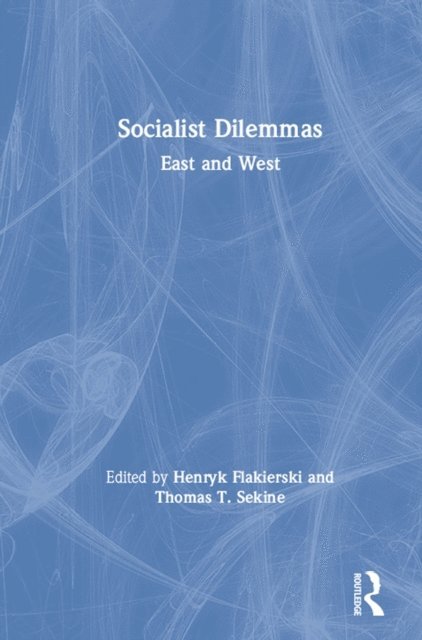
This book, consisting of eight related articles, deals with several dimensions of socialism in the 1980s just before the beginning of the great changes which took place in Eastern Europe. Profound changes in the political economy of the world in the 1970s led to a decline of over-confidence and over-optimism characteristic of the earlier times both in the West and in the East. The painful experience of stagnation ended the grand Keynesian dream and led to the return of neo-conservatism in the West. The disappointing pace of industrial and technological progress during the Brezhnev era and increasing shortages of productivity of communism in the East. With both sides in the grip of political and economic uncertainties, the ideological confrontation seemed to have lost much of its sharp edge. No longer did the accepted dogmas and ideologies of the past appear either valid or convincing. The presupposition of the debate on comparative economic systems were in need of fundamental revisions. It was in this perspective that the Political Economy Workshop at York University undertook to feature a series of lectures on socialism in its 1988 sessions. Of about a dozen presentations by York University scholars and invited speakers, eight were subsequently made available in the form of articles and are published in this volume. These articles cover a wide range of issues, both theoretical and practical, and from both the Western and the Eastern perspective. It is recognized by all authors that neither the East European experiments in communism nor the Western process into social democracy have been a great success. The clue to what might lie beyond the socialist dilemmas in the age of perestroika will be found only by going through once again to the circumstances which led to the failure of socialism thus far.
E-bok
PDF, Engelska, 20192 758 kr
Läs direkt efter köp
This book, consisting of eight related articles, deals with several dimensions of socialism in the 1980s just before the beginning of the great changes which took place in Eastern Europe. Profound changes in the political economy of the world in the 1970s led to a decline of over-confidence and over-optimism characteristic of the earlier times both in the West and in the East. The painful experience of stagnation ended the grand Keynesian dream and led to the return of neo-conservatism in the West. The disappointing pace of industrial and technological progress during the Brezhnev era and increasing shortages of productivity of communism in the East. With both sides in the grip of political and economic uncertainties, the ideological confrontation seemed to have lost much of its sharp edge. No longer did the accepted dogmas and ideologies of the past appear either valid or convincing. The presupposition of the debate on comparative economic systems were in need of fundamental revisions. It was in this perspective that the Political Economy Workshop at York University undertook to feature a series of lectures on socialism in its 1988 sessions. Of about a dozen presentations by York University scholars and invited speakers, eight were subsequently made available in the form of articles and are published in this volume. These articles cover a wide range of issues, both theoretical and practical, and from both the Western and the Eastern perspective. It is recognized by all authors that neither the East European experiments in communism nor the Western process into social democracy have been a great success. The clue to what might lie beyond the socialist dilemmas in the age of perestroika will be found only by going through once again to the circumstances which led to the failure of socialism thus far.
E-bok
Engelska, 2016936 kr
Läs direkt efter köp
This is the second volume in the author''s ongoing inquiry into the extent of income inequality in the East European socialist countries and the effect of market-oriented reforms on patterns of income distribution. Although there has been remarkably little empirical research on this question (in part because of the problem of obtaining reliable data), both proponents and opponents of reforms voice strong views on this subject, with both sides, however, tending to grant the assumption that decentralization and the increased use of market mechanisms will increase inequality. In this study as in the preceding volume, "Economic Reform and Income Distribution: A Case Study of Hungary and Poland", Henryk Flakierski undertakes a study of the data in order to shed light on this question - this time with reference to the most decentralized of the East European economics and the one in which marketization of the economy has been most advanced.
E-bok
PDF, Engelska, 2016936 kr
Läs direkt efter köp
This is the second volume in the author''s ongoing inquiry into the extent of income inequality in the East European socialist countries and the effect of market-oriented reforms on patterns of income distribution. Although there has been remarkably little empirical research on this question (in part because of the problem of obtaining reliable data), both proponents and opponents of reforms voice strong views on this subject, with both sides, however, tending to grant the assumption that decentralization and the increased use of market mechanisms will increase inequality. In this study as in the preceding volume, "Economic Reform and Income Distribution: A Case Study of Hungary and Poland", Henryk Flakierski undertakes a study of the data in order to shed light on this question - this time with reference to the most decentralized of the East European economics and the one in which marketization of the economy has been most advanced.
Häftad, Engelska, 1993
698 kr
Skickas inom 10-15 vardagar
This study analyses the newly available statistical evidence on income distribution in the former Soviet Union both by social group and by republic, and considers the significance of inequalities as a factor contributing to the demise of the Communist regime. Among the topics covered are wage distribution (interbranch and skill differentials and distribution in terms of gender, education, and age), income distribution for the former USSR as a whole, and wage and income distribution patterns for each republic, with analysis of regional differences.