Hung-Hsi Wu - Böcker
Visar alla böcker från författaren Hung-Hsi Wu. Handla med fri frakt och snabb leverans.
8 produkter
8 produkter
827 kr
Skickas inom 7-10 vardagar
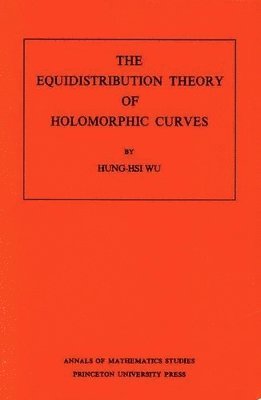
This work is a fresh presentation of the Ahlfors-Weyl theory of holomorphic curves that takes into account some recent developments in Nevanlinna theory and several complex variables. The treatment is differential geometric throughout, and assumes no previous acquaintance with the classical theory of Nevanlinna. The main emphasis is on holomorphic curves defined over Riemann surfaces, which admit a harmonic exhaustion, and the main theorems of the subject are proved for such surfaces. The author discusses several directions for further research.
1 123 kr
Skickas inom 7-10 vardagar
This is a textbook for pre-service elementary school teachers and for current teachers who are taking professional development courses. By emphasizing the precision of mathematics, the exposition achieves a logical and coherent account of school mathematics at the appropriate level for the readership. Wu provides a comprehensive treatment of all the standard topics about numbers in the school mathematics curriculum: whole numbers, fractions, and rational numbers. Assuming no previous knowledge of mathematics, the presentation develops the basic facts about numbers from the beginning and thoroughly covers the subject matter for grades K through 7. Every single assertion is established in the context of elementary school mathematics in a manner that is completely consistent with the basic requirements of mathematics. While it is a textbook for pre-service elementary teachers, it is also a reference book that school teachers can refer to for explanations of well-known but hitherto unexplained facts. For example, the sometimes-puzzling concepts of percent, ratio, and rate are each given a treatment that is down to earth and devoid of mysticism. The fact that a negative times a negative is a positive is explained in a leisurely and comprehensible fashion.
534 kr
Skickas inom 10-15 vardagar
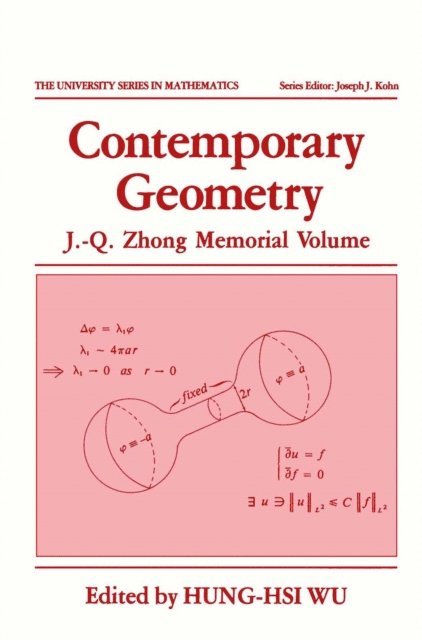
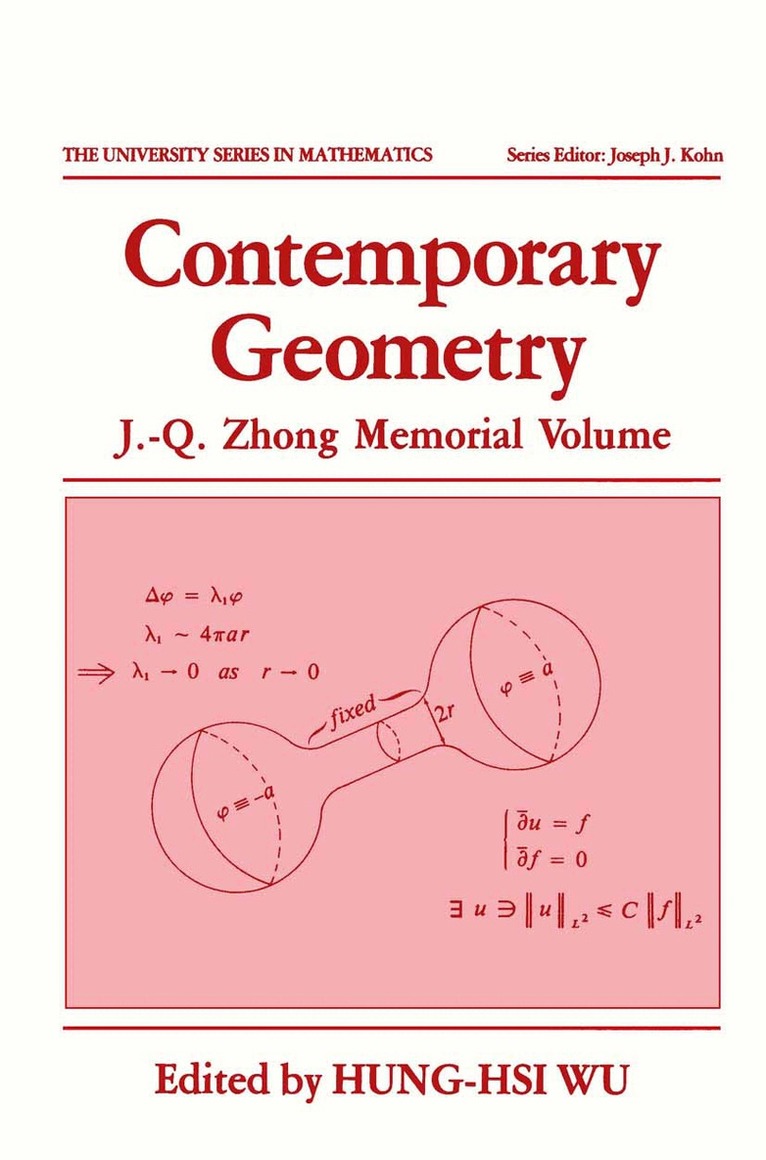
Early one morning in April of 1987, the Chinese mathematician J. -Q. Zhong died unexpectedly of a heart attack in New York. He was then near the end of a one-year visit in the United States. When news of his death reached his Chinese-American friends, it was immediately decided by one and all that something should be done to preserve his memory. The present volume is an outgrowth of this sentiment. His friends in China have also established a Zhong Jia-Qing Memorial Fund, which has since twice awarded the Zhong Jia-Qing prizes for Chinese mathematics graduate students. It is hoped that at least part of the reasons for the esteem and affection in which he was held by all who knew him would come through in the succeeding pages of this volume. The three survey chapters by Li and Treibergs, Lu, and Siu (Chapters 1-3) all center around the areas of mathematics in which Zhong made noteworthy contributions. In addition to putting Zhong's mathematical contributions in perspective, these articles should be useful also to a large segment of the mathematical community; together they give a coherent picture of a sizable portion of contemporary geometry. The survey of Lu differs from the other two in that it gives a firsthand account of the work done in the People's Republic of China in several complex variables in the last four decades.
760 kr
Skickas inom 7-10 vardagar
This is a systematic exposition of a major part of the mathematics of grades 5 to 8 (excluding statistics), written specifically for Common Core era teachers. It differs from other books for teachers in that the mathematics is correct, in the sense that all the concepts are clearly and correctly defined, and a grade-appropriate explanation (that is, proof) is given for every assertion. For example, it gives a precise definition of percent and explains how to use the definition to do all the standard problems about percent in an entirely routine manner. It also gives a leisurely explanation for ``negative times negative is positive''. Another key feature is an intuitive introduction to plane geometry via rotations, translations, reflections, and dilations that, instead of treating these transformations as merely fun activities, shows how they make sense of the usual geometric topics in middle school, including congruence, similarity, length, area, and volume. In short, the readers will find in this volume a clear explanation of whatever was once puzzling to them in the mathematics of grades 5 to 8.
760 kr
Skickas inom 7-10 vardagar
This is a systematic exposition of introductory school algebra written specifically for Common Core era teachers. The emphasis of the exposition is to give a mathematically correct treatment of introductory algebra. For example, it explains the proper use of symbols, why ``variable'' is not a mathematical concept, what an equation is, what equation-solving means, how to define the slope of a line correctly, why the graph of a linear equation in two variables is a straight line, why every straight line is the graph of a linear equation in two variables, how to use the shape of the graph of a quadratic function as a guide for the study of quadratic functions, how to define a parabola correctly, why the graph of a quadratic function is a parabola, why all parabolas are similar, etc. This exposition of algebra makes full use of the geometric concepts of congruence and similarity, and it justifies why the Common Core Standards on algebra are written the way they are.
572 kr
Skickas inom 7-10 vardagar
This is the first of three volumes that, together, give an exposition of the mathematics of grades 9-12 that is simultaneously mathematically correct and grade-level appropriate. The volumes are consistent with CCSSM (Common Core State Standards for Mathematics) and aim at presenting the mathematics of K-12 as a totally transparent subject. The present volume begins with fractions, then rational numbers, then introductory geometry that can make sense of the slope of a line, then an explanation of the correct use of symbols that makes sense of ``variables'', and finally a systematic treatment of linear equations that explains why the graph of a linear equation in two variables is a straight line and why the usual solution method for simultaneous linear equations ``by substitutions'' is correct. This book should be useful for current and future teachers of K-12 mathematics, as well as for some high school students and for education professionals.
572 kr
Skickas inom 7-10 vardagar
This is the second of three volumes that, together, give an exposition of the mathematics of grades 9-12 that is simultaneously mathematically correct and grade-level appropriate. The volumes are consistent with CCSSM (Common Core State Standards for Mathematics) and aim at presenting the mathematics of K-12 as a totally transparent subject.The first part of this volume is devoted to the study of standard algebra topics: quadratic functions, graphs of equations of degree 2 in two variables, polynomials, exponentials and logarithms, complex numbers and the fundamental theorem of algebra, and the binomial theorem. Having translations and the concept of similarity at our disposal enables us to clarify the study of quadratic functions by concentrating on their graphs, the same way the study of linear functions is greatly clarified by knowing that their graphs are lines. We also introduce the concept of formal algebra in the study of polynomials with complex coefficients. The last three chapters in this volume complete the systematic exposition of high school geometry that is consistent with CCSSM. These chapters treat the geometry of the triangle and the circle, ruler and compass constructions, and a general discussion of axiomatic systems, including non-Euclidean geometry and the celebrated work of Hilbert on the foundations.This book should be useful for current and future teachers of K-12 mathematics, as well as for some high school students and for education professionals.
572 kr
Skickas inom 7-10 vardagar
This is the last of three volumes that, together, give an exposition of the mathematics of grades 9–12 that is simultaneously mathematically correct and grade-level appropriate. The volumes are consistent with CCSSM (Common Core State Standards for Mathematics) and aim at presenting the mathematics of K–12 as a totally transparent subject.This volume distinguishes itself from others of the same genre in getting the mathematics right. In trigonometry, this volume makes explicit the fact that the trigonometric functions cannot even be defined without the theory of similar triangles. It also provides details for extending the domain of definition of sine and cosine to all real numbers. It explains as well why radians should be used for angle measurements and gives a proof of the conversion formulas between degrees and radians.In calculus, this volume pares the technicalities concerning limits down to the essential minimum to make the proofs of basic facts about differentiation and integration both correct and accessible to school teachers and educators; the exposition may also benefit beginning math majors who are learning to write proofs. An added bonus is a correct proof that one can get a repeating decimal equal to a given fraction by the “long division” of the numerator by the denominator. This proof attends to all three things all at once: what an infinite decimal is, why it is equal to the fraction, and how long division enters the picture.This book should be useful for current and future teachers of K–12 mathematics, as well as for some high school students and for education professionals.