Ira Verma – författare
Visar alla böcker från författaren . Handla med fri frakt och snabb leverans.
3 produkter
3 produkter
Inbunden, Engelska, 2024
2 655 kr
Skickas inom 10-15 vardagar
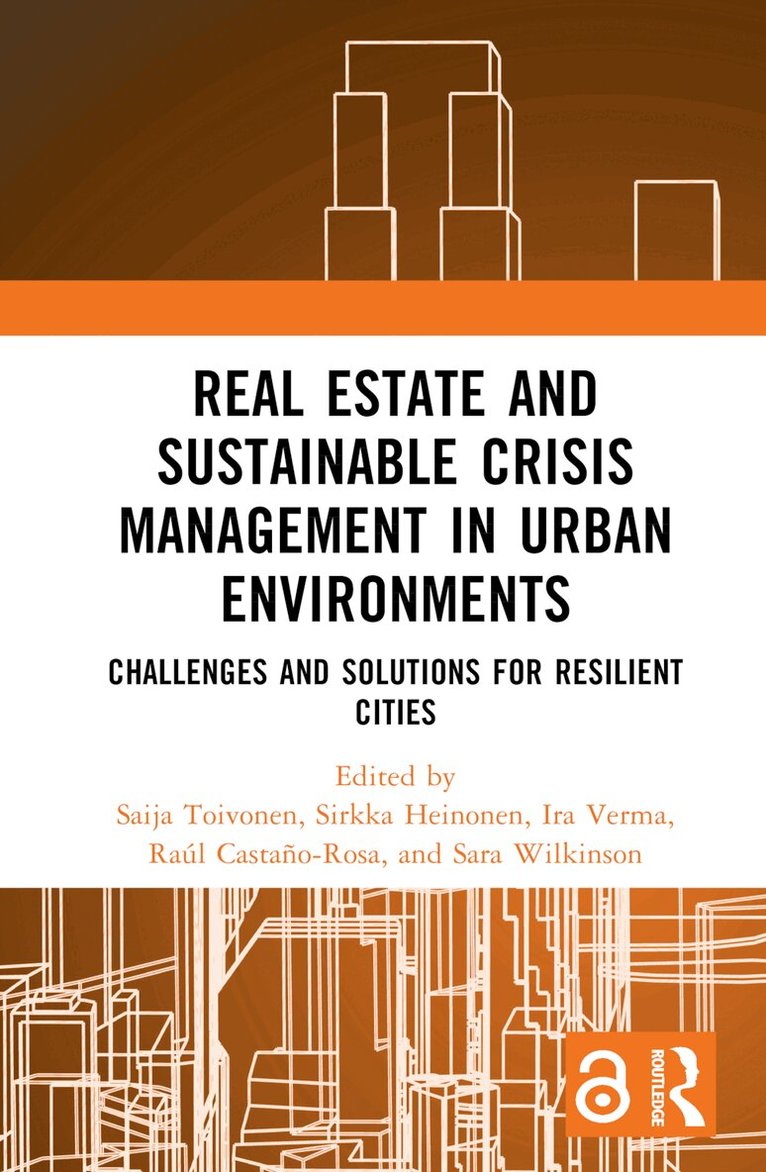
The aim of this book is to promote the dynamic resilience of societies by identifying, analysing, and exemplifying the role of space and land use in both anticipated and unanticipated primary and secondary crisis situations.The book brings together the expertise of a unique team of researchers and methods from fields of futures studies, land use planning, social sustainability and wellbeing, architecture, spatial planning, design and real estate economics, and presents a novel understanding of the direct and indirect impacts of possible crises in the space and land use context. It goes on to discuss the concept of resilience and exemplifies potential solutions and offers a holistic and forward-looking approach for crisis management through a lens of social sustainability and wellbeing, making an important contribution to the promotion of wellbeing in the built environment, especially in terms of land and residential space and building use.This book does not only identify barriers and successful incentives in resilient crisis management but also discusses the role of different stakeholders (e.g., households, office workers, real estate owners, space occupants, firms, the public sector, etc.) in crisis management. Finally, international case studies aiming to tackle the challenging landscape of future threats are presented, along with novel tools to support the development of future policies, regulations, and management practices in the built environment, which can increase the dynamic resilience of societies.Overall, this book is essential reading for decision-makers in the public and private sectors, urban developers, space and spatial designers, architects, planners, community stakeholders, real estate investors, facility managers and crisis and corporate responsibility managers.A PDF version of this book is available for free in Open Access at www. taylorfrancis.com. It has been made available under a Creative Commons Attribution 4.0 International license.
Häftad, Engelska, 2025
796 kr
Skickas inom 10-15 vardagar
The aim of this book is to promote the dynamic resilience of societies by identifying, analysing, and exemplifying the role of space and land use in both anticipated and unanticipated primary and secondary crisis situations.The book brings together the expertise of a unique team of researchers and methods from fields of futures studies, land use planning, social sustainability and wellbeing, architecture, spatial planning, design and real estate economics, and presents a novel understanding of the direct and indirect impacts of possible crises in the space and land use context. It goes on to discuss the concept of resilience and exemplifies potential solutions and offers a holistic and forward-looking approach for crisis management through a lens of social sustainability and wellbeing, making an important contribution to the promotion of wellbeing in the built environment, especially in terms of land and residential space and building use.This book does not only identify barriers and successful incentives in resilient crisis management but also discusses the role of different stakeholders (e.g., households, office workers, real estate owners, space occupants, firms, the public sector, etc.) in crisis management. Finally, international case studies aiming to tackle the challenging landscape of future threats are presented, along with novel tools to support the development of future policies, regulations, and management practices in the built environment, which can increase the dynamic resilience of societies.Overall, this book is essential reading for decision-makers in the public and private sectors, urban developers, space and spatial designers, architects, planners, community stakeholders, real estate investors, facility managers and crisis and corporate responsibility managers.A PDF version of this book is available for free in Open Access at www. taylorfrancis.com. It has been made available under a Creative Commons Attribution 4.0 International license.
2 053 kr
Skickas
Universal Design is a process for creating an equitable and sustainable society. It is a concept committed to recognizing and accepting each individual’s potential and characteristics, and promoting the realization of a built environment that does not stigmatize users, but enables everyone to participate fully in their community.This book presents 32 articles from the 5th International Conference on Universal Design (UD2021). Previous Universal Design conferences have been organized biennially, but the 2020 conference was postponed due to COVID-19 restrictions, and eventually held online from 9 - 11 June 2021. UD2021 brings together a multidisciplinary group of experts from around the world to share knowledge and best practice with the common goal of shaping the way we design; avoiding stereotyped or discriminatory views and solutions that could stigmatize particular groups of people. The articles are organized into chapters under seven broad themes: universal design and inclusive design; user experience and co-design; access to education and learning environment; web accessibility and usability of technology; architecture and the built environment; mobility and transport; and designing for older people.The current situation has highlighted not only the importance of web accessibility, the user-friendliness of interfaces and remote connections; during the last year, the importance and quality of our daily living environment, access to services and green space has also become ever more obvious. This book will be of particular interest to those working to enable all those with disabilities or impairments to live independently and participate fully in all aspects of life.