J. Douglas Toma – författare
Visar alla böcker från författaren J. Douglas Toma. Handla med fri frakt och snabb leverans.
4 produkter
4 produkter
Inbunden, Engelska, 2011
2 432 kr
Skickas inom 10-15 vardagar
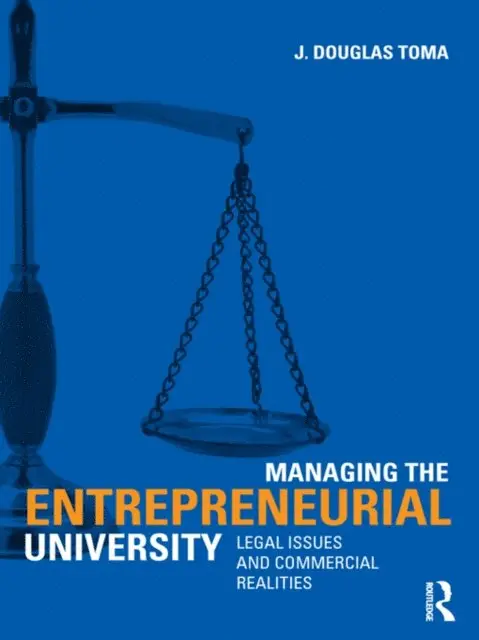
Managing the Entrepreneurial University is essential reading for both higher education administrators and those studying to enter the field. As universities have become more market focused, they have changed dramatically. But has the law kept up? This book explains fundamental legal concepts in clear, non-technical language and grounds them in practical management situations, indicating where doctrines and standards have evolved, identifying where legal difficulties may be more likely to arise, and suggesting where change may be merited.In its chapters on process, discrimination, employment, students, and regulation, the book: Provides lively case studies applicable to every type of institutionIncludes a simulation exercise at the end of each chapter for use in teaching or trainingDraws on an over 550-source bibliographyA hypothetical case spans each chapter, addressing not only research universities and elite liberal arts colleges, but also community colleges, small private colleges, and regional comprehensive universities. Readers working across functional areas and at various institution types will find the book directly relevant in clarifying and deepening their understanding of the legal environment associated with their responsibilities within the entrepreneurial university.
Häftad, Engelska, 2011
670 kr
Skickas inom 10-15 vardagar
Managing the Entrepreneurial University is essential reading for both higher education administrators and those studying to enter the field. As universities have become more market focused, they have changed dramatically. But has the law kept up? This book explains fundamental legal concepts in clear, non-technical language and grounds them in practical management situations, indicating where doctrines and standards have evolved, identifying where legal difficulties may be more likely to arise, and suggesting where change may be merited.In its chapters on process, discrimination, employment, students, and regulation, the book: Provides lively case studies applicable to every type of institutionIncludes a simulation exercise at the end of each chapter for use in teaching or trainingDraws on an over 550-source bibliographyA hypothetical case spans each chapter, addressing not only research universities and elite liberal arts colleges, but also community colleges, small private colleges, and regional comprehensive universities. Readers working across functional areas and at various institution types will find the book directly relevant in clarifying and deepening their understanding of the legal environment associated with their responsibilities within the entrepreneurial university.
Inbunden, Engelska, 2003
602 kr
Skickas inom 5-8 vardagar
The Big Ten . . . the SEC . . . the Final Four . . . sometimes it seems that American higher education is more about sports than studies. Not so, says this well-researched, evenhanded study of athletics in university life. Sports--particularly football--play a key role in defining institutions that might otherwise be indistinguishable and are an indispensable tool in building a sense of community on campus, as well as an important factor in mustering alumni and political support. While abuses exist, the "football school" is not only a legitimate member of the academic community but an inevitable one as well--and football provides much-needed identity at every level from the local to the national scale. Pointing out that universities compete as much academically as athletically, J. Douglas Toma argues that fielding a winning sports team is a quick, effective way to win recognition and that doing so pays dividends across the board, by raising public awareness (thereby making a school more attractive to potential students and faculty) and by creating a wider constituency of "fans" whose loyalties pay off in increased contributions and appropriations that support academic programs as well. He notes that universities like Harvard and Yale, now eclipsed on the gridiron, were "football powers" in the era when America's westward expansion spawned new schools unable to challenge older institutions academically but able to win acclaim through sports. This fosters a campus and alumni culture based on "football Saturday"--a bonding experience that helped forge a larger community whose support, both personal and financial, has become integral to the life of the institution. Football U. brings welcome impartiality to a subject all too often riven by controversy, pitting football boosters against critics who complain that academic achievement takes second place to athletic success. But as a tool for creating "brand awareness" as well as local loyalty and widespread support, high-profile athletic programs meet a variety of institutional needs in ways no other aspect of university life can. This, Toma observes, is a two-edged sword, for even as it fosters collegiality, it discourages reform when the pendulum swings too far in the direction of athletic dominance. Nevertheless, Football U. is here to stay. J. Douglas Toma is Director and Senior Fellow, The Executive Doctorate and Penn Center for Higher Education Management, the University of Pennsylvania's Graduate School of Education.
Inbunden, Engelska, 2011
492 kr
Skickas inom 5-8 vardagar
Every university or college president envisions bold initiatives-big projects intended to change the nature of an institution with significant implications across all sectors. How can leaders and senior managers charged with implementing reforms effectively frame their work and anticipate potential pitfalls? No organization can maximize its capacity, defined as the administrative foundation essential for establishing and sustaining initiatives, without considering its core elements individually and in concert, according to J. Douglas Toma. This book examines eight essential organizational elements-purposes, structure, governance, policies, processes, information, infrastructure, and culture-and illuminates their influence in strategic management through case studies at eight institutions. Building Organizational Capacity situates strategic management within the context of higher education, providing practitioners with the tools to better understand institutional challenges in accomplishing its missions and realizing its aspirations.Toma's clear and well-integrated review of the latest research, as well as his advice for decision makers applying the book's lessons in practice, ensures this volume's place in the growing literature on strategy and management in higher education.