J. E. Lewis – författare
Visar alla böcker från författaren J. E. Lewis. Handla med fri frakt och snabb leverans.
7 produkter
7 produkter
1 188 kr
Skickas inom 5-8 vardagar
Features the classical themes of geometry with plentiful applications in mathematics, education, engineering, and scienceAccessible and reader-friendly, Classical Geometry: Euclidean, Transformational, Inversive, and Projective introduces readers to a valuable discipline that is crucial to understanding bothspatial relationships and logical reasoning. Focusing on the development of geometric intuitionwhile avoiding the axiomatic method, a problem solving approach is encouraged throughout.The book is strategically divided into three sections: Part One focuses on Euclidean geometry, which provides the foundation for the rest of the material covered throughout; Part Two discusses Euclidean transformations of the plane, as well as groups and their use in studying transformations; and Part Three covers inversive and projective geometry as natural extensions of Euclidean geometry. In addition to featuring real-world applications throughout, Classical Geometry: Euclidean, Transformational, Inversive, and Projective includes: Multiple entertaining and elegant geometry problems at the end of each section for every level of studyFully worked examples with exercises to facilitate comprehension and retentionUnique topical coverage, such as the theorems of Ceva and Menalaus and their applicationsAn approach that prepares readers for the art of logical reasoning, modeling, and proofsThe book is an excellent textbook for courses in introductory geometry, elementary geometry, modern geometry, and history of mathematics at the undergraduate level for mathematics majors, as well as for engineering and secondary education majors. The book is also ideal for anyone who would like to learn the various applications of elementary geometry.
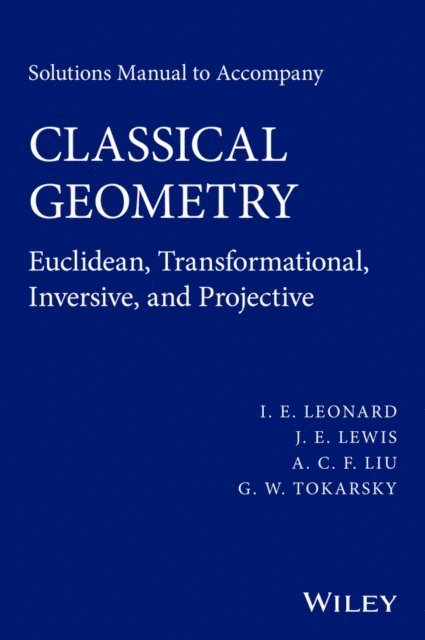
Solutions Manual to Accompany Classical Geometry
Euclidean, Transformational, Inversive, and Projective
Häftad, Engelska, 2014
378 kr
Skickas inom 5-8 vardagar
Solutions Manual to accompany Classical Geometry: Euclidean, Transformational, Inversive, and ProjectiveWritten by well-known mathematical problem solvers, Classical Geometry: Euclidean, Transformational, Inversive, and Projective features up-to-date and applicable coverage of the wide spectrum of geometry and aids readers in learning the art of logical reasoning, modeling, and proof. With its reader-friendly approach, this undergraduate text features self-contained topical coverage and provides a large selection of solved exercises to aid in reader comprehension. Material in this text can be tailored for a one-, two-, or three-semester sequence.
Classical Geometry
Euclidean, Transformational, Inversive, and Projective Set
Inbunden, Engelska, 2014
1 441 kr
Skickas inom 5-8 vardagar
The combination text and Student Solutions Manual that features the classical themes of geometry with plentiful applications Accessible and reader-friendly, Classical Geometry: Euclidean, Transformational, Inversive, and Projective and the companion Student Solutions Manual introduces a valuable discipline that is crucial to understanding both spatial relationships and logical reasoning. Focusing on the development of geometric intuition while avoiding the axiomatic method, a problem solving approach is encouraged throughout. The books address Euclidean geometry, Euclidean transformations, and inversive and projective geometry.
1 162 kr
Skickas inom 5-8 vardagar
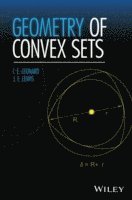
A gentle introduction to the geometry of convex sets in n-dimensional spaceGeometry of Convex Sets begins with basic definitions of the concepts of vector addition and scalar multiplication and then defines the notion of convexity for subsets of n-dimensional space. Many properties of convex sets can be discovered using just the linear structure. However, for more interesting results, it is necessary to introduce the notion of distance in order to discuss open sets, closed sets, bounded sets, and compact sets. The book illustrates the interplay between these linear and topological concepts, which makes the notion of convexity so interesting.Thoroughly class-tested, the book discusses topology and convexity in the context of normed linear spaces, specifically with a norm topology on an n-dimensional space.Geometry of Convex Sets also features: An introduction to n-dimensional geometry including points; lines; vectors; distance; norms; inner products; orthogonality; convexity; hyperplanes; and linear functionals Coverage of n-dimensional norm topology including interior points and open sets; accumulation points and closed sets; boundary points and closed sets; compact subsets of n-dimensional space; completeness of n-dimensional space; sequences; equivalent norms; distance between sets; and support hyperplanes ·Basic properties of convex sets; convex hulls; interior and closure of convex sets; closed convex hulls; accessibility lemma; regularity of convex sets; affine hulls; flats or affine subspaces; affine basis theorem; separation theorems; extreme points of convex sets; supporting hyperplanes and extreme points; existence of extreme points; Krein–Milman theorem; polyhedral sets and polytopes; and Birkhoff’s theorem on doubly stochastic matricesDiscussions of Helly’s theorem; the Art Gallery theorem; Vincensini’s problem; Hadwiger’s theorems; theorems of Radon and Caratheodory; Kirchberger’s theorem; Helly-type theorems for circles; covering problems; piercing problems; sets of constant width; Reuleaux triangles; Barbier’s theorem; and Borsuk’s problem Geometry of Convex Sets is a useful textbook for upper-undergraduate level courses in geometry of convex sets and is essential for graduate-level courses in convex analysis. An excellent reference for academics and readers interested in learning the various applications of convex geometry, the book is also appropriate for teachers who would like to convey a better understanding and appreciation of the field to students.I. E. Leonard, PhD, was a contract lecturer in the Department of Mathematical and Statistical Sciences at the University of Alberta. The author of over 15 peer-reviewed journal articles, he is a technical editor for the Canadian Applied Mathematical Quarterly journal.J. E. Lewis, PhD, is Professor Emeritus in the Department of Mathematical Sciences at the University of Alberta. He was the recipient of the Faculty of Science Award for Excellence in Teaching in 2004 as well as the PIMS Education Prize in 2002.
1 327 kr
Skickas
This set includes Geometry of Convex Sets and Solutions Manual to Accompany Geometry of Convex Sets.Geometry of Convex Sets begins with basic definitions of the concepts of vector addition and scalar multiplication and then defines the notion of convexity for subsets of n-dimensional space. Many properties of convex sets can be discovered using just the linear structure. However, for more interesting results, it is necessary to introduce the notion of distance in order to discuss open sets, closed sets, bounded sets, and compact sets. The book illustrates the interplay between these linear and topological concepts, which makes the notion of convexity so interesting.Thoroughly class-tested, the book discusses topology and convexity in the context of normed linear spaces, specifically with a norm topology on an n-dimensional space.Geometry of Convex Sets also features: An introduction to n-dimensional geometry including points; lines; vectors; distance; norms; inner products; orthogonality; convexity; hyperplanes; and linear functionals Coverage of n-dimensional norm topology including interior points and open sets; accumulation points and closed sets; boundary points and closed sets; compact subsets of n-dimensional space; completeness of n-dimensional space; sequences; equivalent norms; distance between sets; and support hyperplanes ·Basic properties of convex sets; convex hulls; interior and closure of convex sets; closed convex hulls; accessibility lemma; regularity of convex sets; affine hulls; flats or affine subspaces; affine basis theorem; separation theorems; extreme points of convex sets; supporting hyperplanes and extreme points; existence of extreme points; Krein–Milman theorem; polyhedral sets and polytopes; and Birkhoff’s theorem on doubly stochastic matricesDiscussions of Helly’s theorem; the Art Gallery theorem; Vincensini’s problem; Hadwiger’s theorems; theorems of Radon and Caratheodory; Kirchberger’s theorem; Helly-type theorems for circles; covering problems; piercing problems; sets of constant width; Reuleaux triangles; Barbier’s theorem; and Borsuk’s problemGeometry of Convex Sets is a useful textbook for upper-undergraduate level courses in geometry of convex sets and is essential for graduate-level courses in convex analysis. An excellent reference for academics and readers interested in learning the various applications of convex geometry, the book is also appropriate for teachers who would like to convey a better understanding and appreciation of the field to students.I. E. Leonard, PhD, was a contract lecturer in the Department of Mathematical and Statistical Sciences at the University of Alberta. The author of over 15 peer-reviewed journal articles, he is a technical editor for the Canadian Applied Mathematical Quarterly journal.J. E. Lewis, PhD, is Professor Emeritus in the Department of Mathematical Sciences at the University of Alberta. He was the recipient of the Faculty of Science Award for Excellence in Teaching in 2004 as well as the PIMS Education Prize in 2002.
365 kr
Skickas inom 5-8 vardagar
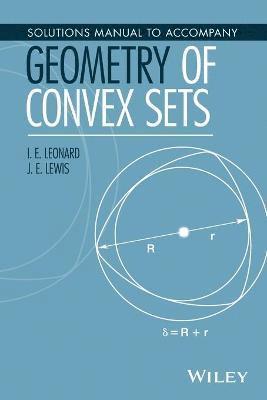
A Solutions Manual to accompany Geometry of Convex SetsGeometry of Convex Sets begins with basic definitions of the concepts of vector addition and scalar multiplication and then defines the notion of convexity for subsets of n-dimensional space. Many properties of convex sets can be discovered using just the linear structure. However, for more interesting results, it is necessary to introduce the notion of distance in order to discuss open sets, closed sets, bounded sets, and compact sets. The book illustrates the interplay between these linear and topological concepts, which makes the notion of convexity so interesting.Thoroughly class-tested, the book discusses topology and convexity in the context of normed linear spaces, specifically with a norm topology on an n-dimensional space.Geometry of Convex Sets also features: An introduction to n-dimensional geometry including points; lines; vectors; distance; norms; inner products; orthogonality; convexity; hyperplanes; and linear functionals Coverage of n-dimensional norm topology including interior points and open sets; accumulation points and closed sets; boundary points and closed sets; compact subsets of n-dimensional space; completeness of n-dimensional space; sequences; equivalent norms; distance between sets; and support hyperplanes ·Basic properties of convex sets; convex hulls; interior and closure of convex sets; closed convex hulls; accessibility lemma; regularity of convex sets; affine hulls; flats or affine subspaces; affine basis theorem; separation theorems; extreme points of convex sets; supporting hyperplanes and extreme points; existence of extreme points; Krein–Milman theorem; polyhedral sets and polytopes; and Birkhoff’s theorem on doubly stochastic matricesDiscussions of Helly’s theorem; the Art Gallery theorem; Vincensini’s problem; Hadwiger’s theorems; theorems of Radon and Caratheodory; Kirchberger’s theorem; Helly-type theorems for circles; covering problems; piercing problems; sets of constant width; Reuleaux triangles; Barbier’s theorem; and Borsuk’s problem Geometry of Convex Sets is a useful textbook for upper-undergraduate level courses in geometry of convex sets and is essential for graduate-level courses in convex analysis. An excellent reference for academics and readers interested in learning the various applications of convex geometry, the book is also appropriate for teachers who would like to convey a better understanding and appreciation of the field to students.I. E. Leonard, PhD, was a contract lecturer in the Department of Mathematical and Statistical Sciences at the University of Alberta. The author of over 15 peer-reviewed journal articles, he is a technical editor for the Canadian Applied Mathematical Quarterly journal.J. E. Lewis, PhD, is Professor Emeritus in the Department of Mathematical Sciences at the University of Alberta. He was the recipient of the Faculty of Science Award for Excellence in Teaching in 2004 as well as the PIMS Education Prize in 2002.
Del 984 - Lecture Notes in Mathematics
Propagation of Singularities for Fuchsian Operators
Häftad, Engelska, 1983
272 kr
Skickas inom 10-15 vardagar