James R. Crawford – författare
Visar alla böcker från författaren James R. Crawford. Handla med fri frakt och snabb leverans.
3 produkter
3 produkter
3 320 kr
Skickas inom 7-10 vardagar
As much as was ever the case in 1979 when the first edition of The Creation of States in International Law published, in the 21st century problems of territorial status and statehood are likely to continue to be a focal point of international disputes. As Rhodesia, Namibia, the South African Homelands and Taiwan then were subjects of acute concern, today governments, international organizations, and other institutions are seized of such matters as the membership of Cyprus in the European Union, application of the Geneva Conventions to Afghanistan, a final settlement for Kosovo, and, still, relations between China and Taiwan. The remarkable increase in the number of States in the 20th century did not abate in the twenty five years following publication of James Crawford's landmark study, which was awarded the American Society of International Law Prize for Creative Scholarship in 1981. The independence of many small territories comprising the 'residue' of the European colonial empires alone accounts for a major increase in States since 1979; while the disintegration of Yugoslavia and the USSR in the early 1990s further augmented the ranks. With these developments, the practice of States and international organizations has developed by substantial measure in respect of self-determination, secession, succession, recognition, de-colonization, and several other fields. Addressing such questions as the unification of Germany, the status of Israel and Palestine, and the continuing pressure from non-State groups to attain statehood, even, in cases like Chechnya or Tibet, against the presumptive rights of existing States, James Crawford discusses the relation between statehood and recognition as it has developed since the eighteenth century. The criteria for statehood and the effect on those criteria of evolving standards of democracy and human rights; their application in international organizations and between States; the creation of States by devolution or recession, by international disposition of major powers or international organizations and through institutions established for Mandated, Trust, and Non-Self-Governing Territories, are also discussed. Apart from the general argument of the normative significance of the legal concept of 'State', and the analysis of the numerous specific cases, this new edition of a landmark book provides a full and up-to-date account of the general development which has led to the birth of so many new States.
1 209 kr
Skickas inom 7-10 vardagar
Statehood in the early 21st century remains as much a central problem as it was in 1979 when the first edition of The Creation of States in International Law was published. As Rhodesia, Namibia, the South African Homelands and Taiwan then were subjects of acute concern, today governments, international organizations, and other institutions are seized of such matters as the membership of Cyprus in the European Union, application of the Geneva Conventions to Afghanistan, a final settlement for Kosovo, and, still, relations between China and Taiwan. All of these, and many other disputed situations, are inseparable from the nature of statehood and its application in practice.The remarkable increase in the number of States in the 20th century did not abate in the twenty five years following publication of James Crawford's landmark study, which was awarded the American Society of International Law Prize for Creative Scholarship in 1981. The independence of many small territories comprising the 'residue' of the European colonial empires alone accounts for a major increase in States since 1979; while the disintegration of Yugoslavia and the USSR in the early 1990s further augmented the ranks. With these developments, the practice of States and international organizations has developed by substantial measure in respect of self-determination, secession, succession, recognition, de-colonization, and several other fields.Addressing such questions as the unification of Germany, the status of Israel and Palestine, and the continuing pressure from non-State groups to attain statehood, even, in cases like Chechnya or Tibet, against the presumptive rights of existing States, James Crawford discusses the relation between statehood and recognition; the criteria for statehood, especially in view of evolving standards of democracy and human rights; and the application of such criteria in international organizations and between states. Also discussed are the mechanisms by which states have been created, including devolution and secession, international disposition by major powers or international organizations and the institutions established for Mandated, Trust, and Non-Self-Governing Territories. Combining a general argument as to the normative significance of statehood with analysis of numerous specific cases, this fully revised and expanded second edition gives a comprehensive account of the developments which have led to the birth of so many new states.
3 059 kr
Skickas inom 5-8 vardagar
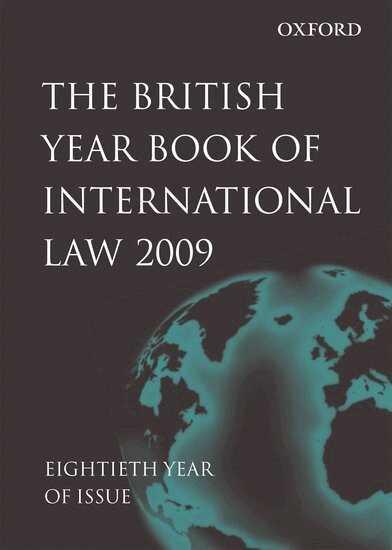
Now in its 80th year, the British Year Book of International Law has become an essential work of reference for academics and practising lawyers. Through a mixture of articles and extended book reviews it continues to provide indispensable analysis on important developments in modern international law. In addition, through its exhaustive coverage of decisions in UK courts and official government statements, the British Year Book offers unique insight into the development of state practice in the United KingdomFrom Volume 81, the British Year Book of International Law will be available as online only, print only, or combined print and online subscriptions from Oxford Journals. The archive back to 1996 will be available immediately from January. Find out more: http://bybil.oxfordjournals.org/