J.L. Heilbron - Böcker
Visar alla böcker från författaren J.L. Heilbron. Handla med fri frakt och snabb leverans.
3 produkter
3 produkter
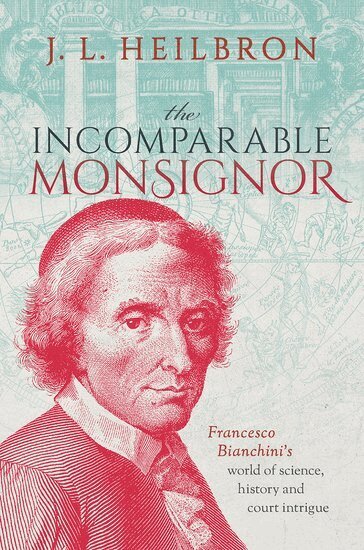
The Incomparable Monsignor
Francesco Bianchini's world of science, history, and court intrigue
Inbunden, Engelska, 2022
264 kr
Skickas inom 5-8 vardagar
Through Francesco Bianchini, the 'greatest Italian of his time' this book explores the exciting meeting of science, history, and politics in early modern Europe.Born in a time where entry into the church granted power, privilege, and access to the most exciting ideas of his time, the magnificent Monsignor Francesco Bianchini was an accomplished player in the political, scientific, and historical arenas of early modern Europe. Among his accomplishments were writing a universal history from the creation to the fall of Assyria; discovering, excavating, and interpreting ancient buildings; and designing a papal collection of antiquities that was later partially realized in the Vatican museums. He was also responsible for confirming and publicizing Newton's theories of light and color; discovering several comets; and building the most beautiful and exact heliometer in the world in the basilica of Santa Maria degli Angeli in Rome. Bianchini's international reputation earned him election to the Académie royale des sciences of Paris and the Royal Society of London. As a trusted servant of Pope Clement XI, he helped to execute the difficult balancing act the papacy practiced during the War of the Spanish Succession, which pitted Britain, the Dutch Republic, and the Habsburg Empire against France and Spain. One of his assignments also resulted in attachment to the cause and person of the Old Pretender, James III, the Stuart claimant to the thrones of England, Scotland, and Ireland. Through the career of this eminent and adept diplomat, astronomer, archaeologist, and historian, J. L. Heilbron introduces a world of learning and discovery, Church and State, and politics and power.
281 kr
Skickas
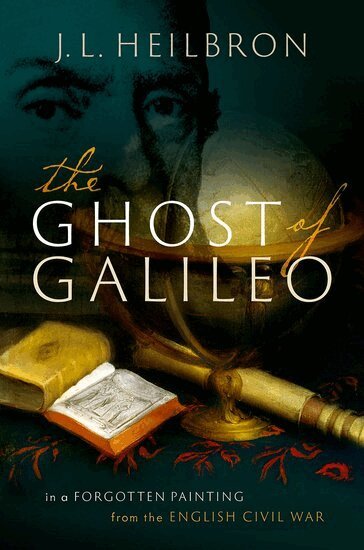
In 1643/4 the once-famous Francis Cleyn painted the unhappy young heir of Corfe Castle, John Bankes, and his tutor, Dr Maurice Williams. The painter is now almost forgotten,the painting much neglected, and the sitters themselves have left little to mark their lives, but on the table of the painting lies a book, open to an immediately identifiable and very significant page. The representation omits the author's name and the book's title; it sits there as a code, as only viewers who had encountered the original and the characteristic figures on its frontispiece would have known its significance. The book is Galileo's Dialogue on the two chief world systems (1632), the defence of Copernican cosmology that incited the infamous clash between its author and the Church, and its presence in this painting is no accident, but instead a statement of learning, attitudes, and cosmopolitan engagement in European discourse by the painting's English subjects.Grasping hold of the clue, John Helibron deciphers the significance of this contentious book's appearance in a painting from Stuart England to unravel the interlocking threads of art history, political and religious history, and the history of science. Drawing on unexploited archival material and a wide range of printed works, he weaves together English court culture and Italian connections, as well as the astronomical and astrological knowledge propagated in contemporary almanacs and deployed in art, architecture, plays, masques, and political discourse. Heilbron also explores the biographies of Sir John Bankes (father of the sitter), Sir Maurice, and the painter, Francis Cleyn, setting them into the narrative of their rich and cultured history.
Del 5 - California Studies in the History of Science
Lawrence and His Laboratory
A History of the Lawrence Berkeley Laboratory, Volume I
Inbunden, Engelska, 1990
550 kr
Skickas inom 7-10 vardagar
The Radiation Laboratory in Berkeley, California, was the birthplace of particle accelerators, radioisotopes, and modern big science. This first volume of its history is a saga of physics and finance in the Great Depression, when a new kind of science was born. Here we learn how Ernest Lawrence used local and national technological, economic, and manpower resources to build the cyclotron, which enabled scientists to produce high-voltage particles without high voltages. The cyclotron brought Lawrence forcibly and permanently to the attention of leaders of international physics in Brussels at the Solvay Congress of 1933. Ever since, the Rad Lab has played a prominent part on the world stage. The book tells of the birth of nuclear chemistry and nuclear medicine in the Laboratory, the discoveries of new isotopes and the transuranic elements, the construction of the ultimate cyclotron, Lawrence's Nobel Prize, and the energy, enthusiasm, and enterprise of Laboratory staff. Two more volumes are planned to carry the story through the Second World War, the establishment of the system of national laboratories, and the loss of Berkeley's dominance of high-energy physics.