John Essick - Böcker
Visar alla böcker från författaren John Essick. Handla med fri frakt och snabb leverans.
4 produkter
4 produkter
792 kr
Skickas inom 5-8 vardagar
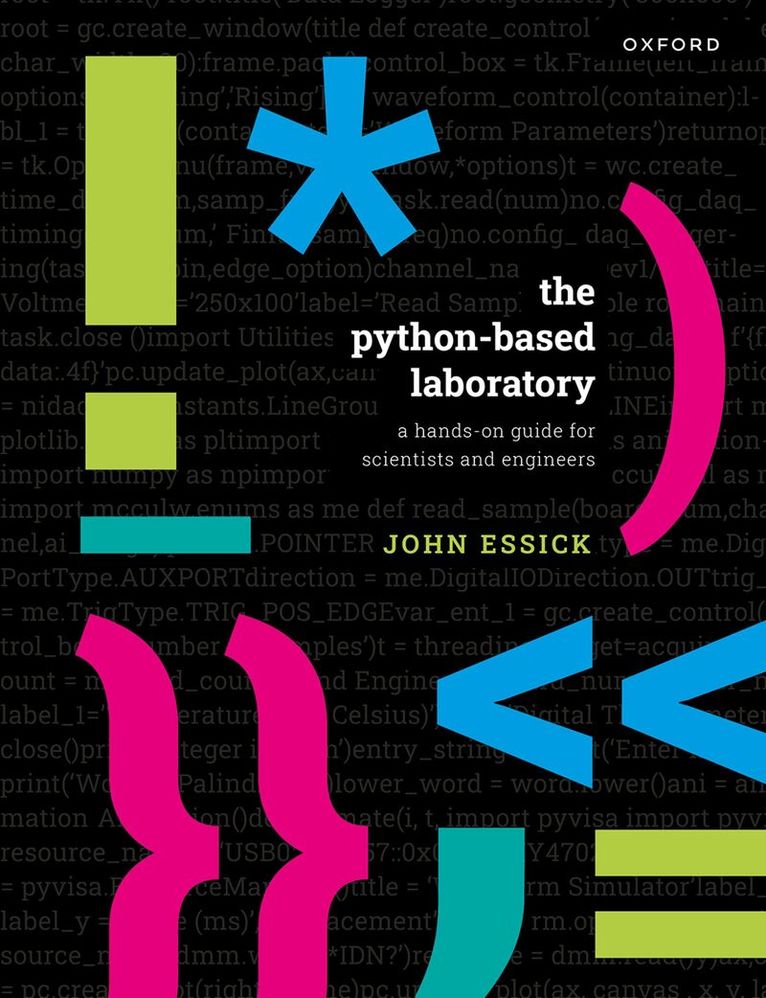
The Python-Based Laboratory: A Hands-On Guide for Scientists and Engineers provides a learn-by-doing approach to acquiring the Python programming skills needed to implement computer-controlled experimental work. The book leads its readers to mastery of the popular, open-source Python computer language in its role as a powerful laboratory tool by carrying out interesting and relevant projects that explore the acquisition, production, analysis, and presentation of digitized waveforms. Readers, who are assumed to have no prior computer programming or Python background, begin writing meaningful programs in the first few pages.The Python-Based Laboratory can be used as a textbook for science and engineering instructional laboratory students who are being taught up-to-date Python-based experimental skills. The book also works well as a self-study guide for professional laboratory researchers, industrial engineers, hobbyists, and electronics enthusiasts seeking to automate tasks using Python. Topics covered include the control of data acquisition devices (including multifunction data acquisition hardware and IEEE-interfaced stand-alone instruments), data file storage and presentation, digitized data concepts (such as resolution, sampling frequency, and aliasing), and data analysis techniques (curve fitting and fast Fourier transform). As readers work their way through the book, they build several computer-based instruments, including a DC voltmeter, digital oscilloscope, DC voltage source, waveform generator, blinking LED array, digital thermometer, and spectrum analyzer. Each chapter concludes with a Do-It-Yourself project and a Use It! example as well as a healthy selection of homework-style problems, allowing readers to test their understanding and further develop their Python-based experimentation skills.
988 kr
Skickas inom 5-8 vardagar
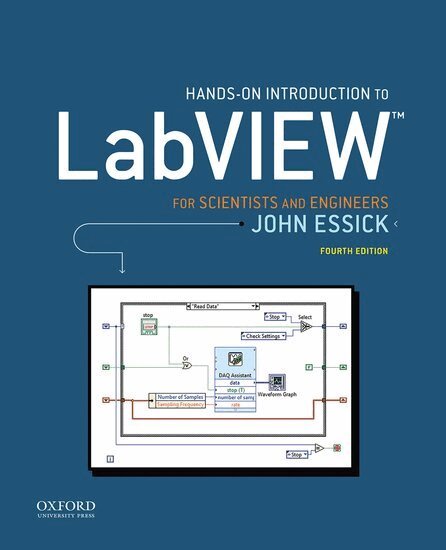
Hands-On Introduction to LaVIEW for Scientists and Engineers provides a learn-by-doing approach to acquiring the computer-based skills used daily in experimental work. The book is not the typical manual-like presentation of LabVIEW. Rather, Hands-On Introduction to LabVIEW guides students through using this powerful laboratory tool to carry out interesting and relevant projects. Readers, who are assumed to have no prior computer programming or LabVIEW experience, begin writing meaningful programs in the first few pages. After learning through experience, readers can master the skills needed to carry out effective experiments.
1 732 kr
Skickas inom 5-8 vardagar
The Python-Based Laboratory: A Hands-On Guide for Scientists and Engineers provides a learn-by-doing approach to acquiring the Python programming skills needed to implement computer-controlled experimental work. The book leads its readers to mastery of the popular, open-source Python computer language in its role as a powerful laboratory tool by carrying out interesting and relevant projects that explore the acquisition, production, analysis, and presentation of digitized waveforms. Readers, who are assumed to have no prior computer programming or Python background, begin writing meaningful programs in the first few pages.The Python-Based Laboratory can be used as a textbook for science and engineering instructional laboratory students who are being taught up-to-date Python-based experimental skills. The book also works well as a self-study guide for professional laboratory researchers, industrial engineers, hobbyists, and electronics enthusiasts seeking to automate tasks using Python. Topics covered include the control of data acquisition devices (including multifunction data acquisition hardware and IEEE-interfaced stand-alone instruments), data file storage and presentation, digitized data concepts (such as resolution, sampling frequency, and aliasing), and data analysis techniques (curve fitting and fast Fourier transform). As readers work their way through the book, they build several computer-based instruments, including a DC voltmeter, digital oscilloscope, DC voltage source, waveform generator, blinking LED array, digital thermometer, and spectrum analyzer. Each chapter concludes with a Do-It-Yourself project and a Use It! example as well as a healthy selection of homework-style problems, allowing readers to test their understanding and further develop their Python-based experimentation skills.
195 kr
Skickas inom 5-8 vardagar