Jose Neuman de Souza – författare
Visar alla böcker från författaren Jose Neuman de Souza. Handla med fri frakt och snabb leverans.
7 produkter
7 produkter
2 822 kr
Läs direkt efter köp
Welcome to the third International Conference on Management of Multimedia Networks and Services (MMNS''2000) in Fortaleza (Brazil)! The first MMNS was held in Montreal ( Canada) in july 1997 and the second MMNS was held in Versailles (France) in November 1998. The MMNS conference takes place every year and a half and is aimed to be a truly international event by bringing together researchers and practitioners from all around the world and by organising the conference each time in a different continent/country. Over the past several years, there has been a considerable amount of research within the fields of multimedia networking and network management. Much of that work has taken place within the context of managing Quality-of Service in broadband integrated services digital networks such as the A TM, and more recently in IP-based networks, to respond to the requirements of emerging multimedia applications. A TM networks were designed to support multimedia traffic with diverse characteristics and can be used as the transfer mode for both wired and wireless networks. A new set of Internet protocols is being developed to provide better quality of service, which is a prerequisite for supporting multimedia applications. Multimedia applications have a different set of requirements, which impacts the design of the underlying communication network as well as its management. Several QoS management mechanisms intervening at different layers of the communication network are required including QoS-routing, QoS-based transport, QoS negotiation, QoS adaptation, FCAPS management, and mobility management.
2 230 kr
Skickas inom 10-15 vardagar
Welcome to the third International Conference on Management of Multimedia Networks and Services (MMNS'2000) in Fortaleza (Brazil)! The first MMNS was held in Montreal ( Canada) in july 1997 and the second MMNS was held in Versailles (France) in November 1998. The MMNS conference takes place every year and a half and is aimed to be a truly international event by bringing together researchers and practitioners from all around the world and by organising the conference each time in a different continent/country. Over the past several years, there has been a considerable amount of research within the fields of multimedia networking and network management. Much of that work has taken place within the context of managing Quality-of Service in broadband integrated services digital networks such as the A TM, and more recently in IP-based networks, to respond to the requirements of emerging multimedia applications. A TM networks were designed to support multimedia traffic with diverse characteristics and can be used as the transfer mode for both wired and wireless networks. A new set of Internet protocols is being developed to provide better quality of service, which is a prerequisite for supporting multimedia applications. Multimedia applications have a different set of requirements, which impacts the design of the underlying communication network as well as its management. Several QoS management mechanisms intervening at different layers of the communication network are required including QoS-routing, QoS-based transport, QoS negotiation, QoS adaptation, FCAPS management, and mobility management.
Del 54 - IFIP Advances in Information and Communication Technology
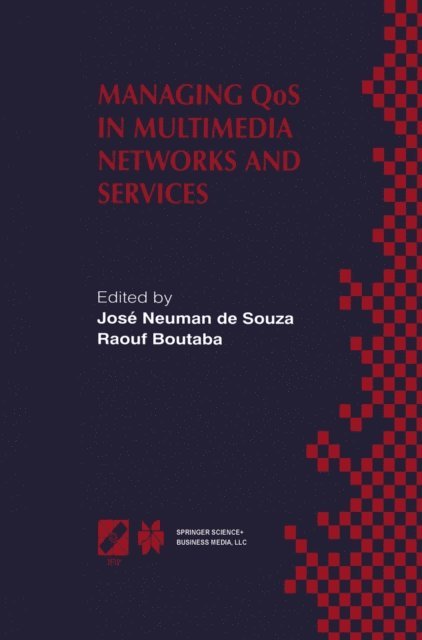
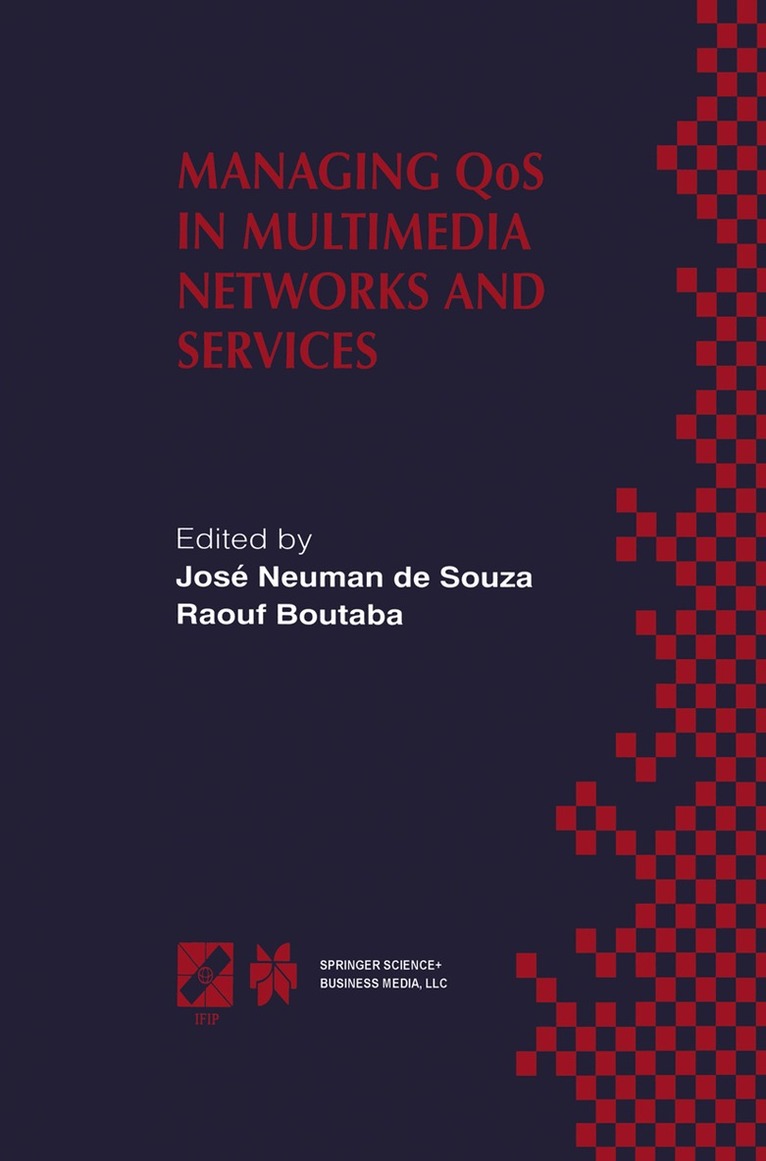
Managing QoS in Multimedia Networks and Services
IEEE / IFIP TC6 — WG6.4 & WG6.6 Third International Conference on Management of Multimedia Networks and Services (MMNS’2000) September 25–28, 2000, Fortaleza, Ceará, Brazil
Häftad, Engelska, 2013
2 230 kr
Skickas inom 10-15 vardagar
Welcome to the third International Conference on Management of Multimedia Networks and Services (MMNS'2000) in Fortaleza (Brazil)! The first MMNS was held in Montreal ( Canada) in july 1997 and the second MMNS was held in Versailles (France) in November 1998. The MMNS conference takes place every year and a half and is aimed to be a truly international event by bringing together researchers and practitioners from all around the world and by organising the conference each time in a different continent/country. Over the past several years, there has been a considerable amount of research within the fields of multimedia networking and network management. Much of that work has taken place within the context of managing Quality-of Service in broadband integrated services digital networks such as the A TM, and more recently in IP-based networks, to respond to the requirements of emerging multimedia applications. A TM networks were designed to support multimedia traffic with diverse characteristics and can be used as the transfer mode for both wired and wireless networks. A new set of Internet protocols is being developed to provide better quality of service, which is a prerequisite for supporting multimedia applications. Multimedia applications have a different set of requirements, which impacts the design of the underlying communication network as well as its management. Several QoS management mechanisms intervening at different layers of the communication network are required including QoS-routing, QoS-based transport, QoS negotiation, QoS adaptation, FCAPS management, and mobility management.
Häftad, Engelska, 2004
565 kr
Skickas inom 10-15 vardagar
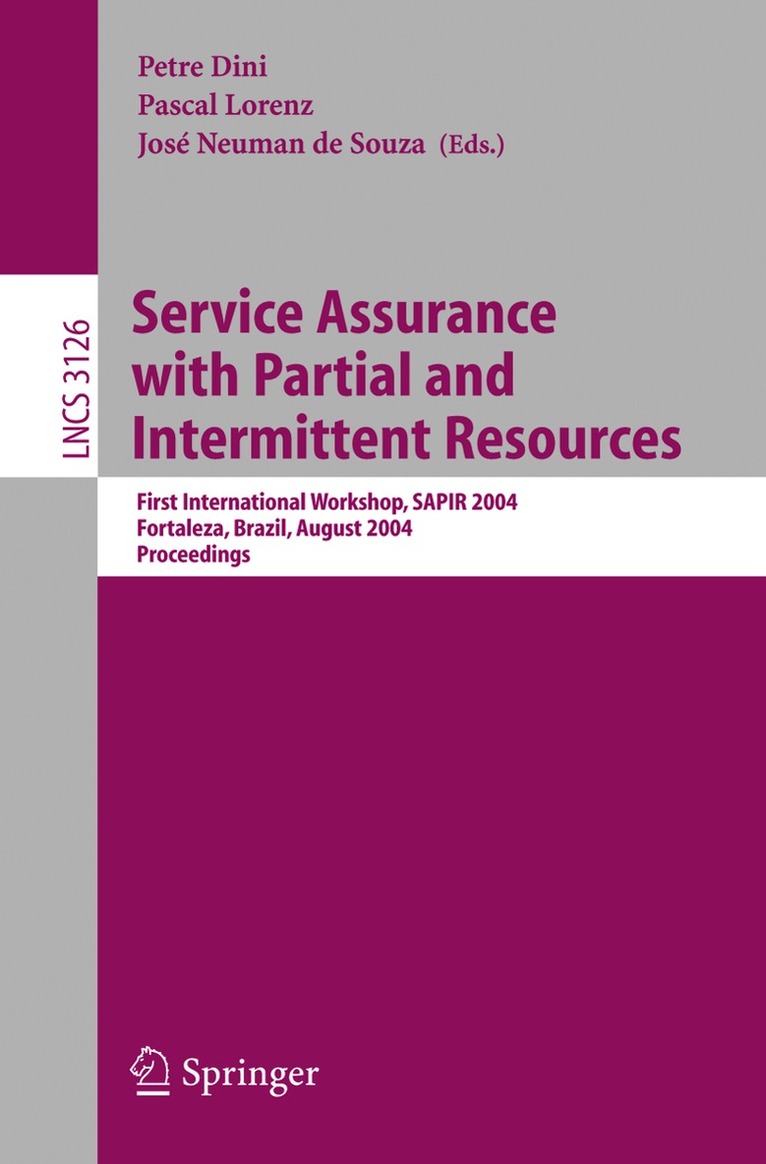
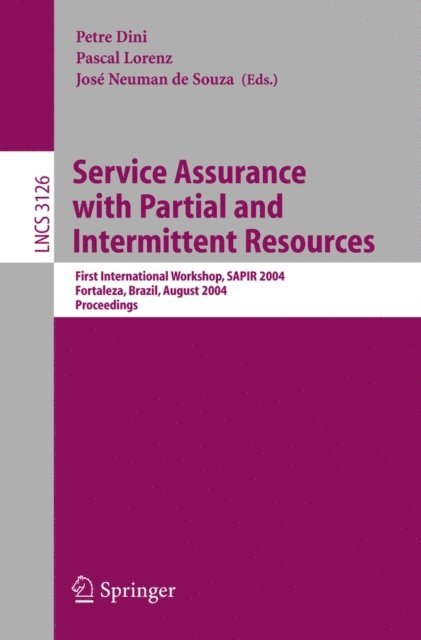
The 1st Workshop on Service Assurance with Partial and Intermittent Resources (SAPIR 2004) was the first event in a series introducing the concept of pi-resources and bridging it with the emerging and important field of distributed and heavily shared resources. The topics concerning this event are driven by a paradigm shift occurring in the last decade in telecommunications and networking considering partial and intermittent resources (pi-resources). The Internet, converged networks, delay-tolerant networks, ad hoc networking, GRID-supporting networks, and satellite communications require a management paradigm shift that takes into account the partial and intermittent availability of resources, including infrastructure (networks, computing, and storage) and service components, in distributed and shared environments. A resource is called partial (p-resource) when only a subset of conditions for it to function to complete specification is met, yet it is still able to provide a (potentially degraded) service, while an intermittent or sporadic resource (i-resource) will be able to provide a service for limited and potentially unpredictable time intervals only. Partial and intermittent services are relevant in environments characterized by high volatility and fluctuation of available resources, such as those experienced in conjunction with component mobility or ad hoc networking, where the notion of traditional service guarantees is no longer applicable. Other characteristics, such as large transmission delays and storage mechanisms during the routing, require a rethinking of today's paradigms with regards to service assurance and how service guarantees are defined.
666 kr
Skickas inom 10-15 vardagar
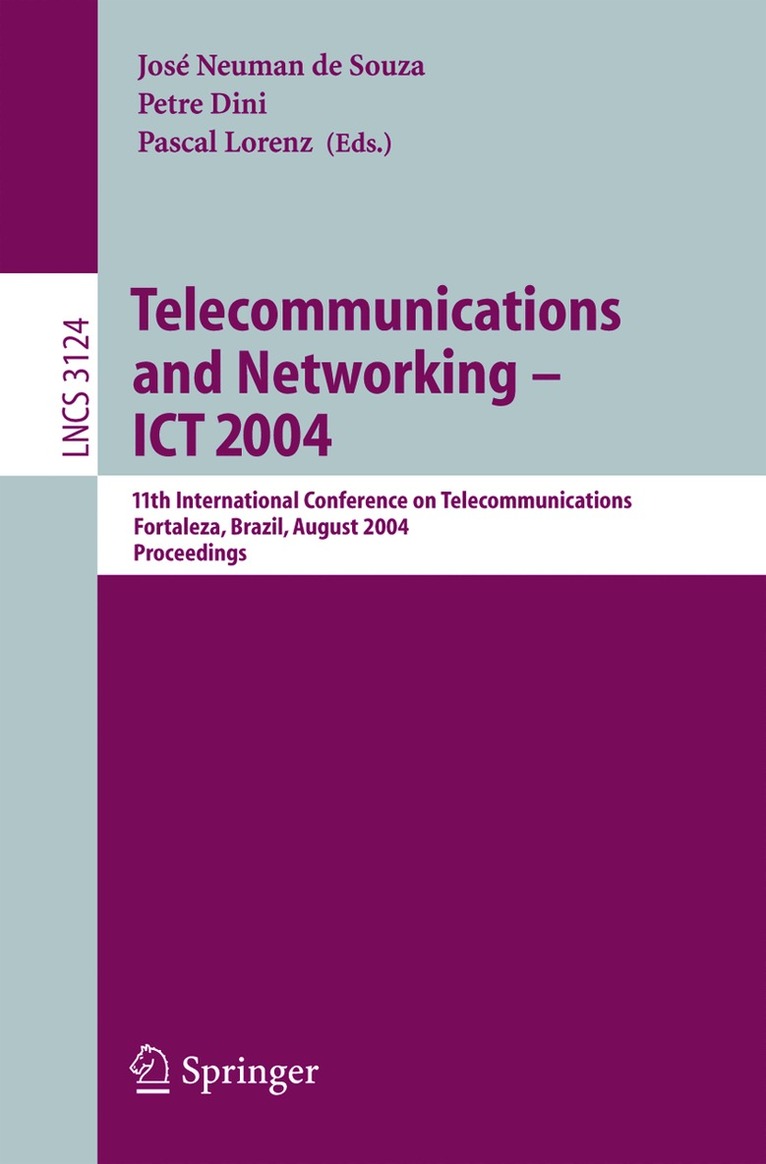
Welcometothe11thInternationalConferenceonTelecommunications(ICT2004)ho- ed by the city of Fortaleza (Brazil). As with other ICT events in the past, this professional meeting continues to be highly competitive and very well perceived by the international networking community, - tracting excellent contributions and active participation. This year, a total of 430 papers from 36 countries were submitted, from which 188 were accepted. Each paper was - viewed by several members of the ICT2004 Technical Program Committee. We were very pleased to receive a large percentage of top-quality contributions. Thetopicsofsubmittedpaperscoveredawidespectrumfromphotonictechniques,signal processing,cellularnetworks,andwirelessnetworks,toadhocnetworks.Webelievethe ICT2004papersofferawiderangeofsolutionstokeyproblemsintelecommunications, and describe challenging avenues for industrial research and development. In addition to the conference regular sessions, seven tutorials and a workshop were organized.Thetutorialsfocusedonspecialtopicsdealingwithnext-generationnetworks. The workshop focused on particular problems and solutions in heavily distributed and shareable environments. We would like to thank the ICT 2004 Technical Program Committee members and referees. Without their support, the creation of such a broad conference program would not be possible. We also thank all the authors who made a particular effort to contribute to ICT2004. We truly believe that due to all these efforts the ?nal conference program consisted of top-quality contributions. We are also indebted to many individuals and organizations that made this conference possible. In particular, we would like to thank the members of the ICT2004 Organizing Committee for their help in all aspects of the organization of thisprofessional meeting.
E-bok
PDF, Engelska, 2004712 kr
Läs direkt efter köp
The 1st Workshop on Service Assurance with Partial and Intermittent Resources (SAPIR 2004) was the first event in a series introducing the concept of pi-resources and bridging it with the emerging and important field of distributed and heavily shared resources. The topics concerning this event are driven by a paradigm shift occurring in the last decade in telecommunications and networking considering partial and intermittent resources (pi-resources). The Internet, converged networks, delay-tolerant networks, ad hoc networking, GRID-supporting networks, and satellite communications require a management paradigm shift that takes into account the partial and intermittent availability of resources, including infrastructure (networks, computing, and storage) and service components, in distributed and shared environments. A resource is called partial (p-resource) when only a subset of conditions for it to function to complete specification is met, yet it is still able to provide a (potentially degraded) service, while an intermittent or sporadic resource (i-resource) will be able to provide a service for limited and potentially unpredictable time intervals only. Partial and intermittent services are relevant in environments characterized by high volatility and fluctuation of available resources, such as those experienced in conjunction with component mobility or ad hoc networking, where the notion of traditional service guarantees is no longer applicable. Other characteristics, such as large transmission delays and storage mechanisms during the routing, require a rethinking of today''s paradigms with regards to service assurance and how service guarantees are defined.
E-bok
PDF, Engelska, 2004712 kr
Läs direkt efter köp
Welcometothe11thInternationalConferenceonTelecommunications(ICT2004)ho- ed by the city of Fortaleza (Brazil). As with other ICT events in the past, this professional meeting continues to be highly competitive and very well perceived by the international networking community, - tracting excellent contributions and active participation. This year, a total of 430 papers from 36 countries were submitted, from which 188 were accepted. Each paper was - viewed by several members of the ICT2004 Technical Program Committee. We were very pleased to receive a large percentage of top-quality contributions. Thetopicsofsubmittedpaperscoveredawidespectrumfromphotonictechniques,signal processing,cellularnetworks,andwirelessnetworks,toadhocnetworks.Webelievethe ICT2004papersofferawiderangeofsolutionstokeyproblemsintelecommunications, and describe challenging avenues for industrial research and development. In addition to the conference regular sessions, seven tutorials and a workshop were organized.Thetutorialsfocusedonspecialtopicsdealingwithnext-generationnetworks. The workshop focused on particular problems and solutions in heavily distributed and shareable environments. We would like to thank the ICT 2004 Technical Program Committee members and referees. Without their support, the creation of such a broad conference program would not be possible. We also thank all the authors who made a particular effort to contribute to ICT2004. We truly believe that due to all these efforts the ?nal conference program consisted of top-quality contributions. We are also indebted to many individuals and organizations that made this conference possible. In particular, we would like to thank the members of the ICT2004 Organizing Committee for their help in all aspects of the organization of thisprofessional meeting.