Joseph Babcock - Böcker
Visar alla böcker från författaren Joseph Babcock. Handla med fri frakt och snabb leverans.
5 produkter
5 produkter
653 kr
Skickas inom 5-8 vardagar
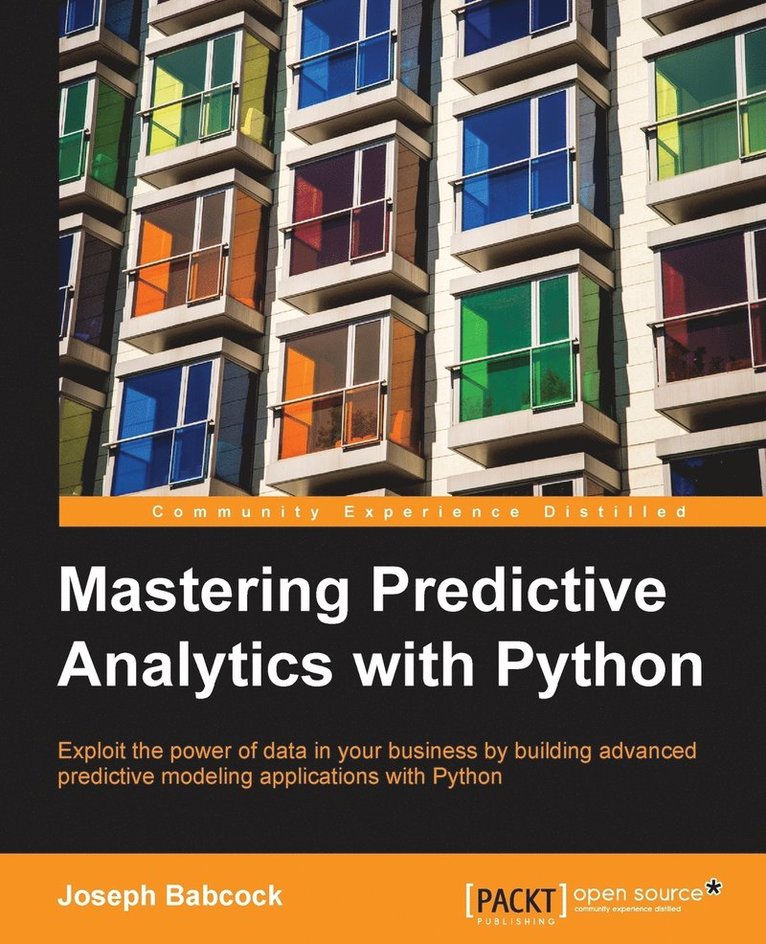
Exploit the power of data in your business by building advanced predictive modeling applications with PythonAbout This Book• Master open source Python tools to build sophisticated predictive models• Learn to identify the right machine learning algorithm for your problem with this forward-thinking guide• Grasp the major methods of predictive modeling and move beyond the basics to a deeper level of understandingWho This Book Is ForThis book is designed for business analysts, BI analysts, data scientists, or junior level data analysts who are ready to move from a conceptual understanding of advanced analytics to an expert in designing and building advanced analytics solutions using Python. You're expected to have basic development experience with Python.What You Will Learn • Gain an insight into components and design decisions for an analytical application• Master the use Python notebooks for exploratory data analysis and rapid prototyping• Get to grips with applying regression, classification, clustering, and deep learning algorithms• Discover the advanced methods to analyze structured and unstructured data• Find out how to deploy a machine learning model in a production environment• Visualize the performance of models and the insights they produce• Scale your solutions as your data grows using Python• Ensure the robustness of your analytic applications by mastering the best practices of predictive analysisIn DetailThe volume, diversity, and speed of data available has never been greater. Powerful machine learning methods can unlock the value in this information by finding complex relationships and unanticipated trends. Using the Python programming language, analysts can use these sophisticated methods to build scalable analytic applications to deliver insights that are of tremendous value to their organizations.In Mastering Predictive Analytics with Python, you will learn the process of turning raw data into powerful insights. Through case studies and code examples using popular open-source Python libraries, this book illustrates the complete development process for analytic applications and how to quickly apply these methods to your own data to create robust and scalable prediction services.Covering a wide range of algorithms for classification, regression, clustering, as well as cutting-edge techniques such as deep learning, this book illustrates not only how these methods work, but how to implement them in practice. You will learn to choose the right approach for your problem and how to develop engaging visualizations to bring the insights of predictive modeling to lifeStyle and approach This book emphasizes on explaining methods through example data and code, showing you templates that you can quickly adapt to your own use cases. It focuses on both a practical application of sophisticated algorithms and the intuitive understanding necessary to apply the correct method to the problem at hand. Through visual examples, it also demonstrates how to convey insights through insightful charts and reporting.
Python: Advanced Predictive Analytics
Gain practical insights by exploiting data in your business to build advanced predictive modeling applications
Häftad, Engelska, 2017
1 211 kr
Skickas inom 5-8 vardagar
Gain practical insights by exploiting data in your business to build advanced predictive modeling applicationsKey Features A step-by-step guide to predictive modeling including lots of tips, tricks, and best practices Learn how to use popular predictive modeling algorithms such as Linear Regression, Decision Trees, Logistic Regression, and Clustering Master open source Python tools to build sophisticated predictive models Book Description Social Media and the Internet of Things have resulted in an avalanche of data. Data is powerful but not in its raw form; it needs to be processed and modeled, and Python is one of the most robust tools out there to do so. It has an array of packages for predictive modeling and a suite of IDEs to choose from. Using the Python programming language, analysts can use these sophisticated methods to build scalable analytic applications. This book is your guide to getting started with predictive analytics using Python. You'll balance both statistical and mathematical concepts, and implement them in Python using libraries such as pandas, scikit-learn, and NumPy. Through case studies and code examples using popular open-source Python libraries, this book illustrates the complete development process for analytic applications. Covering a wide range of algorithms for classification, regression, clustering, as well as cutting-edge techniques such as deep learning, this book illustrates explains how these methods work. You will learn to choose the right approach for your problem and how to develop engaging visualizations to bring to life the insights of predictive modeling. Finally, you will learn best practices in predictive modeling, as well as the different applications of predictive modeling in the modern world. The course provides you with highly practical content from the following Packt books: 1. Learning Predictive Analytics with Python 2. Mastering Predictive Analytics with Python What you will learn Understand the statistical and mathematical concepts behind predictive analytics algorithms and implement them using Python libraries Get to know various methods for importing, cleaning, sub-setting, merging, joining, concatenating, exploring, grouping, and plotting data with pandas and NumPy Master the use of Python notebooks for exploratory data analysis and rapid prototyping Get to grips with applying regression, classification, clustering, and deep learning algorithms Discover advanced methods to analyze structured and unstructured data Visualize the performance of models and the insights they produce Ensure the robustness of your analytic applications by mastering the best practices of predictive analysis Who this book is for This book is designed for business analysts, BI analysts, data scientists, or junior level data analysts who are ready to move on from a conceptual understanding of advanced analytics and become an expert in designing and building advanced analytics solutions using Python. If you are familiar with coding in Python (or some other programming/statistical/scripting language) but have never used or read about predictive analytics algorithms, this book will also help you.
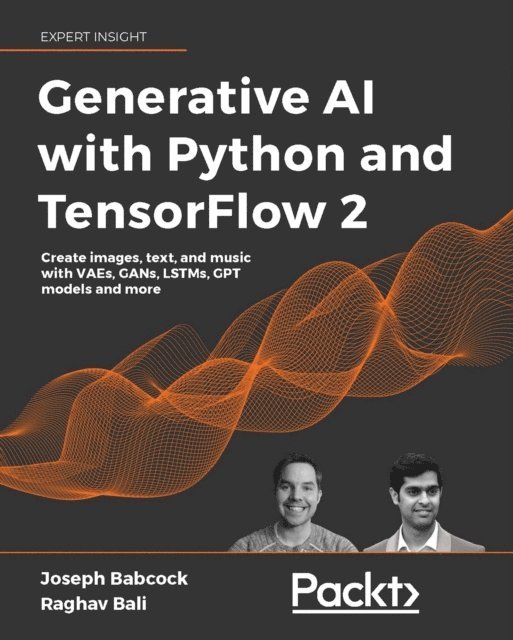
Generative AI with Python and TensorFlow 2
Create images, text, and music with VAEs, GANs, LSTMs, Transformer models
Häftad, Engelska, 2021
813 kr
Skickas inom 5-8 vardagar
This edition is heavily outdated and we have a new edition with PyTorch examples published!Key FeaturesCode examples are in TensorFlow 2, which make it easy for PyTorch users to follow alongLook inside the most famous deep generative models, from GPT to MuseGANLearn to build and adapt your own models in TensorFlow 2.xExplore exciting, cutting-edge use cases for deep generative AIBook DescriptionMachines are excelling at creative human skills such as painting, writing, and composing music. Could you be more creative than generative AI?In this book, you’ll explore the evolution of generative models, from restricted Boltzmann machines and deep belief networks to VAEs and GANs. You’ll learn how to implement models yourself in TensorFlow and get to grips with the latest research on deep neural networks.There’s been an explosion in potential use cases for generative models. You’ll look at Open AI’s news generator, deepfakes, and training deep learning agents to navigate a simulated environment.Recreate the code that’s under the hood and uncover surprising links between text, image, and music generation.What you will learnExport the code from GitHub into Google Colab to see how everything works for yourselfCompose music using LSTM models, simple GANs, and MuseGANCreate deepfakes using facial landmarks, autoencoders, and pix2pix GANLearn how attention and transformers have changed NLPBuild several text generation pipelines based on LSTMs, BERT, and GPT-2Implement paired and unpaired style transfer with networks like StyleGANDiscover emerging applications of generative AI like folding proteins and creating videos from imagesWho this book is forThis is a book for Python programmers who are keen to create and have some fun using generative models. To make the most out of this book, you should have a basic familiarity with math and statistics for machine learning.
Generative AI with Python and PyTorch
Navigating the AI frontier with LLMs, Stable Diffusion, and next-gen AI applications
Häftad, Engelska, 2025
619 kr
Skickas inom 5-8 vardagar
Master GenAI techniques to create images and text using variational autoencoders (VAEs), generative adversarial networks (GANs), LSTMs, and large language models (LLMs)Key FeaturesImplement real-world applications of LLMs and generative AIFine-tune models with PEFT and LoRA to speed up trainingExpand your LLM toolbox with Retrieval Augmented Generation (RAG) techniques, LangChain, and LlamaIndexPurchase of the print or Kindle book includes a free eBook in PDF formatBook DescriptionBecome an expert in Generative AI through immersive, hands-on projects that leverage today’s most powerful models for Natural Language Processing (NLP) and computer vision. Generative AI with Python and PyTorch is your end-to-end guide to creating advanced AI applications, made easy by Raghav Bali, a seasoned data scientist with multiple patents in AI, and Joseph Babcock, a PhD and machine learning expert. Through business-tested approaches, this book simplifies complex GenAI concepts, making learning both accessible and immediately applicable.From NLP to image generation, this second edition explores practical applications and the underlying theories that power these technologies. By integrating the latest advancements in LLMs, it prepares you to design and implement powerful AI systems that transform data into actionable intelligence.You’ll build your versatile LLM toolkit by gaining expertise in GPT-4, LangChain, RLHF, LoRA, RAG, and more. You’ll also explore deep learning techniques for image generation and apply styler transfer using GANs, before advancing to implement CLIP and diffusion models.Whether you’re generating dynamic content or developing complex AI-driven solutions, this book equips you with everything you need to harness the full transformative power of Python and AI.What you will learnGrasp the core concepts and capabilities of LLMsCraft effective prompts using chain-of-thought, ReAct, and prompt query language to guide LLMs toward your desired outputsUnderstand how attention and transformers have changed NLPOptimize your diffusion models by combining them with VAEsBuild text generation pipelines based on LSTMs and LLMsLeverage the power of open-source LLMs, such as Llama and Mistral, for diverse applicationsWho this book is forThis book is for data scientists, machine learning engineers, and software developers seeking practical skills in building generative AI systems. A basic understanding of math and statistics and experience with Python coding is required.
169 kr
Skickas inom 5-8 vardagar