510 kr
Läs direkt efter köp
510 kr
Läs direkt efter köp
512 kr
Läs direkt efter köp
Build real-world Artificial Intelligence applications with Python to intelligently interact with the world around you
About This Book
Step into the amazing world of intelligent apps using this comprehensive guideEnter the world of Artificial Intelligence, explore it, and create your own applicationsWork through simple yet insightful examples that will get you up and running with Artificial Intelligence in no timeWho This Book Is For
This book is for Python developers who want to build real-world Artificial Intelligence applications. This book is friendly to Python beginners, but being familiar with Python would be useful to play around with the code. It will also be useful for experienced Python programmers who are looking to use Artificial Intelligence techniques in their existing technology stacks.
What You Will Learn
Realize different classification and regression techniquesUnderstand the concept of clustering and how to use it to automatically segment dataSee how to build an intelligent recommender systemUnderstand logic programming and how to use itBuild automatic speech recognition systemsUnderstand the basics of heuristic search and genetic programmingDevelop games using Artificial IntelligenceLearn how reinforcement learning worksDiscover how to build intelligent applications centered on images, text, and time series dataSee how to use deep learning algorithms and build applications based on itIn Detail
Artificial Intelligence is becoming increasingly relevant in the modern world where everything is driven by technology and data. It is used extensively across many fields such as search engines, image recognition, robotics, finance, and so on. We will explore various real-world scenarios in this book and you''ll learn about various algorithms that can be used to build Artificial Intelligence applications.
During the course of this book, you will find out how to make informed decisions about what algorithms to use in a given context. Starting from the basics of Artificial Intelligence, you will learn how to develop various building blocks using different data mining techniques. You will see how to implement different algorithms to get the best possible results, and will understand how to apply them to real-world scenarios. If you want to add an intelligence layer to any application that''s based on images, text, stock market, or some other form of data, this exciting book on Artificial Intelligence will definitely be your guide!
Style and approach
This highly practical book will show you how to implement Artificial Intelligence. The book provides multiple examples enabling you to create smart applications to meet the needs of your organization. In every chapter, we explain an algorithm, implement it, and then build a smart application.
442 kr
Läs direkt efter köp
Learn the techniques for object recognition, 3D reconstruction, stereo imaging, and other computer vision applications using examples on different functions of OpenCV.
About This Book
Learn how to apply complex visual effects to images with OpenCV 3.x and PythonExtract features from an image and use them to develop advanced applicationsBuild algorithms to help you understand image content and perform visual searchesGet to grips with advanced techniques in OpenCV such as machine learning, artificial neural network, 3D reconstruction, and augmented realityWho This Book Is For
This book is intended for Python developers who are new to OpenCV and want to develop computer vision applications with OpenCV and Python. This book is also useful for generic software developers who want to deploy computer vision applications on the cloud. It would be helpful to have some familiarity with basic mathematical concepts such as vectors, matrices, and so on.
What You Will Learn
Detect shapes and edges from images and videosHow to apply filters on images and videosUse different techniques to manipulate and improve imagesExtract and manipulate particular parts of images and videosTrack objects or colors from videosRecognize specific object or faces from images and videosHow to create Augmented Reality applicationsApply artificial neural networks and machine learning to improve object recognitionIn Detail
Computer vision is found everywhere in modern technology. OpenCV for Python enables us to run computer vision algorithms in real time. With the advent of powerful machines, we have more processing power to work with. Using this technology, we can seamlessly integrate our computer vision applications into the cloud. Focusing on OpenCV 3.x and Python 3.6, this book will walk you through all the building blocks needed to build amazing computer vision applications with ease.
We start off by manipulating images using simple filtering and geometric transformations. We then discuss affine and projective transformations and see how we can use them to apply cool advanced manipulations to your photos like resizing them while keeping the content intact or smoothly removing undesired elements. We will then cover techniques of object tracking, body part recognition, and object recognition using advanced techniques of machine learning such as artificial neural network. 3D reconstruction and augmented reality techniques are also included. The book covers popular OpenCV libraries with the help of examples.
This book is a practical tutorial that covers various examples at different levels, teaching you about the different functions of OpenCV and their actual implementation. By the end of this book, you will have acquired the skills to use OpenCV and Python to develop real-world computer vision applications.
Style and approach
The book is a practical tutorial that covers various examples at different levels, teaching you about the different functions of OpenCV and their actual implementation.
341 kr
Läs direkt efter köp
Discover powerful ways to effectively solve real-world machine learning problems using key libraries including scikit-learn, TensorFlow, and PyTorch
Key Features
Learn and implement machine learning algorithms in a variety of real-life scenariosCover a range of tasks catering to supervised, unsupervised and reinforcement learning techniquesFind easy-to-follow code solutions for tackling common and not-so-common challengesBook Description
This eagerly anticipated second edition of the popular Python Machine Learning Cookbook will enable you to adopt a fresh approach to dealing with real-world machine learning and deep learning tasks.
With the help of over 100 recipes, you will learn to build powerful machine learning applications using modern libraries from the Python ecosystem. The book will also guide you on how to implement various machine learning algorithms for classification, clustering, and recommendation engines, using a recipe-based approach. With emphasis on practical solutions, dedicated sections in the book will help you to apply supervised and unsupervised learning techniques to real-world problems. Toward the concluding chapters, you will get to grips with recipes that teach you advanced techniques including reinforcement learning, deep neural networks, and automated machine learning.
By the end of this book, you will be equipped with the skills you need to apply machine learning techniques and leverage the full capabilities of the Python ecosystem through real-world examples.
What you will learn
Use predictive modeling and apply it to real-world problemsExplore data visualization techniques to interact with your dataLearn how to build a recommendation engineUnderstand how to interact with text data and build models to analyze itWork with speech data and recognize spoken words using Hidden Markov ModelsGet well versed with reinforcement learning, automated ML, and transfer learningWork with image data and build systems for image recognition and biometric face recognitionUse deep neural networks to build an optical character recognition systemWho this book is for
This book is for data scientists, machine learning developers, deep learning enthusiasts and Python programmers who want to solve real-world challenges using machine-learning techniques and algorithms. If you are facing challenges at work and want ready-to-use code solutions to cover key tasks in machine learning and the deep learning domain, then this book is what you need. Familiarity with Python programming and machine learning concepts will be useful.
427 kr
Läs direkt efter köp
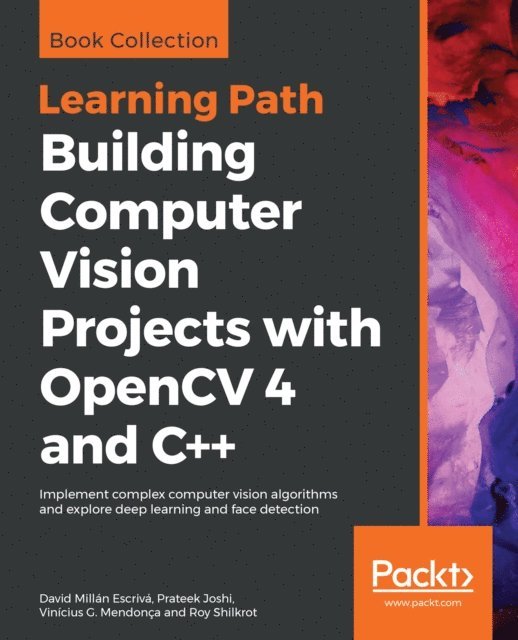
Delve into practical computer vision and image processing projects and get up to speed with advanced object detection techniques and machine learning algorithms
Key Features
Discover best practices for engineering and maintaining OpenCV projectsExplore important deep learning tools for image classificationUnderstand basic image matrix formats and filtersBook Description
OpenCV is one of the best open source libraries available and can help you focus on constructing complete projects on image processing, motion detection, and image segmentation.
This Learning Path is your guide to understanding OpenCV concepts and algorithms through real-world examples and activities. Through various projects, you''ll also discover how to use complex computer vision and machine learning algorithms and face detection to extract the maximum amount of information from images and videos. In later chapters, you''ll learn to enhance your videos and images with optical flow analysis and background subtraction. Sections in the Learning Path will help you get to grips with text segmentation and recognition, in addition to guiding you through the basics of the new and improved deep learning modules. By the end of this Learning Path, you will have mastered commonly used computer vision techniques to build OpenCV projects from scratch. This Learning Path includes content from the following Packt books:
Mastering OpenCV 4 - Third Edition by Roy Shilkrot and David Millán EscriváLearn OpenCV 4 By Building Projects - Second Edition by David Millán Escrivá, Vinícius G. Mendonça, and Prateek JoshiWhat you will learn
Stay up-to-date with algorithmic design approaches for complex computer vision tasksWork with OpenCV''s most up-to-date API through various projectsUnderstand 3D scene reconstruction and Structure from Motion (SfM)Study camera calibration and overlay augmented reality (AR) using the ArUco moduleCreate CMake scripts to compile your C++ applicationExplore segmentation and feature extraction techniquesRemove backgrounds from static scenes to identify moving objects for surveillanceWork with new OpenCV functions to detect and recognize text with TesseractWho this book is for
If you are a software developer with a basic understanding of computer vision and image processing and want to develop interesting computer vision applications with OpenCV, this Learning Path is for you. Prior knowledge of C++ and familiarity with mathematical concepts will help you better understand the concepts in this Learning Path.