Juan Miguel Fernandez-Balboa – författare
Visar alla böcker från författaren Juan Miguel Fernandez-Balboa. Handla med fri frakt och snabb leverans.
2 produkter
2 produkter
E-bok
Spanska, 201990 kr
Läs direkt efter köp
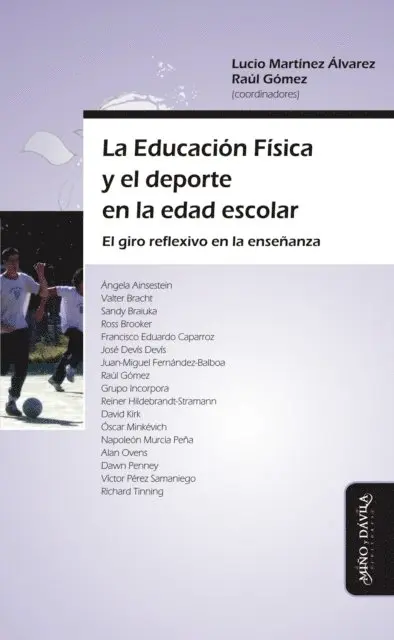
Como el título lo indica, un aspecto clave de la propuesta es la perspectiva reflexiva, planteada a veces con foco en la propia materia para apelar a la reformulación de sus fines, sus medios o sus principios disciplinarios, otras veces dirigida al docente, considerado como un sujeto capacitado para conducir su desarrollo profesional y modificar sus concepciones y actuaciones. Sin embargo, la reflexión que aquí se postula no quiere ni puede sustituir a la experiencia y a la acción, características fundamentales de la motricidad. Precisamente, el "giro reflexivo" supone que la motricidad no debe ser desvalorizada. El lugar de la Educación Física en la sociedad contemporánea, el papel del cuerpo en los procesos de identidad individual y social, las relaciones entre motricidad y cultura, entre actividad física y salud, el impacto de la formación inicial de los profesores en la identidad profesional, el cuestionamiento y el replanteo de la metodología y la didáctica de la Educación Física, los formatos de evaluación, son algunos de los temas en los que se centran las diferentes colaboraciones, cuya finalidad parece ser, pese a sus diversos terrenos y situaciones de origen, la de reflejar el estado de la cuestión en los tiempos que corren.
Häftad, Engelska, 1997
402 kr
Tillfälligt slut
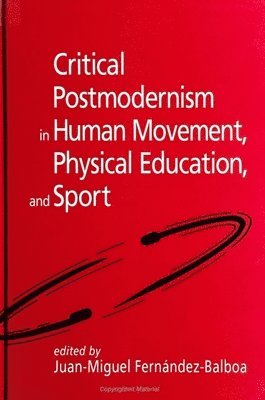
Explores the possibilities of postmodernism in the field of human movement and shows how the profession is related to broader social, political, and cultural contexts and histories.This book proposes alternative ways of looking at human movement and brings into question the traditional role of the human-movement profession as an agent of social and cultural reproduction. The authors argue that the profession has traditionally shaped physical activities in schools and communities in disempowering ways and has adversely influenced how people view their bodies, apply physical activities to their lives, and use and understand the knowledge in the field.To raise awareness of the possibilities of postmodernism for human movement, the contributors employ a critical postmodern conceptualization of the profession to explore the conflicts within it; to ask what can be done to strengthen it; to investigate how professional relations and meanings can be constructed within a new realm of justice, freedom, and equity; and to discuss the professional and civic principles to which the profession should subscribe.Contributors include Linda Bain, Robert Brustad, Cathy Ennis, Larry Fahlberg and Lauri Fahlberg, Don Hellison, Alan Ingham, David Kirk, George H. Sage, Sue Schwager, Richard Tinning, and Gerd von der Lippe.