Katherine Clarke – författare
Visar alla böcker från författaren . Handla med fri frakt och snabb leverans.
12 produkter
12 produkter
E-bok
PDF, Engelska, 2008423 kr
Läs direkt efter köp
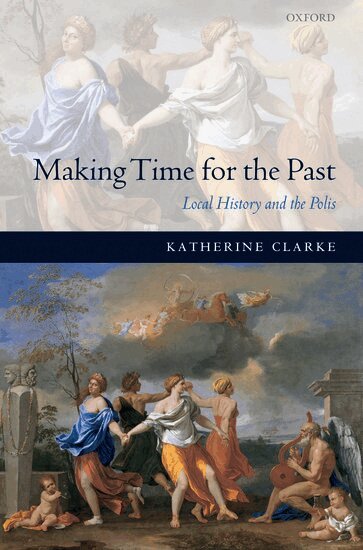
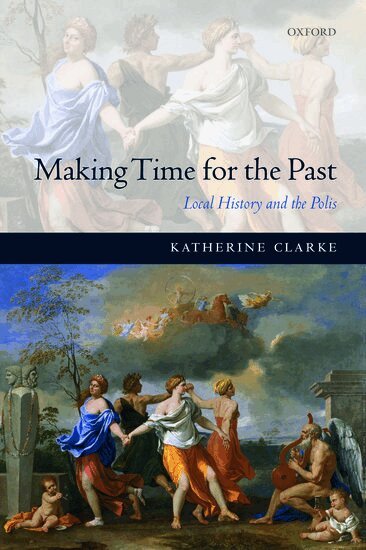
This book has two main and connected themes - the conception and articulation of time in the Greek world and the creation of history, especially in the context of the Greek city. Both how time is expressed and how the past is presented have often been seen as reflections of society. By looking at the construction of the past through the medium of local historiography, where we can view these issues in the relatively restricted world of individual city-states, we cangain a clearer insight into how different versions of the past and different constructions of time were offered to the community for approval. In this way, the citizens were able to negotiate time past and indeed their own history, and thereby to express their values and aspirations.
E-bok
PDF, Engelska, 2000568 kr
Läs direkt efter köp
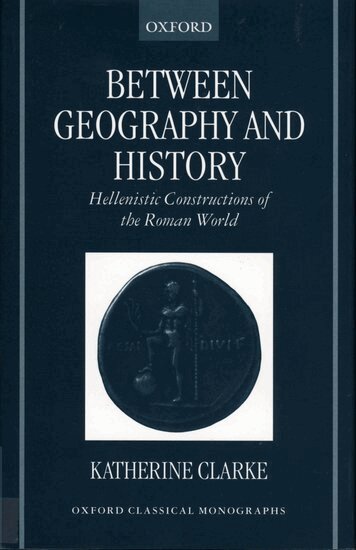
The late Hellenistic period witnessed the rise of an imperial power whose dominion extended across almost the whole known world. The Roman empire radically affected geographical conceptions, evoking new ways of describing the earth and of constructing its history. In this book the writings of three literary figures of the age are explored: the History of Polybius, two fragmentary works of Posidonius, and the universal Geography of Strabo. Analysis in terms of the philosophical concepts of time and space reveals the generic fluidity of such 'geographical' and 'historical' works. Furthermore, these broadly conceived accounts are shown to be appropriate literary media for the response to Roman power. They use, but transform, pre-existing Greek traditions in order to describe the new world of Rome, making them fitting products of a transitional age. This book provides a new approach to Roman imperialism by considering its impact on historiography and geographical thought.
E-bok
PDF, Engelska, 20181 470 kr
Läs direkt efter köp
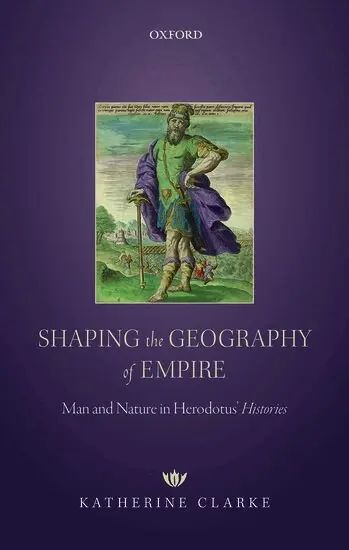
This volume explores the spatial framework of Herodotus'' Histories, the Greek historian''s account of Persian imperialism in the sixth and fifth century BC and its culmination in a series of grand expeditions against Greece itself. Focusing on his presentation of the natural world through careful geographical descriptions, ranging from continents and river and mountain networks on a vast scale down to the local settings for individual episodes, it alsoexamines how these landscapes are charged with greater depth and resonance through Herodotus'' use of mythological associations and spatial parallels. Man''s interaction with, and alteration of, the physical world of the Histories adds another critical dimension to the meaning given to space in Herodotus'' work, ashis subjects'' own agency serves to transform their geography from a neutral backdrop into a resonant landscape with its own role to play in the narrative, in turn reinforcing the placing of the protagonists along a spectrum of positive or negative characterizations. The Persian imperial bid may thus be seen as a war on nature, no less than on their intended subjects: however, as Herodotus reflects, Greece itself is waiting in the wings with the potential to be no less abusive an imperial power.Although the multi-vocal nature of the narrative complicates whether we can identify a ''Herodotean'' world at all, still less one in which moral judgements are consistently cast, the fluid and complex web of spatial relationships revealed in discussion nevertheless allows focalization to be brought productively into play, demonstrating how the world of the Histories may be viewed from multiple perspectives. What emerges from the multiple worlds and world-views that Herodotus creates inhis narrative is the mutability of fortune that allows successive imperial powers to dominate: as the exercise of political power is manifested both metaphorically and literally through control over the natural world, the map of imperial geography is constantly in flux.
E-bok
Engelska, 20181 470 kr
Läs direkt efter köp
This volume explores the spatial framework of Herodotus'' Histories, the Greek historian''s account of Persian imperialism in the sixth and fifth century BC and its culmination in a series of grand expeditions against Greece itself. Focusing on his presentation of the natural world through careful geographical descriptions, ranging from continents and river and mountain networks on a vast scale down to the local settings for individual episodes, it alsoexamines how these landscapes are charged with greater depth and resonance through Herodotus'' use of mythological associations and spatial parallels. Man''s interaction with, and alteration of, the physical world of the Histories adds another critical dimension to the meaning given to space in Herodotus'' work, ashis subjects'' own agency serves to transform their geography from a neutral backdrop into a resonant landscape with its own role to play in the narrative, in turn reinforcing the placing of the protagonists along a spectrum of positive or negative characterizations. The Persian imperial bid may thus be seen as a war on nature, no less than on their intended subjects: however, as Herodotus reflects, Greece itself is waiting in the wings with the potential to be no less abusive an imperial power.Although the multi-vocal nature of the narrative complicates whether we can identify a ''Herodotean'' world at all, still less one in which moral judgements are consistently cast, the fluid and complex web of spatial relationships revealed in discussion nevertheless allows focalization to be brought productively into play, demonstrating how the world of the Histories may be viewed from multiple perspectives. What emerges from the multiple worlds and world-views that Herodotus creates inhis narrative is the mutability of fortune that allows successive imperial powers to dominate: as the exercise of political power is manifested both metaphorically and literally through control over the natural world, the map of imperial geography is constantly in flux.
Inbunden, Engelska, 2018
2 500 kr
Skickas inom 3-6 vardagar
This volume explores the spatial framework of Herodotus' Histories, the Greek historian's account of Persian imperialism in the sixth and fifth century BC and its culmination in a series of grand expeditions against Greece itself. Focusing on his presentation of the natural world through careful geographical descriptions, ranging from continents and river and mountain networks on a vast scale down to the local settings for individual episodes, it also examines how these landscapes are charged with greater depth and resonance through Herodotus' use of mythological associations and spatial parallels. Man's interaction with, and alteration of, the physical world of the Histories adds another critical dimension to the meaning given to space in Herodotus' work, as his subjects' own agency serves to transform their geography from a neutral backdrop into a resonant landscape with its own role to play in the narrative, in turn reinforcing the placing of the protagonists along a spectrum of positive or negative characterizations. The Persian imperial bid may thus be seen as a war on nature, no less than on their intended subjects: however, as Herodotus reflects, Greece itself is waiting in the wings with the potential to be no less abusive an imperial power. Although the multi-vocal nature of the narrative complicates whether we can identify a 'Herodotean' world at all, still less one in which moral judgements are consistently cast, the fluid and complex web of spatial relationships revealed in discussion nevertheless allows focalization to be brought productively into play, demonstrating how the world of the Histories may be viewed from multiple perspectives. What emerges from the multiple worlds and world-views that Herodotus creates in his narrative is the mutability of fortune that allows successive imperial powers to dominate: as the exercise of political power is manifested both metaphorically and literally through control over the natural world, the map of imperial geography is constantly in flux.
Inbunden, Engelska, 2000
3 855 kr
Skickas inom 5-8 vardagar
The late Hellenistic period witnessed the rise of an imperial power whose dominion extended across almost the whole known world. The Roman empire radically affected geographical conceptions, evoking new ways of describing the earth and of constructing its history. In this book the writings of three literary figures of the age are explored: the History of Polybius, two fragmentary works of Posidonius, and the universal Geography of Strabo. Analysis in terms of the philosophical concepts of time and space reveals the generic fluidity of such 'geographical' and 'historical' works. Furthermore, these broadly conceived accounts are shown to be appropriate literary media for the response to Roman power. They use, but transform, pre-existing Greek traditions in order to describe the new world of Rome, making them fitting products of a transitional age. This book provides a new approach to Roman imperialism by considering its impact on historiography and geographical thought.
Häftad, Engelska, 2001
1 058 kr
Skickas inom 5-8 vardagar
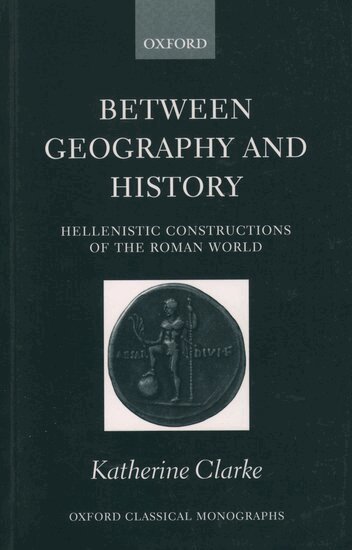
The late Hellenistic period witnessed the rise of an imperial power whose dominion extended across almost the whole known world. The Roman empire radically affected geographical conceptions, evoking new ways of describing the earth and of constructing its history. Katherine Clarke explores the writings of three literary figures of the age - the History of Polybius, two fragmentary works of Posidonius, and the universal Geography of Strabo. Analysis in terms of the philosophical concepts of time and space reveals the generic fluidity of such `geographical' and `historical' works. Furthermore, these broadly conceived accounts are shown to be appropriate literary media for the response to Roman power. They use, but transform, pre-existing Greek traditions in order to describe the new world of Rome, making them fitting products of a transitional age. This book provides a new approach to Roman imperialism by considering its impact on historiography and geographical thought.
Inbunden, Engelska, 2008
1 770 kr
Skickas inom 5-8 vardagar
This book has two main and connected themes - the conception and articulation of time in the Greek world and the creation of history, especially in the context of the Greek city. Both how time is expressed and how the past is presented have often been seen as reflections of society. By looking at the construction of the past through the medium of local historiography, where we can view these issues in the relatively restricted world of individual city-states, we can gain a clearer insight into how different versions of the past and different constructions of time were offered to the community for approval. In this way, the citizens were able to negotiate time past and indeed their own history, and thereby to express their values and aspirations.
Häftad, Engelska, 2011
675 kr
Skickas inom 7-10 vardagar
This book has two main and connected themes - the conception and articulation of time in the Greek world and the creation of history, especially in the context of the Greek city. Both how time is expressed and how the past is presented have often been seen as reflections of society. By looking at the construction of the past through the medium of local historiography, where we can view these issues in the relatively restricted world of individual city-states, we can gain a clearer insight into how different versions of the past and different constructions of time were offered to the community for approval. In this way, the citizens were able to negotiate time past and indeed their own history, and thereby to express their values and aspirations.
E-bok
Engelska, 202374 kr
Läs direkt efter köp
Häftad, Engelska, 2024
187 kr
Skickas
Häftad, Engelska, 2021
88 kr
Skickas