Max F. Perutz – författare
Visar alla böcker från författaren Max F. Perutz. Handla med fri frakt och snabb leverans.
3 produkter
3 produkter
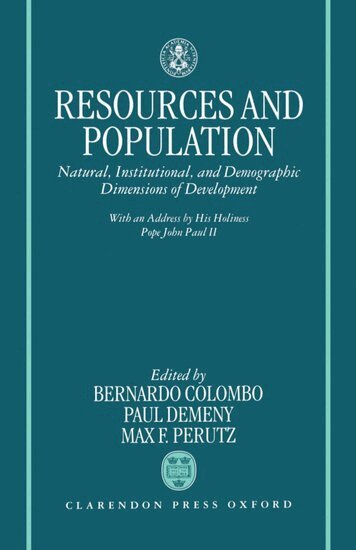
Resources and Population
Natural, Institutional, and Demographic Dimensions of Development
Inbunden, Engelska, 1996
2 454 kr
Skickas inom 5-8 vardagar
Since the beginning of the twentieth century, the world's population has increased threefold. The "demographic revolution" has not only changed the size of the population; it is radically transforming its age structure and its spatial distribution, with attendant problems and contradictions. Despite measurable advances in human welfare, such as increased longevity, more than one billion people - about one third of the total population of the Third World - live in poverty, according to a recent World Bank report. Sharply diverging rates of population growth have been accompanied by increasing disparities in income and quality of life across nations.These papers examine the relationship between physical and human resources and population within this context of mass poverty, historically unprecedented population growth, and environmental deterioration. Attention focused on those resources most critical for human well-being, including soil, water, and energy, on the one hand, and education, social organization and economic management, on the other. The discussion is framed by a broad supervision into six parts, examining demographic history and global population prospects; the relationships between population and physical, biological, and human resources; human health; and human settlements. Introductory statements, including an address by Pope John Paul II, and concluding remarks draw out the common threads and point the way towards future action and research.This book originated in a study week organized by the Pontifical Academy of Sciences to bring the best available scientific evidence to bear on this complex and still inadequately explored topic. The study week brought together experts in demography and from the physical, biological, political, economic, anthropological, religious, cultural, and health sciences, to investigate past experience and observed trends. Through this multidisciplinary analysis, a reference base was assembled that is factual, amply documented, and as scientifically indisputable as possible.
Science Is Not A Quiet Life: Unravelling The Atomic Mechanism Of Haemoglobin
Inbunden, Engelska, 1998
2 938 kr
Tillfälligt slut
Linus Pauling called haemoglobin the most interesting and important of molecules. This important volume shows how X-ray crystallography was used to determine its bewilderingly complex atomic structure and to unravel the stereochemical mechanisms of its respiratory functions. It introduces isomorphous replacement with heavy atoms which led to the first protein structures, haemoglobin and its simpler relative myoglobin. Later papers deal with the stereochemistry of the cooperative effects of haemoglobin, with the relationships between the structures and impaired functions of abnormal haemoglobin, with species adaptation of haemoglobin, and with its action as a drug receptor and as an oxygen sensor. The final papers deal with amino acid repeats which act as polar zippers and their role in certain inherited neurodegenerative diseases.
761 kr
Tillfälligt slut
Linus Pauling called haemoglobin the most interesting and important of molecules. This important volume shows how X-ray crystallography was used to determine its bewilderingly complex atomic structure and to unravel the stereochemical mechanisms of its respiratory functions. It introduces isomorphous replacement with heavy atoms which led to the first protein structures, haemoglobin and its simpler relative myoglobin. Later papers deal with the stereochemistry of the cooperative effects of haemoglobin, with the relationships between the structures and impaired functions of abnormal haemoglobin, with species adaptation of haemoglobin, and with its action as a drug receptor and as an oxygen sensor. The final papers deal with amino acid repeats which act as polar zippers and their role in certain inherited neurodegenerative diseases.